

A legacy for all European cities
The legendary Mayor of Paris, Anne Hidalgo steps down after 12 years in office. Few 21st-century city leaders have reshaped their cities as profoundly as she has — making it worth reflecting on her legacy.
Over the past decades, car traffic in central Paris has decreased by more than 60%, with two-thirds of this reduction achieved during Hidalgo’s leadership. At the same time, air quality has significantly improved: the concentration of the most harmful pollutants has dropped, meaning that children in Paris today have a much lower risk of respiratory diseases than before. This is not just data — it is quality of life.
Hidalgo followed a clear vision: cities are for people, not for cars. Based on this, she implemented bold and often controversial, yet highly consistent measures:
🚗 Removal of 60,000 on-street parking spaces
🚶♀️ Transformation of streets into pedestrian zones and school streets
🌳 Creation of new public spaces and green areas
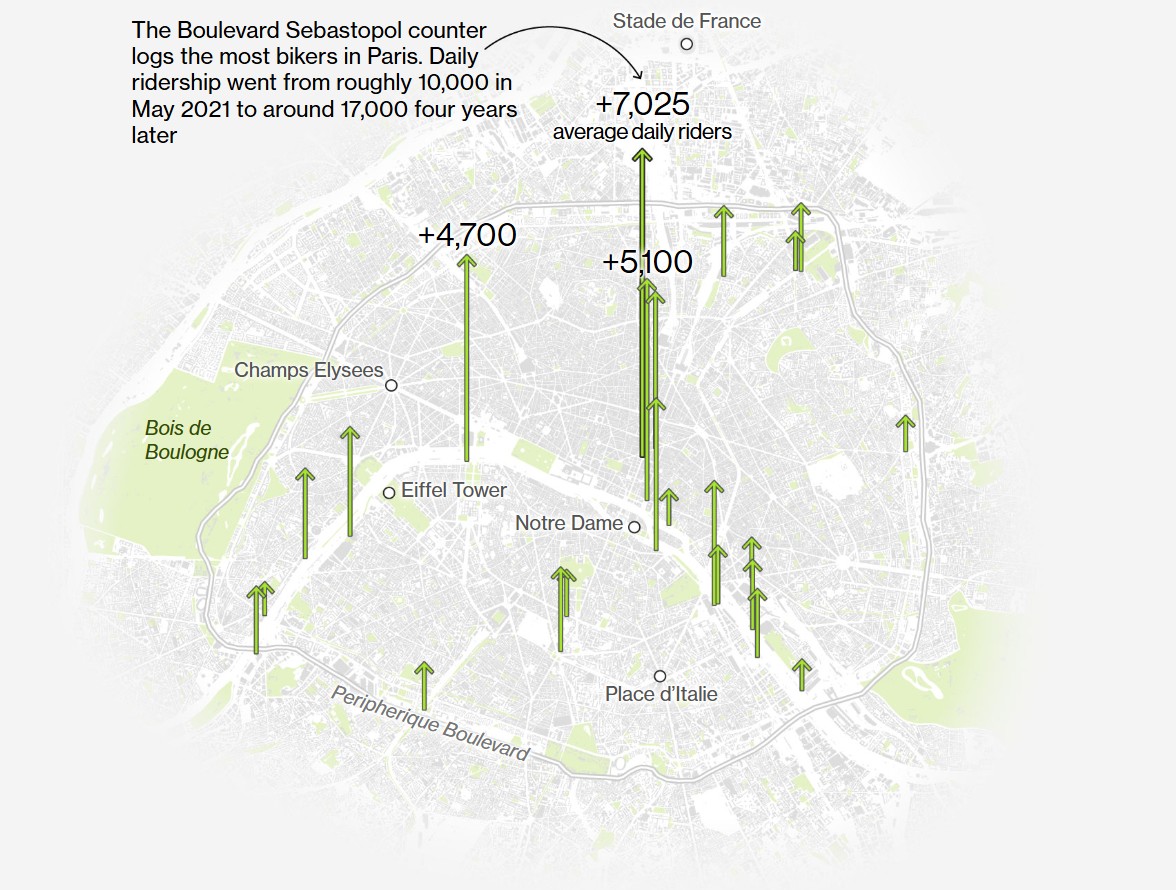
🚲 Development of over 1,000 km of cycling infrastructure
⚠️ Introduction of a general 30 km/h speed limit in central areas
🚫 Restriction of through-traffic in the city center
The banks of the Seine, once dominated by cars, are now promenades, parks, and vibrant public spaces. Entire inner-city districts have become quieter, filled with pedestrians, cyclists, terraces, and life — instead of traffic noise.
The transformation is not only physical, but also economic and social:
hospitality and retail are thriving, people are spending more time in public space, and cycling has become so popular that bike “traffic jams” are now a common sight.
Paris is also actively implementing the concept of the “15-minute city”, ensuring that essential services — shops, schools, parks, pharmacies — are accessible within a short walk or bike ride. Most recently, the city decided to create 500 additional school streets and pedestrian zones.
Perhaps the most important lesson: none of this happened overnight. It took 12 years of consistent political commitment, debate, courage, and a clear strategic direction. Hidalgo did not step back in the face of criticism — she repeatedly sought and received public support to continue.
Today, even political opponents no longer question the fundamentals of this urban policy. That may be the greatest achievement: when a once-radical vision becomes the new normal.
Paris shows that even a large, historic European city can undergo radical transformation — if there is vision, courage, and persistence.
🌱 The question is: how many cities are willing to follow this path?
Picture source: Bloomberg IGN, Overture Maps Foundation, Direction de la Voirie et des Déplacements — Ville de Paris via Paris Data
Only includes counters that have been active since at least 2021. Counters that flatlined in either May 2021 or May 2025 were excluded. Porte de Charenton’s tally was excluded because the bike lane moved further from the counter.
#citywalk20 #citywalk #interregdanube #drp #activemobility #urbandevelopment #peoplefirst #walkablecities

24/03/2026
By Miklos Lukovics
Share on social media:


Green

News & Events
Read the most recent updates and explore the upcoming events.

Would you like to receive project updates?
You're already part of our community!
Welcome to our newsletter community!
Subscribe to our newsletter