


CultHeRit Insights: Mentorship in CHIM – A New Collection of Tools and Testimonies Now Live
The CultHeRit project is proud to announce the publication of CultHeRit Insights: Mentorship in CHIM, a comprehensive resource designed to continue transformative conversations on how cultural heritage institutions support young professionals. Led by author and editor Senka Gavranov with editorial assistants Anna Böhm-Vinceffy, Carlotta Schiller and Sebastian Boniș, this volume synthesizes insights from two and a half years of work by thirteen organizations across eight Central and Southeastern European countries to address structural barriers in employment and professional development in cultural heritage institutes and museums. The collection moves beyond theory to offer grounded, participatory strategies that foster intergenerational solidarity and knowledge transfer.
Accompanying the main volume are five specialized Annexes, each offering unique perspectives ranging from raw personal testimonies to actionable policy frameworks. Together, these documents provide insights and actionable information for HR experts, policymakers and practitioners committed to building inclusive and resilient communities of practice. Marking the closure of the CultHeRit project this June, this publication represents not an ending but a transition. While the formal project period concludes, the knowledge generated, the professional bonds forged and the vital conversations and work on improving the employment situation in the cultural heritage sector continue.
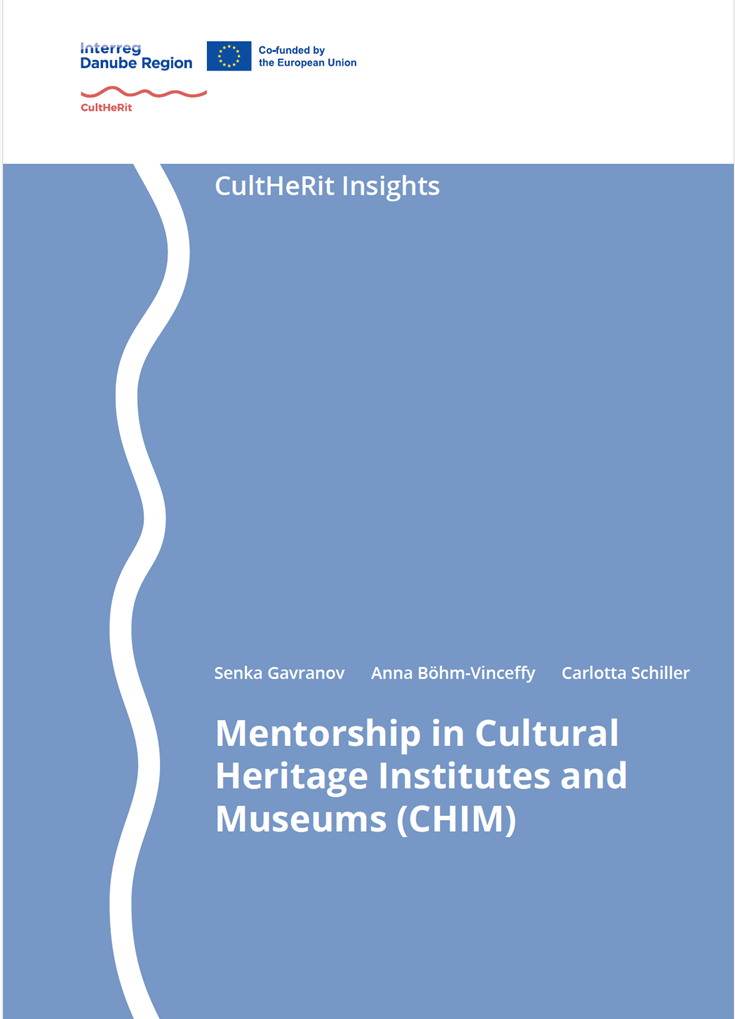
CultHeRit Insights: Mentorship in CHIM — A synthesis of findings, definitions and lived experiences gathered from workshops and surveys. It outlines the core principles of mentorship, profiles the ideal mentor and presents a vision for an institutional ecosystem that supports knowledge transfer and professional growth. Author and editor: Senka Gavranov. Editorial assistants: Anna Böhm-Vinceffy, Carlotta Schiller and Sebastian Boniș.
Annex I: Methodology and Inquiry Framework – The Evolving Dialogue — This document details the participatory process used to generate the project's insights, explaining how the inquiry evolved through continuous dialogue with mentors and mentees. It includes the timeline of transnational encounters and the specific questions that shaped the research. Author: Senka Gavranov, Anna Böhm-Vinceffy and Sebastian Boniș.
Annex II: Voices from the Field – Perspectives on Mentorship in the CHIM — Featuring written testimonies from seven mentors and seven mentees, this annex preserves the nuanced, emotional and practical realities of their journeys. The contributors include mentors Ştefania Dogărel (MNIT), Neda Džamić (IPCMS), Vladimir Džamić (RIPCM), Marija Jurkić Flis (MUO), Milijana Okilj (IPC), Miroslav Malinović (IPC), Jelena Savić (IPC), Kathrin Pokorny-Nagel (MAK), Lucie Vlčková (UPM) and Michaela Neškerová (UPM). The mentees featured are Dorotea Ašćerić (RIPCM), Tessa Bachrach-Krištofić (MUO), Andra-Cezara Comiati (MNIT), Sara Đumić (IPC), Erika Nagy (INP), Dalma Pszota (MNMKK-IMM) and Richárd Morvai Rácz (IPCMS). Editors: Senka Gavranov, Anna Böhm-Vinceffy and Sebastian Boniș.
Annex III: Mentoring Young Professionals – From Model to Practice and Evaluation — This text traces the mentorship as an element of the transnational employment model piloted in 2025, from its introduction to the institutions reported experiences and evaluation lessons. It provides a critical assessment of the pilot's impact on retention and professional integration. Author: Thomas Philipp.
Annex IV: The Mentorship Lab – Concepts, Proposals and Activities — A curated menu of twelve conceptual tools and activities designed to help institutions co-design their own mentorship programs. It offers flexible proposals for matching, training and troubleshooting, intended to spark local innovation rather than prescribe rigid solutions. Author: Senka Gavranov.
Annex V: Mentorship Rulebook — A concrete example of policy implementation, documenting the formal rulebook drafted and adopted by the Republic Institute for Protection of Cultural Monuments (RIPCM) in Serbia. It serves as a model of good practice for integrating mentorship into standard HR procedures and job descriptions. Authors: Vladimir Džamić, Tatjana Tripković, Ana Vranjš, Dorotea Ašćerić, Danica Čolakov.
This volume of the four-part CultHeRit Insights series is available for download here.

29/06/2026
By Marija Jurkić-Flis
Share on social media:


Social

News & Events
Read the most recent updates and explore the upcoming events.


Would you like to receive project updates?
You're already part of our community!
Welcome to our newsletter community!
Subscribe to our newsletter