
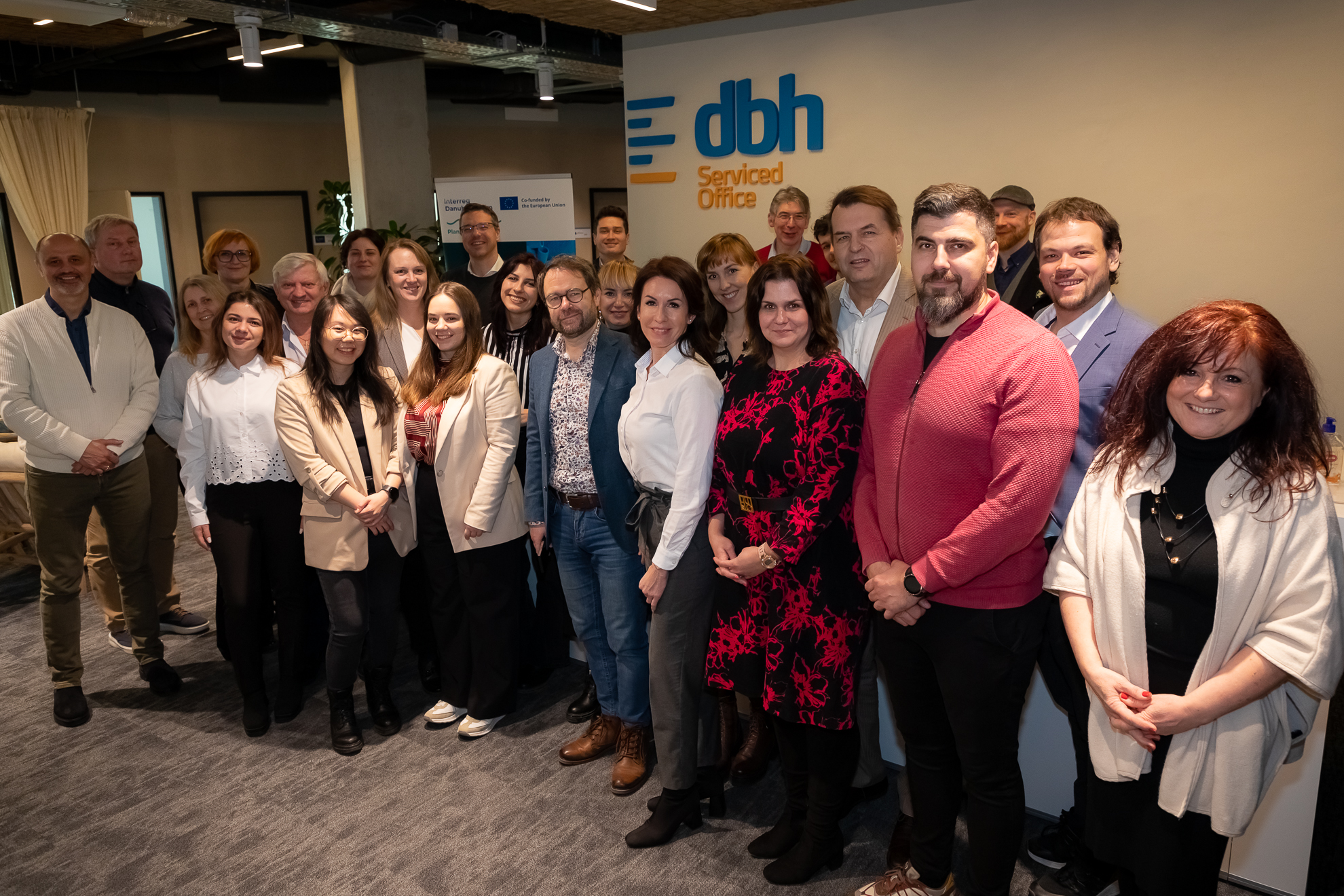

About us
Plan-C Project
Plastics are ubiquitous in modern life, yet recycling rates remain insufficient after initial use. The EU's Circular Economy Action Plan targets a 50% recycling rate for plastic packaging by 2025, posing significant challenges, especially in the Southern and Eastern Danube regions due to waste management deficits and lack of industrial processing knowledge. The Plan-C project, a consortium of 14 partners from Germany, Austria, Czech Republic, Slovakia, Hungary, Serbia, Bosnia and Herzegovina, Romania, and Moldova, aims to address these challenges. By fostering transnational cooperation among plastic processors, producers, and the machine industry, the project seeks to drive the transformation of the plastics value chain in the Danube Region towards circularity. Achieving this requires close collaboration to change mindsets, behaviors, and business paradigms. The goal is to enhance the competitiveness of key actors, contributing to the EU Strategy for the Danube Region (EUSDR) Priority Area 8 objectives. Using technology transfer and a design thinking process, the partners will co-create and demonstrate circular plastic prototypes, resulting in a Circular Plastics Guideline to build regional knowledge and capacities. Strategic partners and policy stakeholders will help integrate this strategy into regional innovation strategies (RIS3). Similarly, project partners and machine firms will develop circular solutions for each phase of the machine lifecycle, and create digital business models summarized in a Guideline for Circularity in the Machine Industry, to be integrated into RIS3 as well. Overall, at least 140 enterprises from the plastics and machine industries in the Danube region are collaborating to create a vision for a transformed plastics value chain focused on circularity. This effort demonstrates the benefits of reusing and recycling plastics, as well as maintaining, redistributing, refurbishing, remanufacturing, and recycling machines. The final Transnational Action Plan to embed circular economy principles in the holistic plastics value chain targets SMEs, large enterprises, business support organizations, sectoral agencies, and public authorities, aiming to increase the capacity of at least 70 organizations to implement circular concepts along the plastics value chain.
Lead Partner
Business Upper Austria
Hafenstrasse 47-51, 4020 Linz, Österreich (AT)


Austria Wirtschaftsservice
Rechte Wienzeile 225, 1120 Vienna, Österreich (AT)

Romanian Cluster Association
Bd Ion Ionescu de la Brad 6, 013813 Bucharest, România (RO)


Foundation for Innovation, Technology and Knowledge Transfer
Bosne Srebrene bb (SKPC Mejdan), 75000 Tuzla, Bosnia and Herzegovina (BA)


Innovation Center, Faculty of Mechanical Engineering
Kraljice Marije 16, 11000 Belgrade, Serbia (RS)

“Petru Poni” Institute of Macromolecular Chemistry
Aleea “Gr. Ghica Voda” 41A, 700487 Iasi, România (RO)
Innoskart Business Development Nomprofit Kft.
Kertalja street 11, 8000 Székesfehérvár, Magyarország (HU)

Czech Plastics Cluster z.s.
Vavreckova 5262, 76001 Zlin, Česko (CZ)


Association of Light industry enterprises
Independentei 77, MD3006 Soroca, Moldova (MD)

Slovak Plastic Cluster
Novozámocká 117/222, 949 05 Nitra- Dolné Krškany, Slovensko (SK)


Technical University of Košice, Faculty of Manufacturing Technologies with a seat in Prešov
Letná 9, 04200 Košice, Slovensko (SK)
Technology Center Horb
Geschwister-Scholl-Str. 10, 72160 Horb a. N., Deutschland (DE)


Tomas Bata University in Zlín
Nam. T.G.Masaryka 5555, 760 01 Zlin, Česko (CZ)


Would you like to receive project updates?
You're already part of our community!
Welcome to our newsletter community!
Subscribe to our newsletter