


Coal as gold: The story of Marjeta Hribar
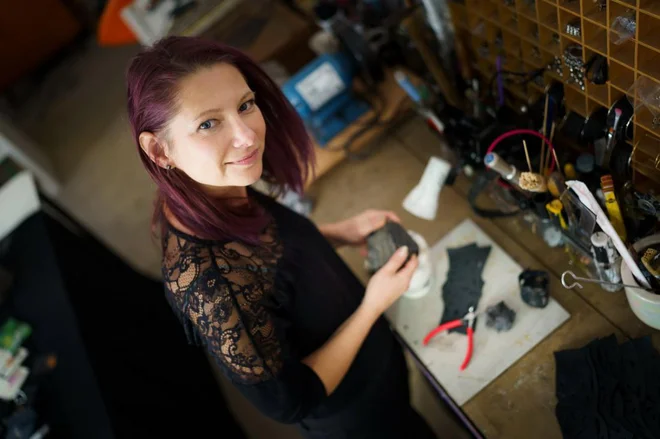
She is wearing five bracelets. “Most people tell me it’s too many,” smiles Marjeta Hribar, “but because they’re black, they somehow merge into a whole.” The bracelets are made of coal – a material she knew as a child growing up in a mining colony in the Zasavje region, and the material from which she now creates unique jewelry sold as far away as Hollywood.
Rooted in coal
Marjeta comes from Zasavje, a region whose identity has been woven from coal for centuries. As a little girl, she played with coal – it was part of daily life, shaping both the landscape and the local identity. Marjeta only realized the significance of this background later, when searching for her design inspiration. “Every designer should start from what they know best,” she says. “When I asked myself that question, the answer was clear.”
Coal is a material with a strong character, and Marjeta lets it tell its own story – she does not force it, she listens. Because each piece is shaped entirely by hand, without machines or molds, the result is unmistakably unique: no shape is repeated, no two creations are alike. “Sometimes someone says to me: ‘I’d like one exactly like that.’” She smiles. “That won’t be possible.”
From local to global
Her journey was never intended as a direct path. Marjeta started with smaller projects, initially making crowns for Slovenian events. However, as interest in her coal jewelry spread from the region to national and then international audiences, art critics began to notice. They described her as a remarkable phenomenon: a designer who had crafted a distinctive style from an unconventional material. This story led to her invitation to present at an international symposium of art critics.
From the symposium, events took an unexpected turn. Someone from New York reached out via her website – which, at the time, was just three months old and largely unoptimized – expressing interest in collaborating to bring her narrative to a wider audience. “I checked three times whether it was even credible,” she laughs. “A colleague and I went through everything they had sent me. And it still seemed impossible.”
The Oscars and gift bags
This seemingly impossible opportunity became reality. Marjeta’s jewelry began appearing in the gift bags for Oscar nominees – not just once, but recurrently. Each year since, she has created pieces for prestigious Hollywood events, including the Miss California pageant. “I never really highlighted this in the Slovenian public,” she admits, “but every year, something of mine is there.”
Behind that first order lies a tense story. At the time the order was placed, Marjeta had to send 100 bracelets to the United States within two days, scheduled to arrive directly at the hotel hosting the event. At that very moment, an embargo on coal had just been introduced. “I knew nothing could get held up at customs. One wrong step and the entire project would have been buried.” But it worked, and the collaboration continues to this day.
What does it mean for marketing when Hollywood stars wear your jewelry? Marjeta is honest: “I received an enormous number of responses. But I’m not allowed to reveal most of them – I don’t have permission from their side. The Hollywood marketing machine is strictly defined and, above all, paid for.” She is nonetheless convinced that these doors lead forward – slowly, thoughtfully, in the long term.
Coal from the people, for the people
Although a rise in prestige could have led to higher prices, Marjeta consciously chose otherwise. “Coal was always the material of heroes and at the same time of poor people,” she explains. “Its journey, which it now makes in the form of jewelry, must remain accessible to those who don’t have full wallets.”
In line with this philosophy, she developed several lines: an accessible line for everyone, a higher-priced line, and an exclusive line for clients seeking truly exceptional pieces. “Coal belonged to the people and was for the people. And it will stay that way.”
She sources her materials through diverse means. Originally, the coal came from the Zasavje mines. Today, people contact her when they uncover coal during renovations or when they find a piece in the forest. “This is my treasury,” she says, “and as long as it exists, I will have material.”
Burnout and transformation
However, entrepreneurship brought its own challenges. Marjeta acknowledges that exhaustion crept in – not from creative work but from brand management, accounting, communication, and logistics. “I realized I needed to reorganize. That I had to keep what fills me for myself, and hand everything else over to others.”
Today, she has a team of people around her who take on administrative and organizational tasks so she can focus on what she knows and loves: design, working with coal, and interacting with clients. “That is the luxury you gain with experience,” she says. “When you know what drains you and what fills you, you can organize yourself accordingly.”
She also draws energy from stepping away – holidays, travel, breaks from routine. “As an artist, I have to do this. It’s not rest – it’s a departure from established patterns. When I look at my work from a distance, I find new elements in it again.”
Advice for those who dream of going global
For those who dream of taking a local idea to the global market, Marjeta has a clear answer: “The world is small. If your idea is good enough and original enough, someone, somewhere, will understand it.” She is convinced that the path depends on persistence and on not paying attention to those who don’t understand. “Sometimes it seems like no one understands. But that is just a signal that you are on the right path.”
And on the question of whether, as a woman in the world of design and entrepreneurship, she feels in a subordinate position? Marjeta considers this. “Male designers feel close to me – they have a strong style, just like my coal. I don’t feel that I’m in competition with them. I would rather we joined forces and made better things together than any of us can manage alone.” A brief pause: “There are no barriers. But there are some very creative solutions along the way.”
And that path – she says – just keeps getting more beautiful and smooth.
Explore this story online: [LINK]

19/05/2026
By
Share on social media:



News & Events
Read the most recent updates and explore the upcoming events.











Would you like to receive project updates?
You're already part of our community!
Welcome to our newsletter community!
Subscribe to our newsletter