

Deliverable 1.1.2: Joint Territorial and Local Diagnostic Study
Territorial diagnosis and baseline study
Whitin the framework of COOPOWER project, Sapientia University was responsible to help the creation of the Country Reports (by creating a frame which was filled by colleagues from participant countries Bulgaria, Hungary, Romania, Slovakia, Serbia, and Ukraine - alongside comparative partners from Austria and the Czech Republic), and, based on these reports, to create a Baseline Study and Synthesis Report entitled Territorial Diagnosis of Disadvantaged Regions and Vulnerable Youth Transitions implemented under the Interreg Danube Region Programme.
Based on the country reports the Sapientia University team created a synthesis report and a baseline study. The aim of this study was to find the common ground among the partner countries regarding the challenges of the selected pilot areas. Through the synthesis we were focusing on identifying the mutual- and specific challenges which faces every pilot project.
The analysis highlighted persistent challenges affecting vulnerable youth, including unequal access to education and training, difficulties navigating career pathways, and fragmented support systems across local contexts. These structural conditions underline the importance of coordinated interventions that strengthen both individual capacities and institutional cooperation.
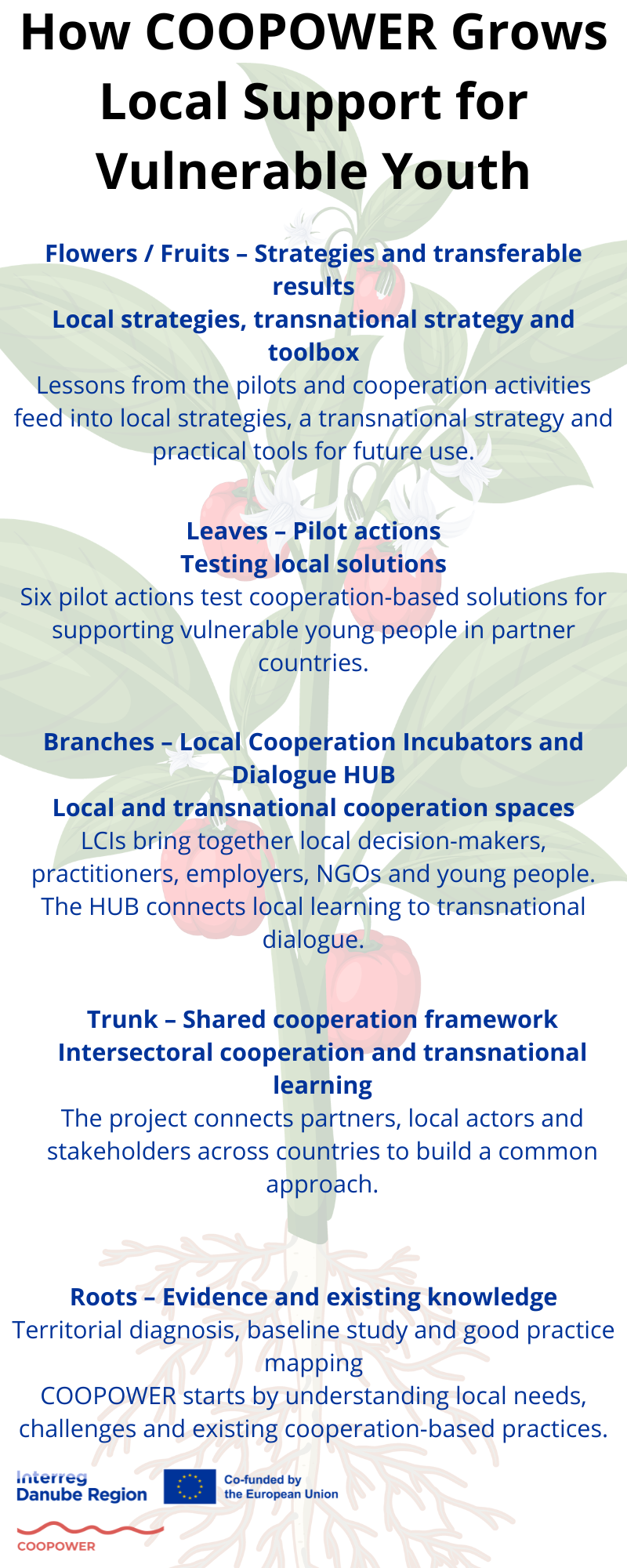
The comparative analysis of the six pilot interventions demonstrates that, despite differences in local contexts and target groups, the pilots share a common ambition: to support young people in disadvantaged situations through structured guidance, mentoring, and coordinated support services. The diversity of approaches reflects the different institutional environments and needs identified in the baseline analysis. At the same time, the shared focus on engagement, orientation, and capacity-building provides a common foundation for learning across countries.
The baseline indicator framework developed in this study provides a structured approach for monitoring the progress and outcomes of these pilot interventions. By combining macro-level contextual indicators with project-level outputs and pilot-level expected change indicators, the framework enables a multi-level understanding of how the project contributes to improving youth support pathways. This approach also ensures comparability across pilots while leaving space for context-specific implementation.
Regarding the future of the project, we can state that the lessons generated through the pilot implementations and their monitoring will help identify promising practices and policy-relevant insights that may inform future strategies to improve the transition from education to employment for vulnerable youth across Europe.


18/05/2026
By Virág Vajda
Share on social media:


Social

News & Events
Read the most recent updates and explore the upcoming events.










Would you like to receive project updates?
You're already part of our community!
Welcome to our newsletter community!
Subscribe to our newsletter