
Deliverable 2.1.1: Stakeholder map
Turning methodology into action: COOPOWER completes stakeholder mapping across partner countries
Building on the previously published article about the COOPOWER stakeholder mapping methodology, the project has now reached the next important step: the completion of stakeholder mapping across the partner countries. While the stakeholder mapping methodology established the common framework for identifying and categorising relevant actors, the newly prepared stakeholder maps turn that shared methodology into country-level practice and help lay the foundation for stronger local cooperation in support of vulnerable young people.
This is a particularly important stage in COOPOWER, as the project is built on the understanding that the labour-market integration of vulnerable youth cannot be supported by one institution or one sector alone. Young people facing unemployment, early school leaving, social exclusion, or multiple disadvantages often need support that connects education, employment services, local governance, civil society, business actors, and community-based initiatives. This is why intersectoral cooperation is not just a project principle in COOPOWER, but one of its core ambitions.
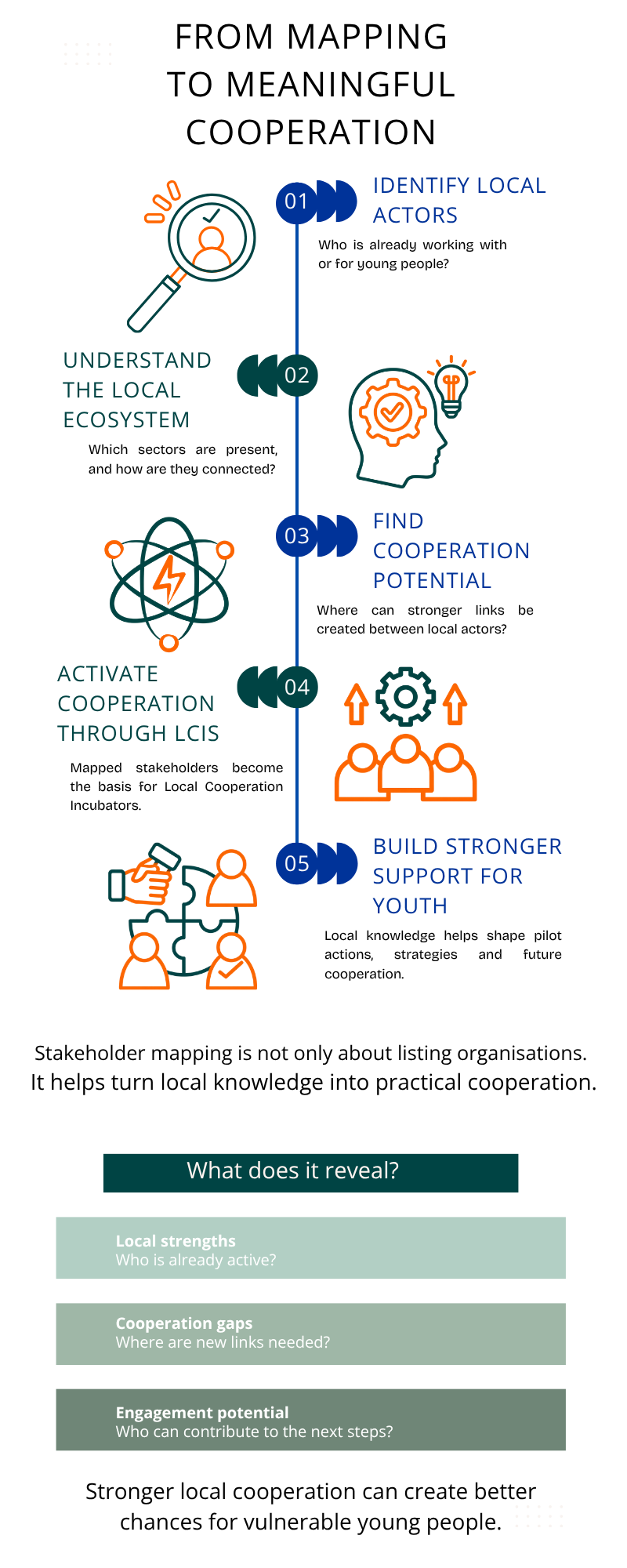
The stakeholder mapping activity was designed to identify the actors who can play a meaningful role in this process in each partner country and target region. These include public institutions, educational and research bodies, employers, NGOs, youth organisations, social service providers, and other relevant actors working directly or indirectly with vulnerable youth. By mapping them in a structured way, COOPOWER helps create a clearer picture of the local ecosystems surrounding young people and of the cooperation potential within them. This deliverable directly supports the targeted engagement of stakeholders and the establishment of Local Cooperation Incubators in each partner country.
What makes this step especially useful is that it goes beyond a simple list of organisations. The completed maps begin to show what kinds of stakeholder structures already exist in different national and regional contexts, and which sectors appear to have stronger or weaker representation in the mapped stakeholder pool. Additionally, the maps aim to show the level of interest and engagement potential of the various mapped stakeholders, as not all of them are equally invested in or capable of acting on behalf of vulnerable youth. While the maps do not manage to describe the whole national ecosystem in each partner country, they try to provide an important project-level snapshot of where cooperation may already have a strong base and where stronger bridging efforts may still be needed.
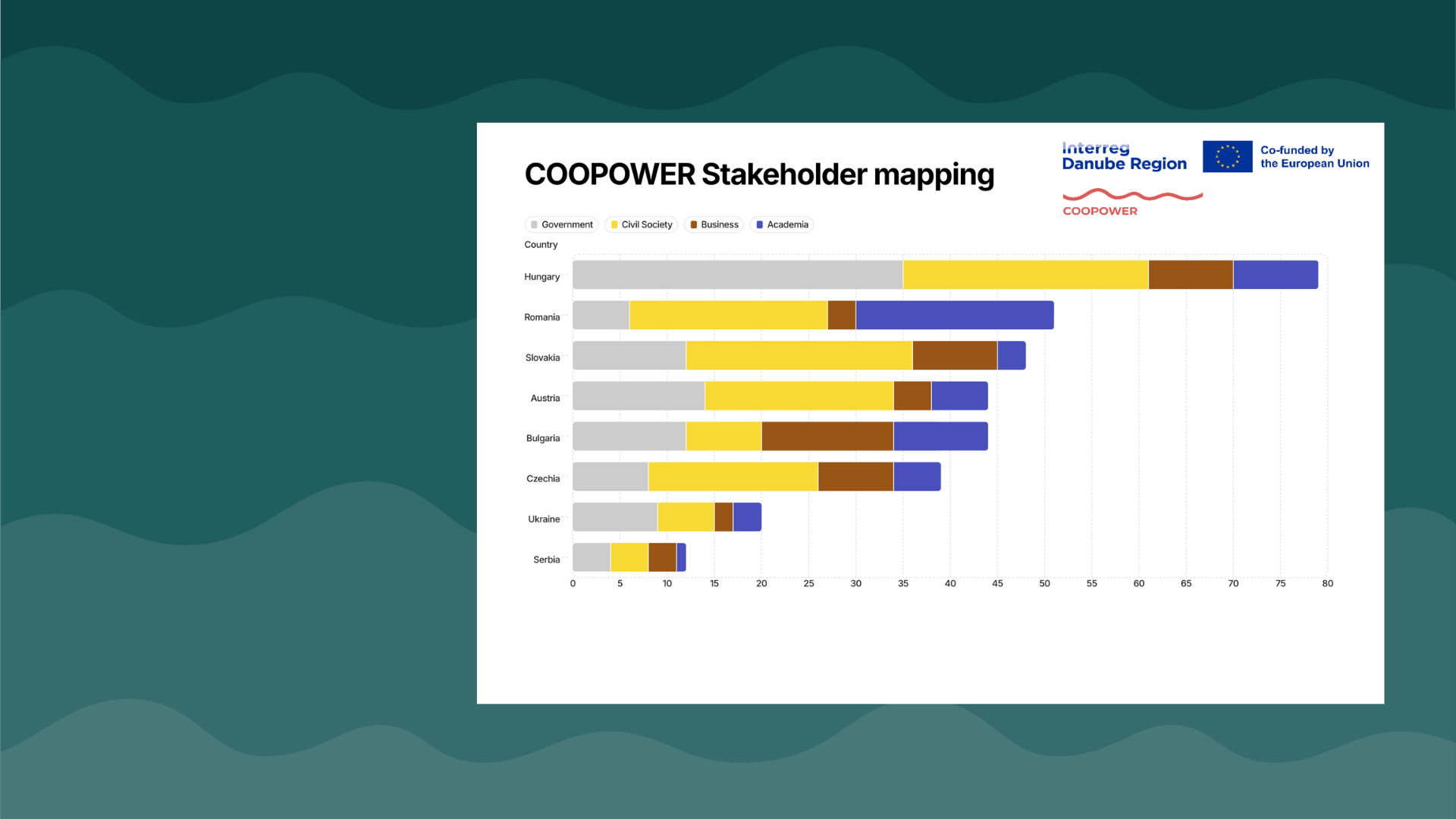
Mapped stakeholders by country and Quadruple Helix branch
Several intriguing patterns emerge from the country-level stakeholder maps. In Austria, Czechia, Hungary, Romania and Slovakia, civil society actors form the largest group within the mapped stakeholder pool, suggesting that NGOs and community-based organisations may play a particularly important role in local cooperation processes. Romania also stands out for its especially strong presence of academia alongside civil society, indicating a promising basis for cooperation between knowledge institutions and local support actors.
Bulgaria shows a comparatively stronger representation of business actors, which may offer useful opportunities for building closer links to labour-market actors and employers. In Austria, Hungary and Slovakia, public institutions are also strongly represented, showing that local cooperation can build not only on active civil society ecosystems but also on a significant institutional base.
Ukraine deserves particular attention in this context. Despite the ongoing war situation, the stakeholder mapping still identified a substantial and diverse group of relevant actors. This in itself reflects a strong level of commitment, institutional resilience, and willingness among local and regional stakeholders to remain engaged in cooperation processes supporting vulnerable young people.
These differences matter because they show that local cooperation does not start from the same stakeholder landscape everywhere. In several partner countries, civil society appears to provide a particularly strong basis for engagement, while in others the maps indicate stronger opportunities for involving public institutions, academia, or business actors more intensively. Across the partnership, the mapping brought together a total of 337 identified stakeholders, underlining both the scale of the exercise and the strong cooperation potential already present across the Danube Region. Rather than applying one fixed cooperation formula, COOPOWER uses a shared methodology that can be adapted to these different local realities. This is one of the key strengths of the project’s approach: it combines comparability across countries with the flexibility needed for meaningful local implementation.
The wider relevance of this activity becomes even clearer when seen in the context of the project’s overall goals. COOPOWER aims to support vulnerable youth aged 15–30 in disadvantaged territories by strengthening intersectoral cooperation, promoting innovative and adaptable support models, and improving evidence-based policy development. Within this framework, stakeholder mapping is not an isolated analytical task but part of the project’s cooperative backbone. It helps identify who should be engaged, who can contribute knowledge or implementation capacity, and who can later support local and transnational uptake of project results.
The stakeholder maps also directly support the next stage of implementation. Under Activity 2.1, COOPOWER establishes Local Cooperation Incubators (LCIs) in each partner country in order to strengthen local engagement, foster dialogue among diverse stakeholders, and support more effective measures for the labour-market integration and inclusion of vulnerable youth. The project framework explicitly states that these LCIs build on the stakeholder maps prepared in each country, ensuring that relevant actors are represented and actively involved. In some cases, the first LCI meetings have already taken place, marking an important transition from mapping stakeholders to activating cooperation in practice. More about these first LCI experiences will be shared in a separate article.
For the wider public, this work is highly relevant as well. Supporting vulnerable youth is not only a matter for project partners or policy experts. It concerns schools, municipalities, employers, community actors, families, and local services alike. A clearer understanding of who is already active, where local strengths lie, and where cooperation gaps still exist can help create more connected and more responsive support systems for young people. It also helps make visible that youth unemployment and exclusion are not only individual problems, but issues shaped by local systems, institutions, and the quality of cooperation between them.
The completion of stakeholder mapping across the partner countries therefore marks more than the delivery of a project output. It shows how a shared methodology can be translated into concrete local knowledge, and how that knowledge can help prepare stronger cooperation on the ground. As COOPOWER moves forward, these stakeholder maps will serve as an important bridge between analysis and action, helping ensure that future cooperation is built on real actors, real networks, and real local potential.


23/04/2026
By Virág Vajda
Share on social media:


Social

News & Events
Read the most recent updates and explore the upcoming events.







Would you like to receive project updates?
You're already part of our community!
Welcome to our newsletter community!
Subscribe to our newsletter