


Danube4Rural.com transnational SWOT analysis on remote work in rural areas now available
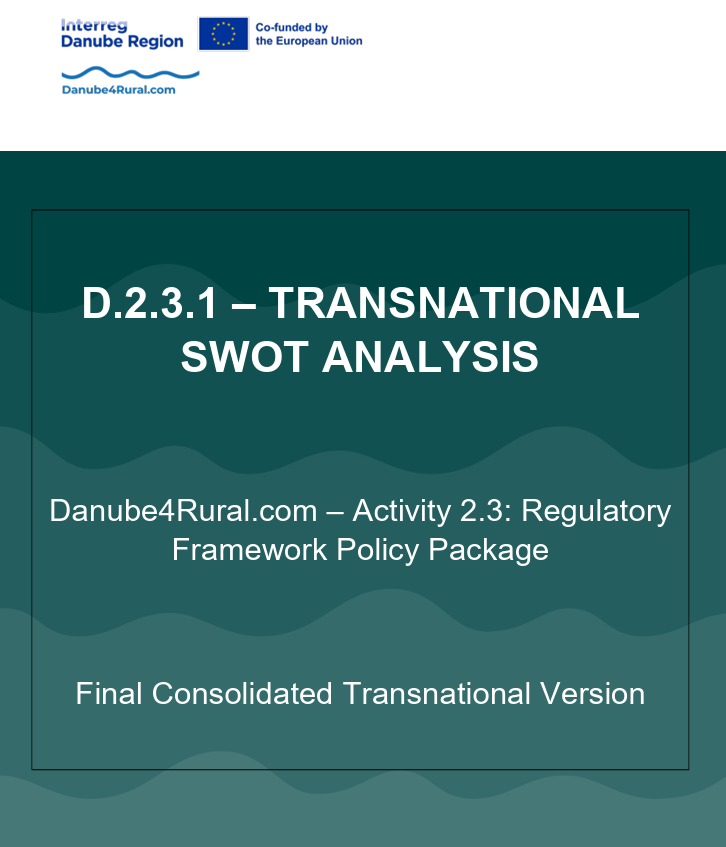
TRANSNATIONAL SWOT ANALYSIS
Overview
The Danube4Rural.com partnership has published its new D.2.3.1 – Transnational SWOT Analysis, providing a comprehensive, evidence-based overview of how legal, administrative and institutional frameworks across nine Danube Region countries affect the feasibility of remote work in rural territories. Developed under Activity 2.3 – Regulatory Framework Policy Package, the document consolidates partner-level SWOT analyses from Slovenia, Croatia, Bosnia and Herzegovina, Serbia, Hungary, Romania, Bulgaria, Slovakia and Montenegro into a single, comparative transnational assessment.
Analytical and strategic role
The report serves as the analytical foundation for the project’s regulatory work, systematically mapping strengths, weaknesses, opportunities and threats related to remote workers, digital nomads, freelancers, digital entrepreneurs and rural newcomers. It addresses key territorial challenges – rural depopulation, youth outmigration, fragmented governance and a lack of tailored instruments for remote worker attraction – while highlighting strong local assets such as environmental quality, cultural heritage, community life and improving policy support at EU and national level.
Structure and key focus areas
The framework is organised into several core chapters: a transnational SWOT analysis (strengths, weaknesses, opportunities, threats), a cross-SWOT that links internal and external factors into strategic directions, a review of regulatory barriers, and a set of best practices and recommendations for remote-work-friendly rural governance. It also includes detailed partner-specific SWOT annexes, offering granular insight into pilot territories such as Moravske Toplice, Prijedor, Babušnica, Cetinje, Baranja, Țara Dornelor, Gotse Delchev and rural municipalities in Slovakia.
From analysis to policy directions
Building on harmonised methodology, the document identifies how legal recognition of remote work, digital nomad schemes, e‑government services, territorial assets and entrepreneurship ecosystems can be leveraged, while infrastructural gaps, administrative complexity and unclear tax and social security rules are addressed through targeted reform proposals. The resulting strategic directions feed directly into the Regulatory Framework Policy Package, guide the design of pilot actions in 9 rural areas, and support the development of the project’s integrated transnational governance model.

22/07/2026
By Manca Rajh
Share on social media:


News & Events
Read the most recent updates and explore the upcoming events.

Would you like to receive project updates?
You're already part of our community!
Welcome to our newsletter community!
Subscribe to our newsletter