
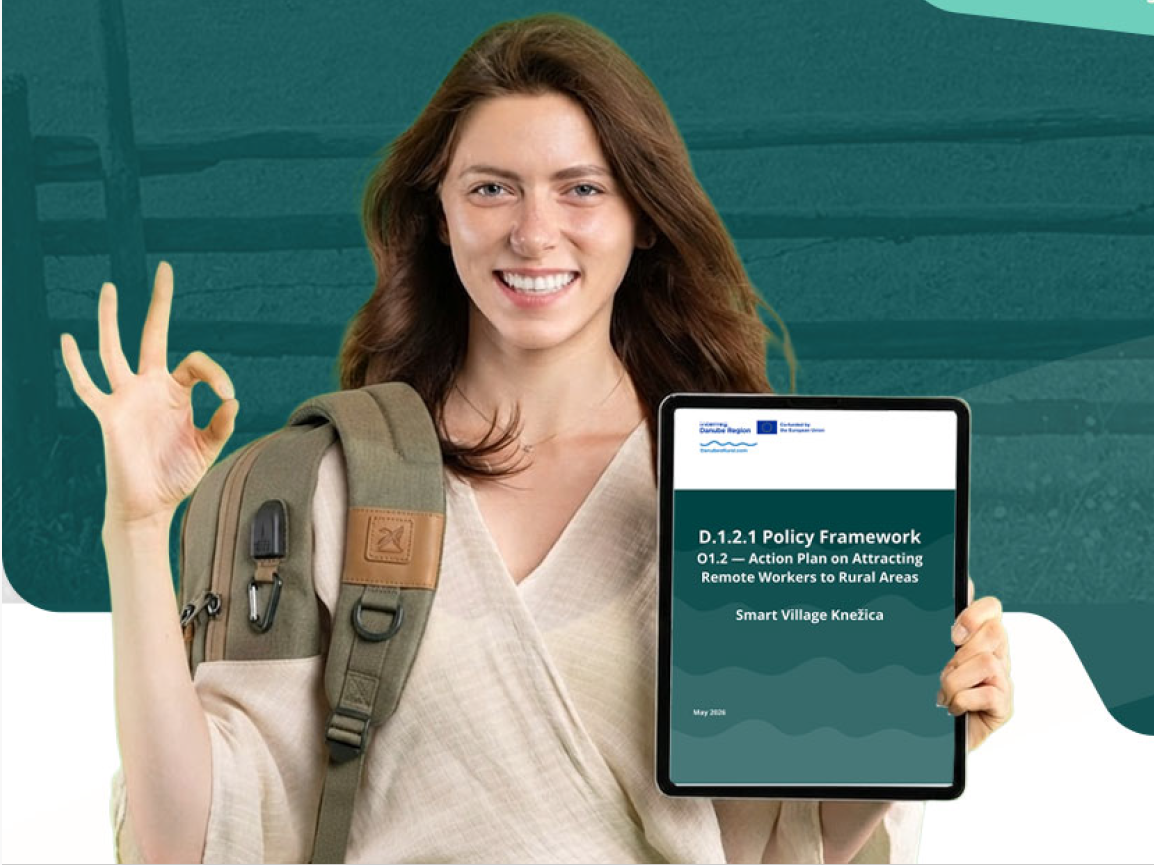

O 1.2 Action Plan on Attracting Remote Workers to Rural Areas
Danube4Rural.com policy framework and action plan on attracting remote workers to rural areas now available
O1.2 — Action Plan on Attracting Remote Workers to Rural Areas
The Danube4Rural.com partnership has published its new Policy Framework / O1.2 Action Plan on Attracting Remote Workers to Rural Areas, delivering the analytical and strategic foundation for future pilot testing and governance model development within the project. Developed under Activity 1.2 and led by Smart Village Knežica, the document turns evidence from partner questionnaires, Remote Workers Policy Hub submissions, and macro-regional analysis into structured policy directions for rural territories across the Danube Region.
The report responds to a major territorial challenge: rural depopulation, youth outmigration, governance fragmentation, and the absence of targeted instruments for attracting remote workers in the project area. At the same time, it highlights strong local assets, including environmental quality, available housing stock, cultural life, and growing policy support at EU and national level for rural revitalisation.
The framework is built around three interconnected policy packages that together shape a more supportive environment for remote workers in rural areas:
Quality of Life, focusing on housing activation, coworking and digital infrastructure, public services, and welcome and integration programmes.Financial Incentives, addressing relocation and housing grants, tax incentives, and access to low-interest loans to reduce the costs and risks of relocation.
Regulatory Framework, targeting administrative simplification, digital standards, and stronger institutional recognition of remote worker attraction as a governance objective.
The document also introduces a three-level governance architecture covering the local pilot level, project coordination level, and transnational learning level, which will guide the testing and refinement of these policy directions in the next phases of the project. This architecture is intended to support the transition from analytical groundwork to pilot implementation and, later, to the final governance model.
A comparative territorial assessment included in the framework shows that pilot areas differ in their readiness to attract remote workers, ranging from structurally ready territories to emerging and structurally constrained ones. This is why the action plan promotes differentiated local approaches while maintaining a shared strategic structure across the partnership.
The publication is designed as a living document and will be further updated with additional evidence from comparative research and public consultations in later project periods. In this way, the framework serves not only as a current policy reference, but also as the bridge toward tested and transferable governance recommendations for rural remote worker attraction in the Danube Region.

15/07/2026
By Manca Rajh
Share on social media:


News & Events
Read the most recent updates and explore the upcoming events.


Would you like to receive project updates?
You're already part of our community!
Welcome to our newsletter community!
Subscribe to our newsletter