
D.3.1.2 Cooperation-based pilot designs
From Plans to Action: COOPOWER Pilots Will Support Young People Across the Danube Region
Many young people in the Danube Region face a difficult start when they try to enter the labour market. For some, the problem is not only the lack of jobs. It can also be linked to where they live, the support they receive at school, their family situation, transport problems, low confidence, or limited access to reliable information.
The COOPOWER project works with this reality. It starts from a simple idea: young people need connected support. Schools, municipalities, NGOs, employment services, businesses and local communities can all help. But their support is stronger when they work together.
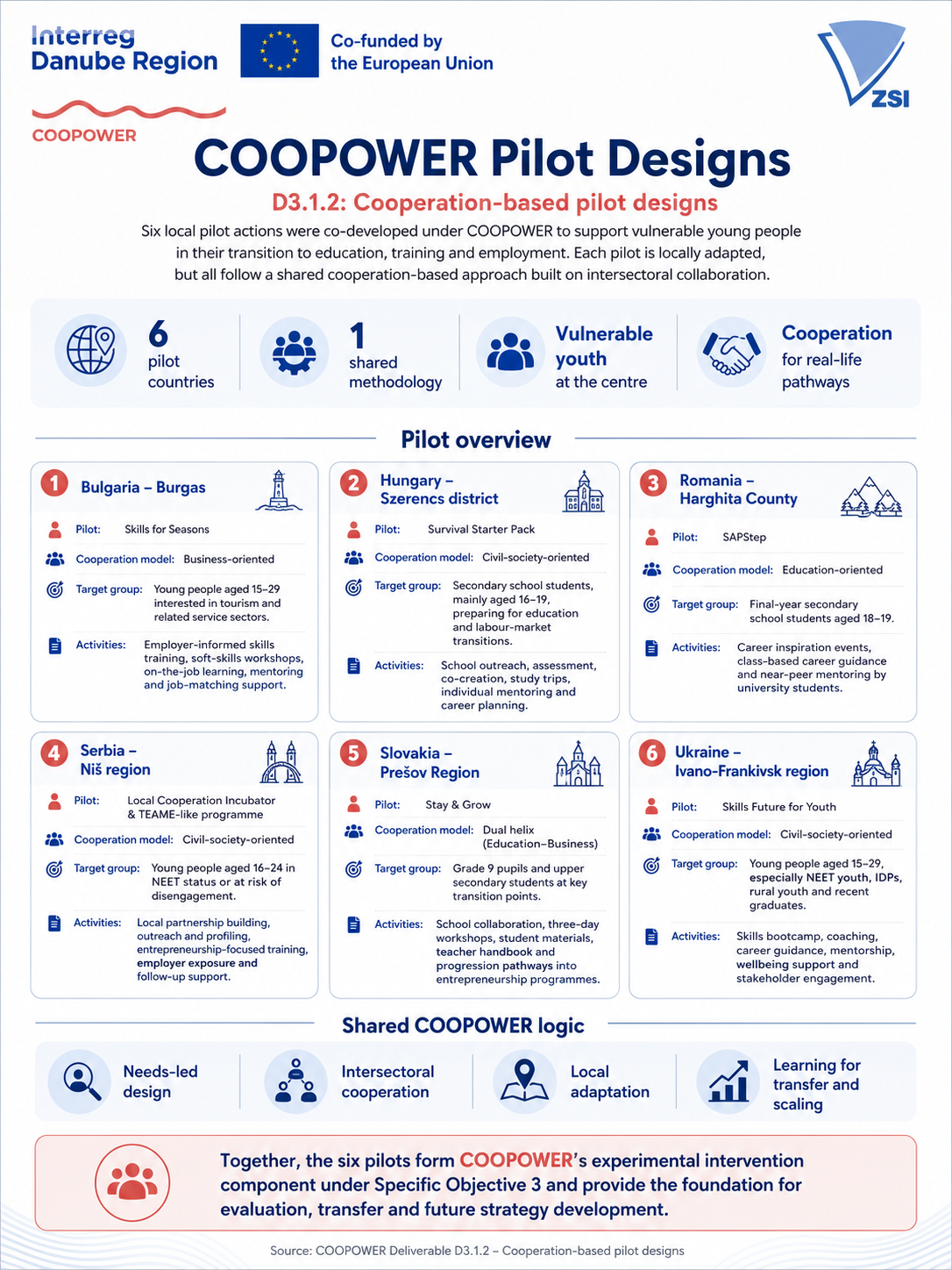
The project has now developed six cooperation-based pilot actions in Bulgaria, Hungary, Romania, Serbia, Slovakia and Ukraine. These pilots will test practical local solutions that help vulnerable young people move closer to education, training or work. They are not one-size-fits-all programmes. Each pilot responds to a real local challenge and to the needs of young people in that area.
In Bulgaria, the pilot will support young people in the Burgas region who are interested in tourism and hospitality. Local employers, municipalities, schools and employment services will work together to offer job-focused training, soft-skills workshops, mentoring and job-matching support. The aim is to help young people gain practical skills and find more stable opportunities in a sector that is important for the region.
In Hungary, the “Survival Starter Pack” mentorship programme will work with secondary school students in the Szerencs district. Many young people in the area are unsure about their future and do not have enough access to personal career guidance. The pilot will offer mentoring, self-knowledge activities, study trips and workshops. It will help students make more informed choices about further education and work.
In Romania, the pilot will focus on final-year secondary school students in Harghita County. It aims to prevent early leaving from education and training. Students will receive career guidance, inspiration events and support from university students acting as near-peer mentors. The goal is to strengthen motivation and help young people plan their next steps after school.
In Serbia, the pilot in the Niš region will support young people who are not in education, employment or training, or who are at risk of becoming disengaged. It will combine local cooperation, outreach, training, mentoring and follow-up support. The aim is to build trust and create clearer pathways towards learning, work and entrepreneurship.
In Slovakia, the pilot in the Prešov Region will work mainly with pupils at an important school transition point. It will help them build self-awareness, confidence, entrepreneurial thinking and career orientation. Schools and business actors will cooperate closely, and the pilot will also develop materials that teachers can use later.
In Ukraine, the pilot in the Ivano-Frankivsk region will support vulnerable young people, including internally displaced youth and young people from rural or peri-urban areas. The programme will combine practical skills training, career guidance, coaching and wellbeing support. This is especially important for young people whose education, work plans or sense of security have been affected by the war.
Across all six pilots, the focus is on practical learning. Young people will not only receive information. They will take part in activities, meet mentors, visit workplaces, build skills and reflect on their own future. Local partners will also learn how to cooperate better and how to keep useful support structures alive after the pilot period.
The pilots are an important step in the COOPOWER journey. They turn research, local knowledge and stakeholder dialogue into concrete action. The experience gained from these pilots will later support evaluation, local strategies and a shared toolbox of cooperation models. In this way, COOPOWER will not only test solutions in six places. It will also collect lessons that can help other communities in the Danube Region support young people more effectively.

24/07/2026
By Virág Vajda
Share on social media:


Social

News & Events
Read the most recent updates and explore the upcoming events.








Would you like to receive project updates?
You're already part of our community!
Welcome to our newsletter community!
Subscribe to our newsletter