

D.1.2.2 - Catalogue of youth employment practices based on intersectoral cooperation
Learning from practice: how cooperation can support young people on their way to work
Across the Danube Region, many young people still face serious barriers when they try to enter the labour market. These barriers are not always only about finding a job. They can also be linked to early school leaving, low educational attainment, poverty, rural isolation, disability, migration background, or mental health difficulties.
For many vulnerable young people, support is often fragmented. Schools, employment services, social services, municipalities, NGOs and employers may all work with young people, but not always together. This can make it difficult for young people to find the right support at the right time.
The COOPOWER project is built on a simple idea: no single organisation can solve these challenges alone. Young people need connected support systems. This means cooperation between different sectors, practical links to employers, trusted local actors, and services that understand the real-life situation of young people.
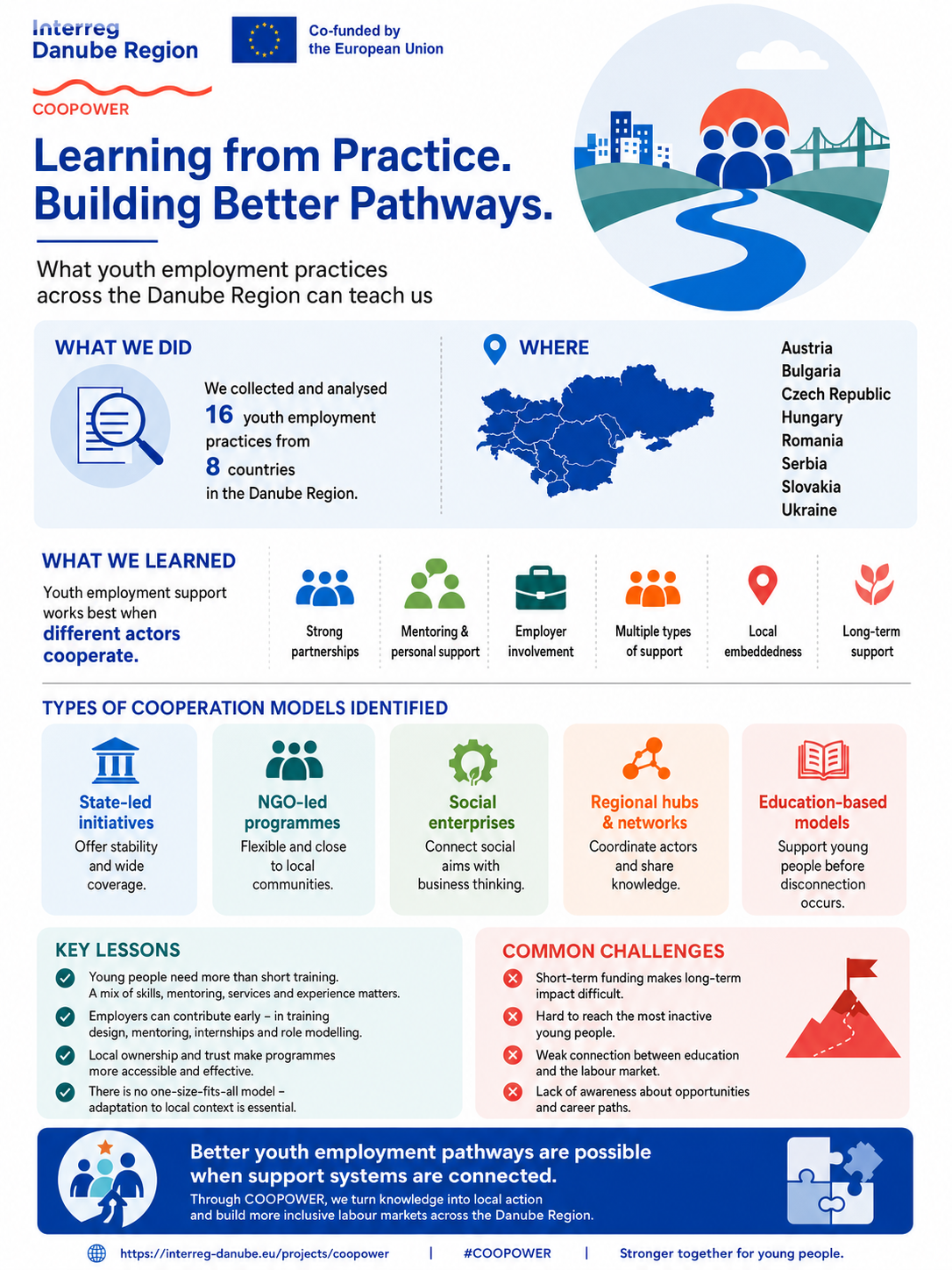
As part of this work, the project partnership collected and analysed 16 youth employment practices from eight countries in the Danube Region. The aim was not only to list good examples, but to understand what makes them useful, what can be learned from them, and how similar approaches could inspire future local actions.
The selected practices come from Austria, Bulgaria, Czech Republic, Hungary, Romania, Serbia, Slovakia and Ukraine. They show a wide range of approaches. Some are led by public authorities. Others are run by NGOs, schools, social enterprises, municipalities or regional networks. Some focus on mentoring. Others provide training, career guidance, psychosocial support, youth spaces, work-based learning or entrepreneurship support.
Despite these differences, the practices have one important point in common. They all show that youth employment support works better when different actors cooperate.
The catalogue looks at several types of cooperation models. State-led initiatives can offer stability and wide coverage. NGO-led programmes are often flexible and close to local communities. Social enterprises can connect social aims with business thinking. Regional hubs and networks help coordinate actors and share knowledge. Education-based models can support young people before they become disconnected from school or work.
This diversity is important. It shows that there is no single perfect model. What works in one country or region may need to be adapted elsewhere. But many basic elements can be transferred. These include strong partnerships, local ownership, mentoring, employer involvement, and long-term support.
One of the main lessons is that young people often need more than short training courses. The most promising practices combine several forms of support. Skills development is important, but it is more effective when it is connected with mentoring, career guidance, mental health support, real workplace experience and trust-based relationships.
Employer involvement is also a key factor. Employers can do much more than offer jobs at the end of a programme. They can take part in designing training, provide internships, mentor young people, offer workplace visits, and help young people understand what the labour market really expects. When employers are involved early, support becomes more practical and more relevant.
Mentoring appears as another strong element across several practices. A mentor can help a young person set goals, build confidence, understand opportunities and navigate difficult decisions. For young people who have limited support at home or in their wider environment, this kind of personal guidance can be especially valuable.
The catalogue also points to the importance of local embeddedness. Programmes that are close to schools, municipalities, local employers and community organisations can react faster to local needs. They can also build trust more easily. This is especially important in disadvantaged regions, where young people may have little confidence in institutions or may not know where to turn for help.
At the same time, the analysis also identifies common challenges. Many good initiatives depend on short-term funding. This makes it difficult to keep staff, maintain services and plan for the future. Some programmes also struggle to reach the most inactive or disengaged young people. Traditional communication is often not enough. Outreach needs to be proactive, local and sometimes peer-based.
Another challenge is the limited connection between education and the labour market. In many places, young people have narrow information about possible career paths. They may not see realistic opportunities close to them. Without practical exposure to workplaces and role models, it is harder to make informed decisions.
These lessons are highly relevant for the next steps of COOPOWER. The project is not collecting good examples as an end in itself. The knowledge gathered through this work will support the development of local cooperation models and pilot activities in the participating countries.
The catalogue gives partners a shared basis for thinking about what kind of support works, under what conditions, and what should be avoided. It also offers inspiration for policymakers, practitioners and local organisations that want to strengthen youth employment support in their own region.
Most importantly, it shows that better youth employment pathways are possible when support systems are connected. A young person’s path to work should not depend on whether they find the right organisation by chance. It should be supported by a local ecosystem where schools, social services, employers, NGOs and public institutions know each other, cooperate, and work toward the same goal.
Through COOPOWER, these lessons will now feed into local and transnational cooperation. The aim is to turn knowledge into practical action, and to help build more inclusive labour markets for vulnerable young people across the Danube Region.


02/06/2026
By Virág Vajda
Share on social media:


Social

News & Events
Read the most recent updates and explore the upcoming events.







Would you like to receive project updates?
You're already part of our community!
Welcome to our newsletter community!
Subscribe to our newsletter