
Deliverable 1.1.1: Country reports on territorial and diagnostic analysis
Seeing the Real Picture Behind Youth Employment Challenges
Young people across the Danube Region face very different realities. Some live in large cities with many services and opportunities. Others grow up in small towns or rural areas, where access to education, jobs and support is more limited. Some are still in education, but do not see a clear path to work. Others are already outside both school and the labour market.
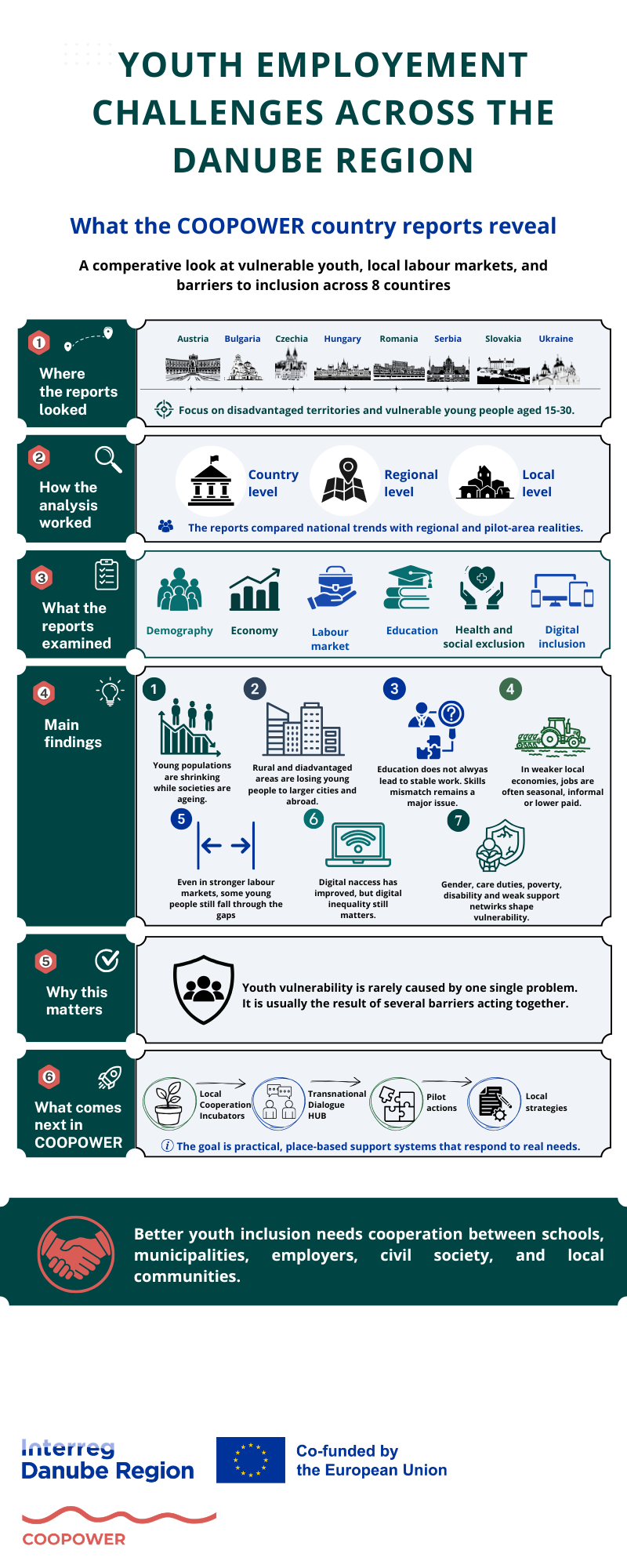
The COOPOWER project prepared a series of country reports to better understand these differences. The reports focused on Austria, Bulgaria, Czech Republic, Hungary, Romania, Serbia, Slovakia and Ukraine. They explored the situation of vulnerable young people aged 15–30, especially those who face barriers to labour market integration.
Within the COOPOWER project, Sapientia Hungarian University of Transylvania supported the preparation of these country reports. Sapientia created the common analytical framework, which was then used by partners in the participating countries. Based on the country reports, Sapientia also prepared the Baseline Study and Synthesis Report, titled Territorial Diagnosis of Disadvantaged Regions and Vulnerable Youth Transitions.
The aim of the country reports was simple, but important: to understand what makes the transition from education to work difficult for vulnerable young people, and what kind of local support is needed. The reports looked not only at national trends, but also at regional and local realities, especially in the territories where COOPOWER pilot activities will take place.
To provide a more complete picture, the reports examined several key areas. These included population and demographic trends, the economic situation, labour market conditions, education, health, poverty, social exclusion, and digital inclusion. The analysis was based on data collected at country level, regional level and, where possible, local level.
The reports show that many challenges are shared across the region. In most countries, the number and share of young people is decreasing, while societies are ageing. This is especially visible in rural and disadvantaged areas. Many young people leave these places because they do not see enough local opportunities. They move to bigger cities or abroad to study, work or build a more stable future.
This trend is visible in several pilot territories. In Burgas in Bulgaria, Tállya and Northern Hungary, Harghita County in Romania, Nišava District in Serbia, Prešov Region in Slovakia and Ivano-Frankivsk in Ukraine, demographic decline is closely linked to weak local labour markets. Fewer jobs, lower wages, limited transport and weaker services all make it harder for young people to stay.
At the same time, the reports show that youth vulnerability does not look the same everywhere.
In Austria and the Czech Republic, the general labour market situation is stronger. But this does not mean that all young people have equal chances. The main challenges are often more hidden. Young people with low education, disabilities, care responsibilities, weak family support or limited access to information can still fall behind. In these contexts, the issue is often not the complete lack of services. It is rather that services are difficult to navigate, or they do not work together well enough.
In other regions, the problem is more direct. In Harghita County in Romania and Burgas in Bulgaria, the local economy often cannot offer stable career paths. Many businesses are small. Apprenticeships are limited. Flexible work is not widespread. Jobs are often seasonal, informal or low paid. In these places, even good career guidance has limits if there are not enough real opportunities behind it.
This is one of the strongest messages of the reports. Young people do not only need motivation. They do not only need training. They also need a local environment where their skills can be used.
Education is another key issue. In several countries, early school leaving remains a serious risk. This is especially true for young people from disadvantaged families and rural areas. In Hungary and Romania, the reports show strong differences between urban and rural youth. In the Czech Republic, early school leaving is less common, but skills mismatch remains important. Many young people finish school, but their qualifications do not fully match the needs of the labour market.
In Serbia and Slovakia, the reports also point to gaps in practical skills, digital competences and access to quality education. These gaps are stronger outside large urban centres. They can make young people less confident and less prepared for work.
One interesting finding is that demographic trends can be mixed. Some regions are losing young people, but still have high birth rates in specific vulnerable communities. The Prešov Region in Slovakia is one example. This shows why averages can be misleading. A region can have a younger population in some local communities, but still face serious poverty, exclusion and educational disadvantage.
Ukraine adds a very specific perspective. The war has made existing problems much deeper. Young people are affected by displacement, disrupted education, unstable employment, trauma and uncertainty. In Ivano-Frankivsk, local communities also need to support internally displaced young people. This creates extra pressure on schools, social services, employers and municipalities.
Gender also matters. In several countries, young women are more likely to become inactive because of care duties, early family formation or lack of childcare. Young men are often more exposed to early school leaving, unstable work or discouragement after repeated failures in the labour market. These situations are different, but both show the same thing: support must take real life circumstances into account.
Digital access has improved in many places. But digital inequality has not disappeared. Internet connection alone is not enough. Young people also need skills, devices, confidence and meaningful ways to use digital tools. This is especially important for rural youth, low-income families and young people whose education has been interrupted.
Overall, the country reports confirm the basic idea behind COOPOWER. Youth vulnerability is rarely caused by one single problem. It is usually the result of many barriers together. These can include poor transport, weak local economies, low education, poverty, lack of guidance, digital gaps, health difficulties, care duties or weak support networks.
For this reason, isolated solutions are not enough.
COOPOWER will build on these findings through coordinated, place-based and intersectoral pilot interventions. The next steps will include Local Cooperation Incubators, the Transnational Dialogue HUB, pilot actions and local strategies. These activities will bring together schools, municipalities, employers, civil society organisations, youth workers and other local actors.
The goal is to create better connected support systems for young people. These systems must be practical. They must be local. And they must respond to real needs.
The country reports make one message clear. Young people in disadvantaged territories do not only need individual help. They need communities, institutions and employers that work together. By understanding both the shared challenges and the local differences, COOPOWER can help create solutions that are not copied from one place to another, but shaped by the realities of each territory.


28/05/2026
By Virág Vajda
Share on social media:


Social

News & Events
Read the most recent updates and explore the upcoming events.









Would you like to receive project updates?
You're already part of our community!
Welcome to our newsletter community!
Subscribe to our newsletter