
Deliverable 1.2.1: Country-specific inventory of good practices
Building a shared knowledge base for better youth employment support
How can young people facing multiple disadvantages receive better support on their way to education, training or work? This is one of the central questions of the COOPOWER project.
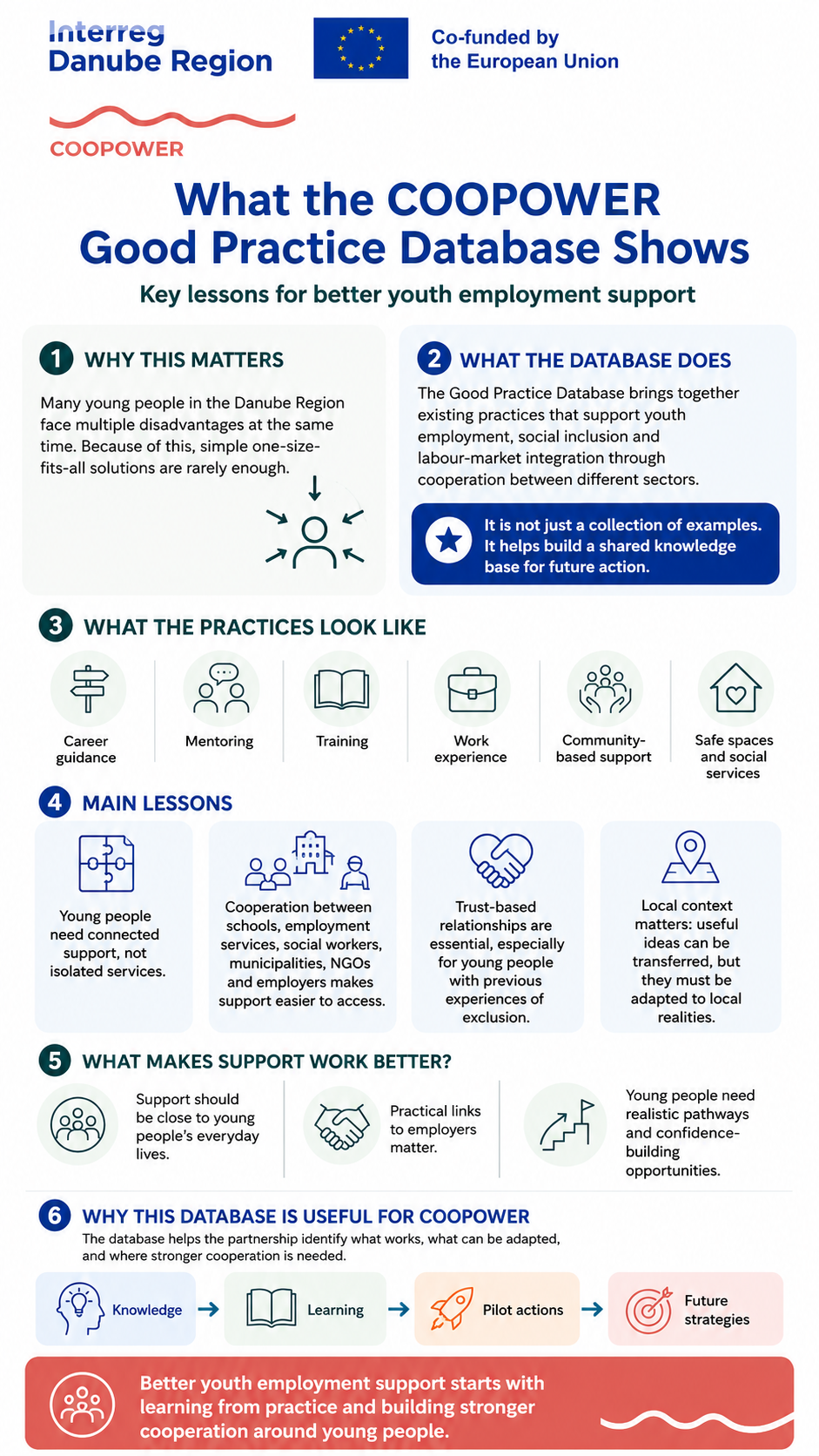
Across the Danube Region, many young people do not only face one single barrier when entering the labour market. Their situation may be shaped by poverty, early school leaving, low educational attainment, rural isolation, disability, lack of family support, limited access to services, or previous negative experiences with institutions. These challenges often appear together. This means that simple, one-size-fits-all solutions are rarely enough.
To better understand what kind of support can work in practice, the COOPOWER partnership prepared the D.1.2.1 Good Practice Database. The database brings together existing practices that support youth employment, social inclusion and labour-market integration through cooperation between different sectors.
The aim of the database is not only to collect examples. It helps the partnership build a common knowledge base before developing local pilot actions in the participating countries. By looking at already existing initiatives, the project partners can better understand which elements are useful, what can be adapted to different local contexts, and where stronger cooperation is needed.
The good practices included in the database come from several countries of the Danube Region. They show that youth employment support can take many forms. Some examples focus on career guidance and mentoring. Others provide training, work experience, youth coaching, community-based support, social services, or safe spaces where young people can receive guidance and build confidence.
What connects these practices is the idea that young people need more than isolated services. A young person may need help from a school, an employment office, a social worker, a youth organisation, a municipality, an employer, or a mentor. If these actors work separately, support can become difficult to access and hard to navigate. If they cooperate, young people have a better chance of finding the right pathway.
The database also shows that local context matters. A model that works well in one city or region may need changes before it can be used elsewhere. Rural areas, small towns, urban neighbourhoods and disadvantaged communities all have different needs and resources. This is why COOPOWER does not look for one universal solution. Instead, it looks for transferable elements that can inspire locally relevant responses.
Several important lessons emerge from the collected practices. Support is more effective when it is close to young people’s everyday lives. Trust-based relationships are essential, especially for those who have limited support networks or previous experiences of exclusion. Practical links to employers also matter, because young people need real information about work, realistic career options and opportunities to gain experience.
The Good Practice Database will support the next stages of the COOPOWER project. It will feed into the development of local cooperation models, pilot actions and future strategies. In this way, the database serves as a bridge between knowledge and action.
By learning from existing practices, COOPOWER aims to strengthen support systems that are more connected, inclusive and responsive to young people’s real needs. The final goal is to contribute to labour markets in the Danube Region where vulnerable young people are not left alone to find their way, but are supported by cooperation between institutions, communities and employers.


15/06/2026
By Virág Vajda
Share on social media:


Social

News & Events
Read the most recent updates and explore the upcoming events.







Would you like to receive project updates?
You're already part of our community!
Welcome to our newsletter community!
Subscribe to our newsletter