

D3.1.1. - Joint implementation framework
COOPOWER prepares cooperation-based pilots to support young people’s pathways
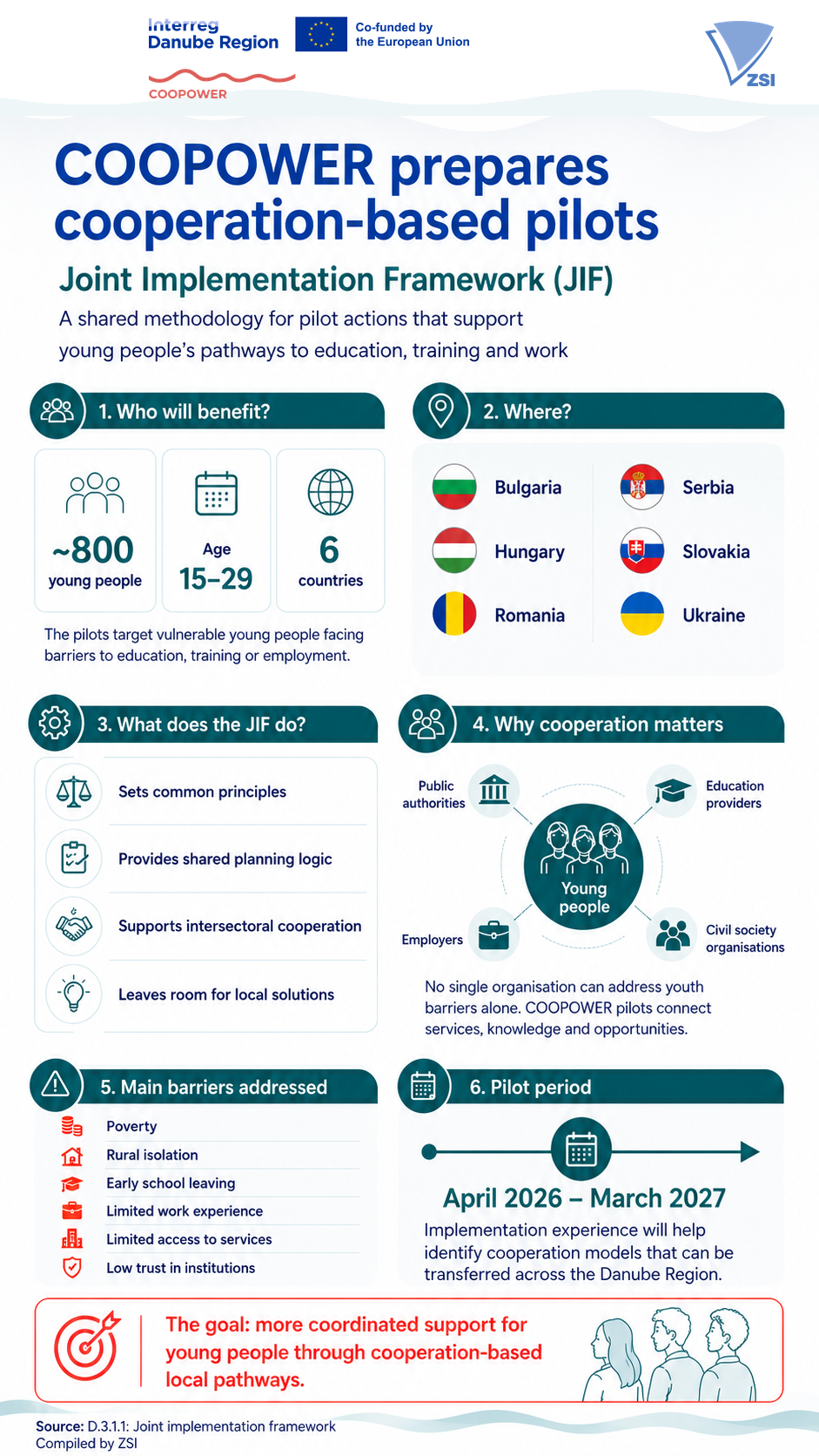
Around 800 young people facing barriers across six Danube Region countries will benefit from planned pilot actions designed to support their transition to education, training and work. To prepare these activities, COOPOWER partners have developed the Joint Implementation Framework (JIF): The shared methodological structure behind the pilot designs.
The JIF sets out the common principles, planning logic and cooperation approach that all pilots follow, while leaving room for each country to design activities that respond to its local context. It does not prescribe identical activities across the participating countries. Instead, it provides a shared foundation for designing the pilots in a coherent way and for learning from the different local experiences.
The framework is built around intersectoral cooperation. This means bringing together public authorities, education providers, employers and civil society organisations. By combining their expertise and resources, partners aim to create more coordinated pathways for young people who face barriers in accessing education, training or employment.
The pilots in Bulgaria, Hungary, Romania, Serbia, Slovakia and Ukraine will support vulnerable young people aged 15-29. Many young people in the Danube Region continue to face barriers such as poverty, rural isolation, early school leaving, limited work experience, lack of access to services or low trust in institutions.
A key idea behind COOPOWER is that no single organisation can support young people facing these barriers alone. Schools, employment services, municipalities, NGOs, youth workers and employers all see different parts of the same challenge. When they work separately, support can become fragmented. Young people may receive help too late, or may not know where to turn.
For this reason, cooperation is at the centre of the COOPOWER pilots. The JIF encourages partners to involve actors from different sectors and to think carefully about how cooperation can support young people’s pathways. It also supports a common way of thinking about how pilot activities are expected to contribute to change, without assuming that one approach will work in the same way everywhere.
Building on the JIF, the next COOPOWER publication will present the planned pilot designs in more detail. It will show how partners in Bulgaria, Hungary, Romania, Serbia, Slovakia and Ukraine intend to apply the shared approach in their own local settings.
The pilot period is planned from April 2026 to March 2027. The experiences gathered during implementation will help identify cooperation models and support approaches that can be transferred and adapted across the Danube Region. Through these pilots, COOPOWER aims to show that young people can be supported more effectively when organisations connect their knowledge, services and opportunities.

26/06/2026
By Virág Vajda
Share on social media:


Social

News & Events
Read the most recent updates and explore the upcoming events.











Would you like to receive project updates?
You're already part of our community!
Welcome to our newsletter community!
Subscribe to our newsletter