
2nd Report LSG meeting - Bulgaria
From Ideas to Confidence: Bulgarian Stakeholders Shape IMPACTA’s Future Training Approach
What does a woman need to take the first step towards entrepreneurship?
For some, it may be a clear business plan. For others, it may be access to finance, a supportive network, digital skills, or simply the confidence to say: “What I know and what I have already experienced can become the starting point of something new.”
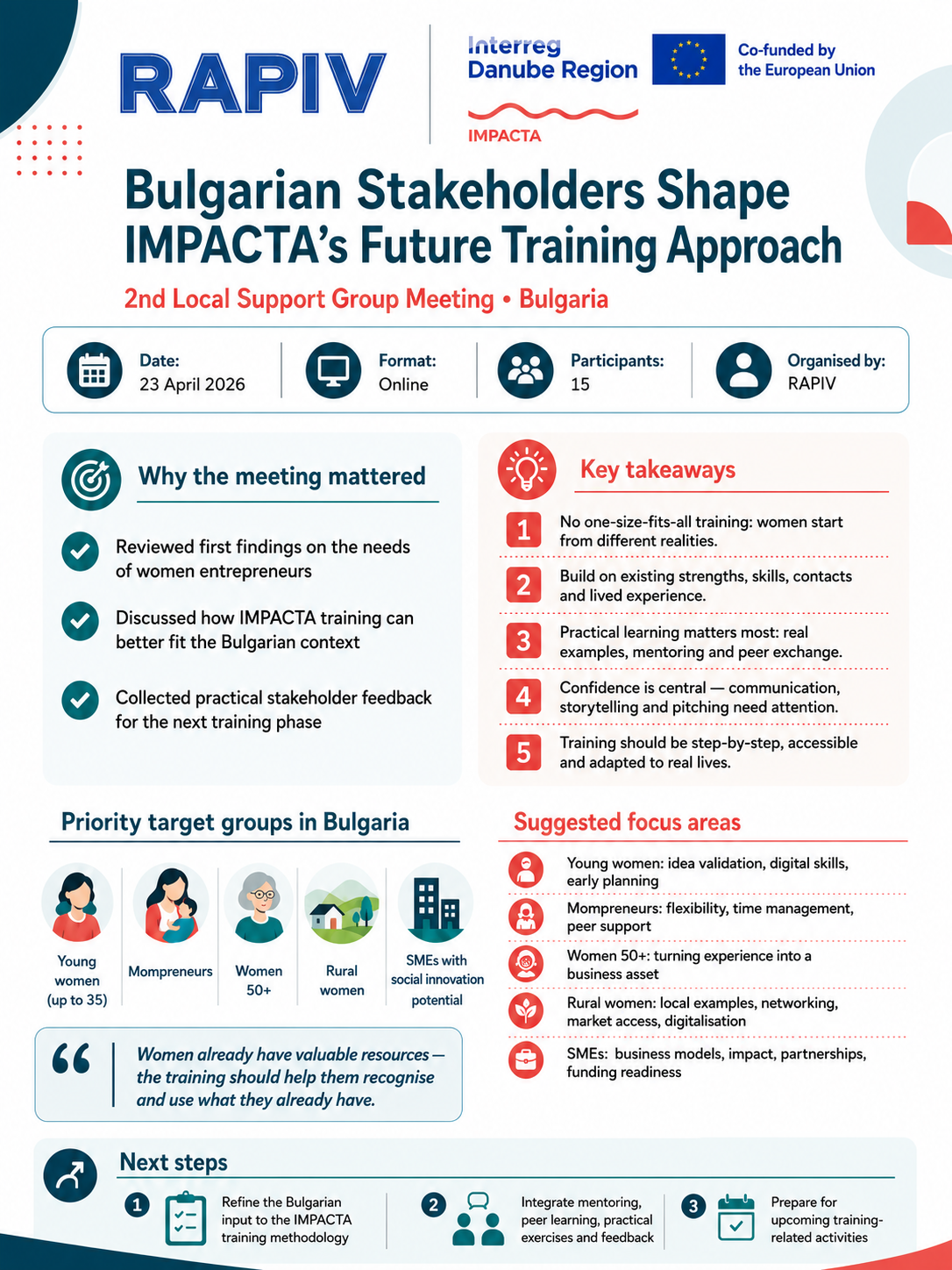
This was one of the central messages of the second Bulgarian Local Support Group meeting, organised online by RAPIV in April 2026 within the IMPACTA project. The meeting brought together 15 participants from public institutions, business support organisations, civil society, academia, SMEs and the investment community. Around the virtual table were representatives of the Ministry of Economy and Industry, the Regional Information Centre – Varna, the Bulgarian Chamber of Commerce and Industry – Varna branch, the Industrial Association – Varna, Smart Varna, Business Angels – Varna chapter, and Varna Free University “Chernorizets Hrabar”.
Their shared task was practical and important: to review the first findings of the needs analysis on women entrepreneurs and to discuss how the future IMPACTA training materials could become truly useful in the Bulgarian context.
The discussion quickly moved beyond the idea of a “standard entrepreneurship course”. Stakeholders agreed that women do not all start from the same place. A young woman with a new idea, a mother trying to balance business and family life, a woman over 50 considering a fresh professional path, a rural woman with limited access to networks, or an SME working on social innovation may all need different types of support.
This is why the Bulgarian stakeholders highlighted the importance of a flexible and practical training approach. Instead of long theoretical sessions, they called for real examples, peer learning, mentoring, simple tools and exercises that help participants move step by step.
A particularly important idea discussed during the meeting was that many women already have valuable resources, even if they do not always recognise them as such. Their professional experience, family and community roles, informal knowledge, practical skills, contacts, and everyday problem-solving abilities can all become part of an entrepreneurial journey.
This approach is especially relevant for women who may feel that they are “not ready yet” or that they lack the perfect conditions to start. The stakeholders therefore supported a method that helps women build on what they already have, rather than waiting for ideal circumstances.
The meeting also underlined that confidence is not a side issue — it is central. A good business idea can remain invisible if it is not presented clearly. Participants stressed that communication, presentation and pitching skills should be strengthened in the future training process. Women entrepreneurs should have time to develop their message, practise their pitch, receive feedback, and improve in a supportive environment before meeting investors, business angels or other external stakeholders.
One suggestion was to dedicate at least two weeks to preparing business presentations, including repeated practice and feedback. Involving experienced entrepreneurs or business angels as a feedback panel was also seen as a valuable way to create a realistic but safe learning space.
The meeting confirmed that the IMPACTA training methodology is on the right path, but it also gave a clear direction for further refinement: it must remain accessible, practical and adapted to real lives. For young women, this may mean support in idea validation, digital skills and early-stage planning. For mompreneurs, flexibility and peer support are essential. For women over 50, the training should help turn life and professional experience into a business asset. For rural women, local examples, networking and digital access matter. For SMEs with social innovation potential, the focus should include partnerships, impact and funding opportunities.
The feedback collected in Bulgaria will now feed into the further development of the IMPACTA training materials and methodology. The Local Support Group will continue to play an advisory role, helping the project keep its outputs close to the needs of real women, real communities and real entrepreneurial ecosystems.
Through this process, IMPACTA is not only designing training materials. It is building a space where women’s ideas, experience and confidence can meet the support they need to grow.

02/07/2026
By Renáta Anna Jaksa
Share on social media:


Social

News & Events
Read the most recent updates and explore the upcoming events.



Would you like to receive project updates?
You're already part of our community!
Welcome to our newsletter community!
Subscribe to our newsletter