
2nd Report LSG meeting - Croatia
Croatian stakeholders validated IMPACTA training framework for supporting women entrepreneurs
On 29 May 2026, Technology Park Varaždin organised the second Croatian Local Support Group meeting within the IMPACTA project. The meeting was held online and brought together local stakeholders with experience in entrepreneurship support, women’s entrepreneurship, business development, education, mentoring and institutional support.
The main purpose of the meeting was to present the first draft of the IMPACTA training materials and methodologies developed under Deliverable D1.2.1 and to collect practical feedback from Croatian stakeholders. The discussion was particularly important because the presented framework will serve as a basis for future train-the-trainer activities and for the further development of support models for women entrepreneurs within the IMPACTA project.
At the beginning of the meeting, the participants were briefly informed about the progress achieved so far within the project and the role of the Local Support Group in validating project results. Special attention was given to the draft training framework, which is structured around the entrepreneurial journey and includes three main training sessions: entrepreneurial mindset and ideation, incubation and acceleration, and stakeholder collaboration and ecosystem development.
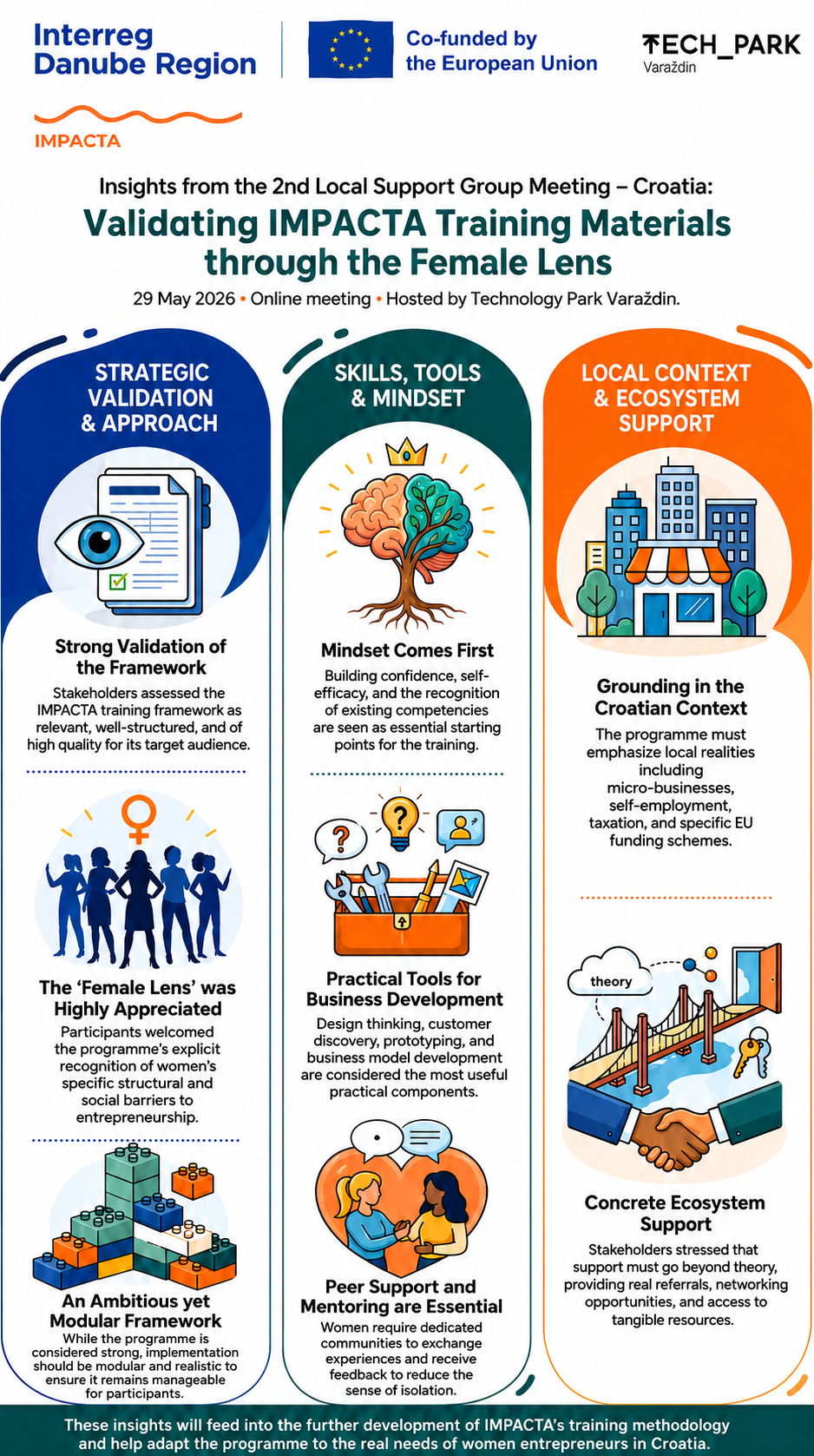
The presented framework was positively received by the participants. Stakeholders expressed general satisfaction with the quality, structure and relevance of the proposed training materials. They particularly welcomed the fact that the entire framework is developed through a so-called “female lens”, meaning that it does not treat women entrepreneurs as a homogeneous group or as individuals who simply need more motivation, but recognises the specific structural, social, psychological and practical barriers women often face when entering and developing entrepreneurship.
A strong point of agreement among the participants was that women entrepreneurs frequently face challenges that are not sufficiently addressed in standard entrepreneurship training programmes. These include lower self-confidence at the beginning of the entrepreneurial journey, limited access to relevant business information, difficulties in balancing business development with family and care responsibilities, weaker access to informal networks, and insufficient visibility of successful female role models. Several participants also shared their own personal experiences from the period when they were entering entrepreneurship, confirming that many of the barriers described in the IMPACTA materials correspond closely to real-life situations in Croatia.
The discussion confirmed that mindset development should be treated as an essential starting point in entrepreneurship education. Participants agreed that many women do not lack ideas, skills or motivation, but often lack encouragement, structured guidance, peer support and a safe environment in which they can test their ideas without fear of judgement. The proposed focus on growth mindset, entrepreneurial self-efficacy, reflection circles and peer support was therefore considered highly relevant.
Stakeholders also recognised the value of the ideation and validation components of the framework. They agreed that women entrepreneurs should be supported in moving from informal ideas and lived experience towards concrete, testable business concepts. Methods such as design thinking, customer discovery, co-creation workshops and structured brainstorming were seen as useful, especially if they are adapted to the local context and explained in simple, practical language.
The part of the framework dealing with incubation and acceleration was assessed as particularly valuable, but also ambitious. Participants agreed that tools such as the Business Model Canvas, Lean Startup, low-cost prototyping, peer accountability groups and investment readiness coaching can significantly improve the quality of support offered to women entrepreneurs. However, they also pointed out that the Croatian context requires careful adaptation. For many women, especially those starting micro-businesses, crafts, service-based activities or self-employment initiatives, access to venture capital is not the most immediate issue. More emphasis may be needed on financial literacy, administrative requirements, taxation, local and national support schemes, EU funding opportunities, microfinance, grants and practical first-market access.
The stakeholders therefore suggested that the future training programme should remain flexible and modular. While the overall framework was considered strong and well designed, participants stressed that not all target groups will need the same level of complexity. Some women may require introductory support focused on confidence, basic business knowledge and regulatory literacy, while others may benefit from more advanced modules on pitching, growth, visibility, mentoring, networking and investment readiness.
The ecosystem dimension of the training framework was also considered highly relevant. Participants agreed that women entrepreneurs do not develop in isolation, but within a broader ecosystem of institutions, mentors, business support organisations, public authorities, financial actors, experienced entrepreneurs and community networks. The Croatian Local Support Group confirmed that the role of the ecosystem should not be limited to providing information, but should include concrete connections, mentoring opportunities, referrals, visibility and access to relevant resources.
An important conclusion of the discussion was that the IMPACTA framework is of high quality, but should be implemented in a realistic and staged way. Stakeholders described it as comprehensive, relevant and ambitious. They supported its overall direction, especially the integration of the “female lens”, but also recommended that the materials be adapted to the actual needs, capacities and starting positions of women in Croatia.
The meeting confirmed several key messages. First, entrepreneurship education for women should begin with mindset, confidence and recognition of existing competences. Second, training should be practical and should help women transform ideas into testable business concepts. Third, incubation and acceleration tools are useful, but must be adjusted to micro and small businesses as well as to more growth-oriented ventures. Fourth, peer support, mentoring and community-based learning are essential. Finally, the entrepreneurial ecosystem must actively open doors for women, rather than merely offer general information.
The feedback collected during the second Croatian Local Support Group meeting will be used to further refine the IMPACTA training methodology and to ensure that the future training materials are relevant, inclusive and applicable in the Croatian context. In this way, the Croatian LSG contributes directly to the development of a more responsive and gender-sensitive support system for women entrepreneurs in the Danube Region.

02/06/2026
By Renáta Anna Jaksa
Share on social media:


Social

News & Events
Read the most recent updates and explore the upcoming events.



Would you like to receive project updates?
You're already part of our community!
Welcome to our newsletter community!
Subscribe to our newsletter