
D1.1.3. Benchmarking Analysis
”From Barriers to Opportunities: Unlocking Women’s Economic Potential in the Danube Region”
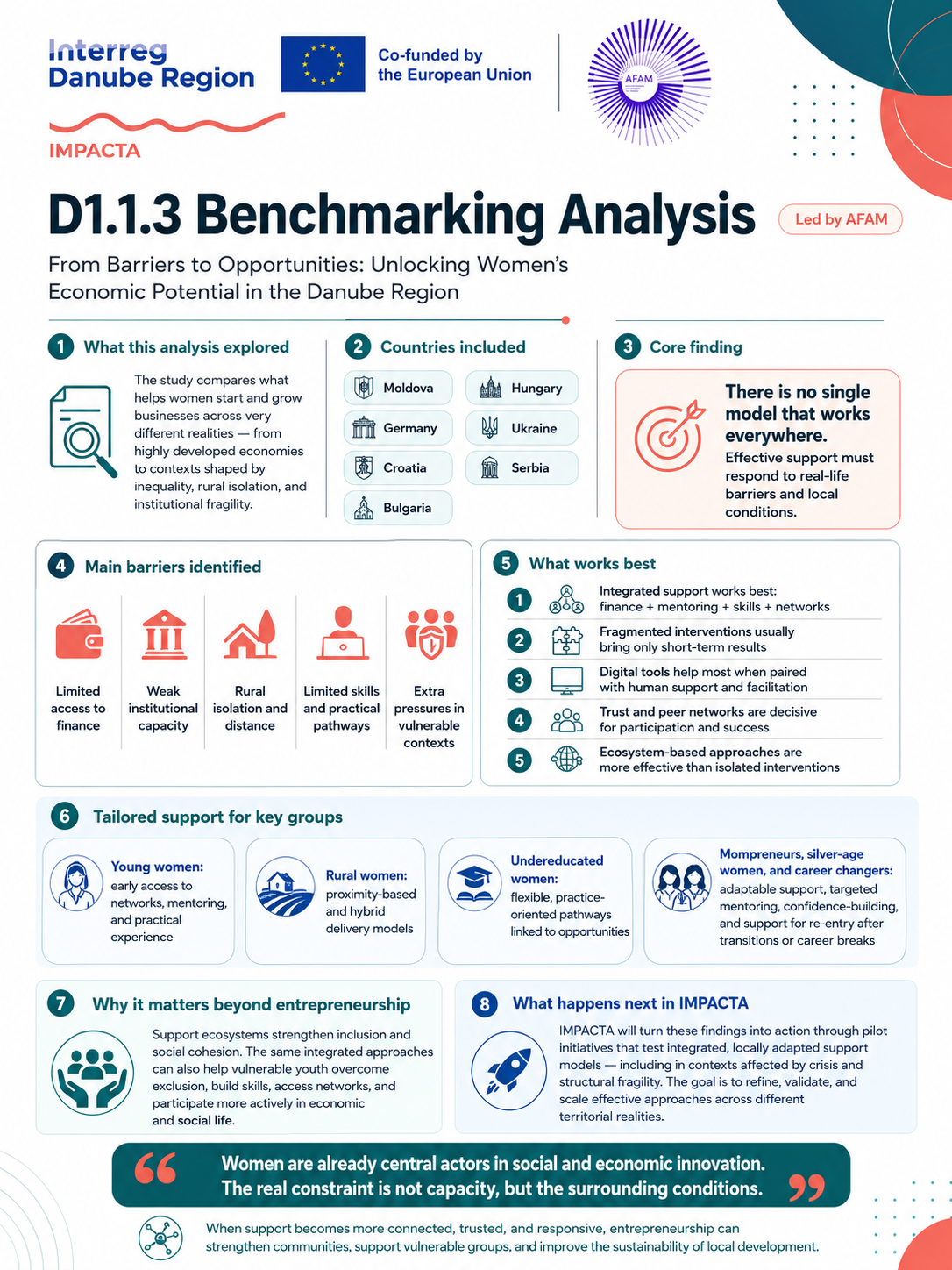
What actually helps women start and grow businesses in very different realities, from highly developed economies to contexts shaped by inequality, rural isolation, or institutional fragility is ultimately about how support systems are designed and whether they respond to real-life constraints.
Led by AFAM, this benchmarking analysis brings together experiences from Moldova, Germany, Croatia, Bulgaria, Hungary, Ukraine, and Serbia, focusing on what makes initiatives effective and transferable. A key conclusion is that there is no single model that works everywhere, because barriers differ: from access to finance and weak institutional capacity to rural isolation and limited skills, with additional pressures for more vulnerable contexts.
These findings directly inform how support should be tailored for key target groups. Young women need early access to networks, mentoring, and practical experience. Rural women require proximity-based and hybrid delivery models that overcome geographic distance. Undereducated women need flexible, practice-oriented pathways linked directly to economic opportunities. For “mompreneurs”, silver-age women, and career changers, the priority is adaptable support that rebuilds confidence, provides targeted mentoring, and enables re-entry into economic activity after transitions or career breaks.
Across all contexts, the most effective approaches are those that integrate multiple forms of support. Finance alone is insufficient; when combined with mentoring, skills development, and access to networks, it becomes significantly more impactful. Fragmented interventions tend to produce only short-term results.
Digital tools expand access, but are most effective when combined with human support and facilitation that ensures trust, relevance, and usability in local contexts.
Trust and peer networks remain decisive factors in participation and success, while from a policy perspective the findings clearly point toward ecosystem-based approaches rather than isolated interventions. For youth inclusion in particular, these models also create pathways into broader labour market participation.
From a social innovation perspective, these findings extend beyond entrepreneurship, highlighting how support ecosystems contribute to broader inclusion and social cohesion. This is particularly relevant for vulnerable youth, who often face similar barriers such as limited networks, exclusion, and reduced access to opportunity. Integrated approaches that combine skills development, mentorship, and community-based support create pathways not only into entrepreneurship, but also into active participation in economic and social life.
Building on these insights, the IMPACTA project will translate evidence into action through pilot initiatives that test integrated and locally adapted support models in real contexts, including those operating under conditions of crisis and structural fragility. The aim is to ensure that effective approaches are refined, validated, and scaled across different territorial realities.
What ultimately emerges is a clear shift in perspective: women are already central actors in social and economic innovation across the region. The constraint is not capacity, but the surrounding conditions. When these conditions become more connected, trusted, and responsive, entrepreneurship becomes a mechanism for strengthening communities, supporting vulnerable groups, and enhancing the sustainability of local development system


02/07/2026
By Renáta Anna Jaksa
Share on social media:


Social

News & Events
Read the most recent updates and explore the upcoming events.



Would you like to receive project updates?
You're already part of our community!
Welcome to our newsletter community!
Subscribe to our newsletter