
D1.1.2. Analysis and policy review
Why Women's Entrepreneurship Still Faces Hidden Barriers Across the Danube Region?
Women are starting businesses in record numbers across Europe. They are creating jobs, supporting local communities, developing innovative services, and contributing to more resilient economies. Yet for many women, especially those from vulnerable groups, the journey from a business idea to a sustainable enterprise remains much more difficult than it should be.
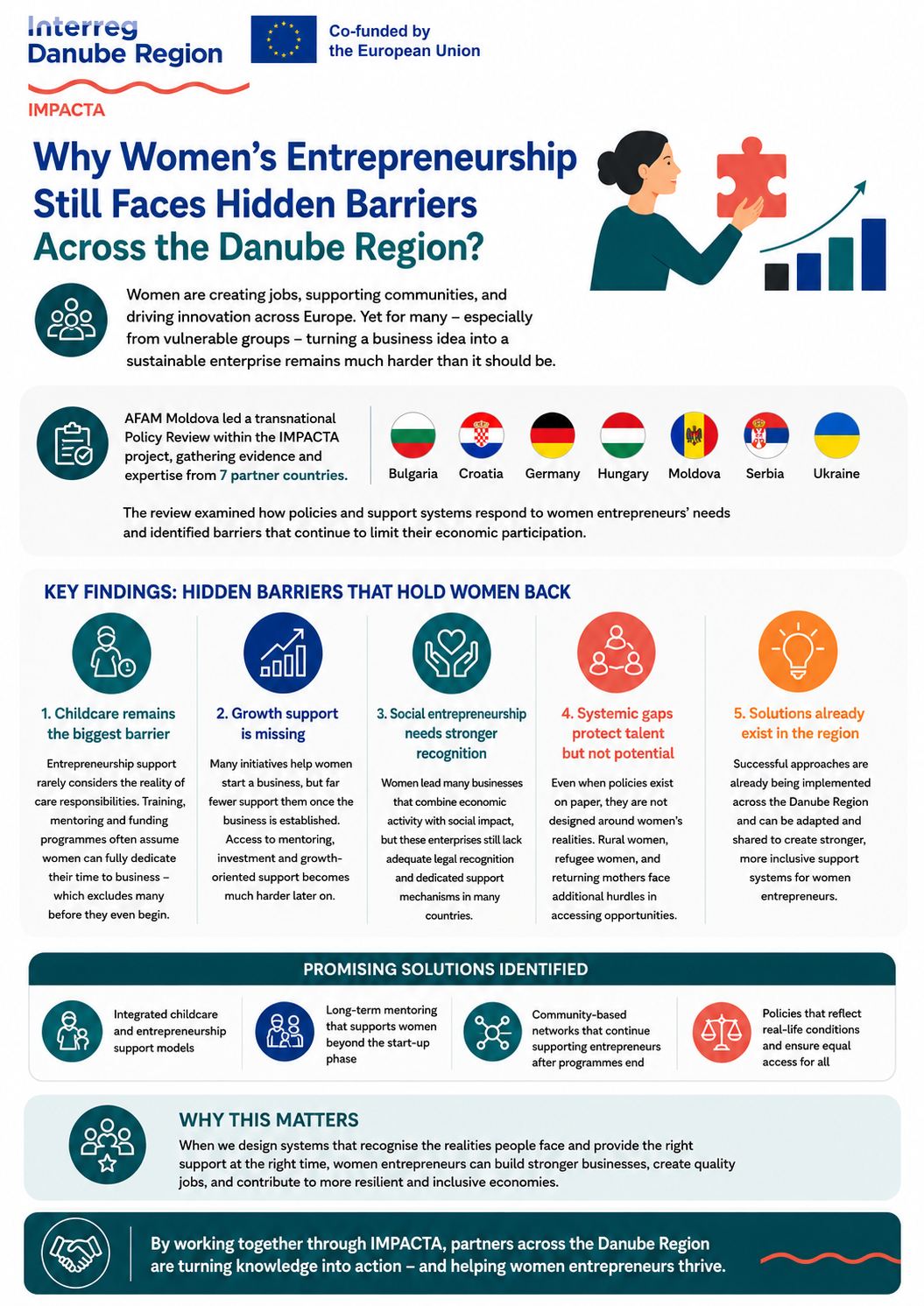
To better understand these challenges, AFAM Moldova led a transnational Policy Review within the IMPACTA project, bringing together evidence and expertise from seven partner countries – Bulgaria, Croatia, Germany, Hungary, Moldova, Serbia, and Ukraine. The review explored how existing policies, support programmes, and regulatory frameworks respond to the needs of women entrepreneurs and identified common barriers that continue to limit their economic participation.
The analysis found that most countries have policies that formally support gender equality and entrepreneurship. However, many support systems are not designed around the realities of women's lives. Women with caregiving responsibilities, women living in rural areas, refugee women, social entrepreneurs, and women returning to the labour market often struggle to access opportunities that are technically available to everyone.
One challenge emerged consistently across all participating countries: childcare. For many women, entrepreneurship must be balanced with caring for children or other family members. Yet childcare is rarely considered part of entrepreneurship support. Training programmes, mentoring activities, and funding schemes often assume that participants can fully dedicate their time to business development. In reality, many talented women are excluded before they even begin.
Another important finding concerns business growth. Many initiatives successfully help women start a business, but far fewer support them once the business is established. Women often receive initial training or small grants, only to find that mentoring, investment opportunities, and growth-oriented support become much harder to access later on. As a result, promising businesses frequently remain small despite having the potential to expand and create jobs.
The review also highlighted the important role of social entrepreneurship. Across the Danube Region, women are often at the forefront of businesses that combine economic activity with social impact. These enterprises help address local challenges, create employment opportunities, and strengthen communities. Yet in many countries they still lack adequate legal recognition and dedicated support mechanisms.
Perhaps the most encouraging finding is that solutions already exist within the region. IMPACTA partners identified successful approaches that can be adapted and transferred across countries, including integrated childcare and entrepreneurship support models, long-term mentoring programmes, and community-based networks that continue supporting entrepreneurs after formal programmes end.
By bringing together evidence from seven countries, the Policy Review provides a stronger understanding of what works, what does not, and what needs to change. The findings will help inform future pilot actions, policy dialogue, and cooperation between stakeholders working to create more inclusive opportunities for women entrepreneurs across the Danube Region.
Supporting women's entrepreneurship is not simply about creating more programmes. It is about designing systems that recognize the realities people face and provide the right support at the right moment. Through IMPACTA, partners are working together to help make that vision a reality.


02/06/2026
By Renáta Anna Jaksa
Share on social media:


Social

News & Events
Read the most recent updates and explore the upcoming events.






Would you like to receive project updates?
You're already part of our community!
Welcome to our newsletter community!
Subscribe to our newsletter