
D3.2.1 Joint guidelines on outreach to and engagement of stakeholders
Building Stronger Connections: IMPACTA’s New Guidelines for Stakeholder Engagement
The IMPACTA partnership has completed a new joint document to support better cooperation with stakeholders across the Danube Region. The Joint Guidelines on Outreach to and Engagement of Stakeholders were developed by the Association of Business Women in Serbia (ABW), in close cooperation with NGO BRIT.
The guidelines provide a practical framework for identifying, approaching and involving organisations and individuals who can contribute to the project. These stakeholders include public authorities, business support organisations, universities, NGOs, women entrepreneurs, SMEs, international organisations and the wider public.
This work is important because IMPACTA does not aim to develop solutions only within the project partnership. The project wants to make sure that its research, training activities, pilot actions and future policy recommendations reflect real needs. Stakeholder engagement helps the partnership understand local challenges, test ideas and improve project activities before they are finalised.
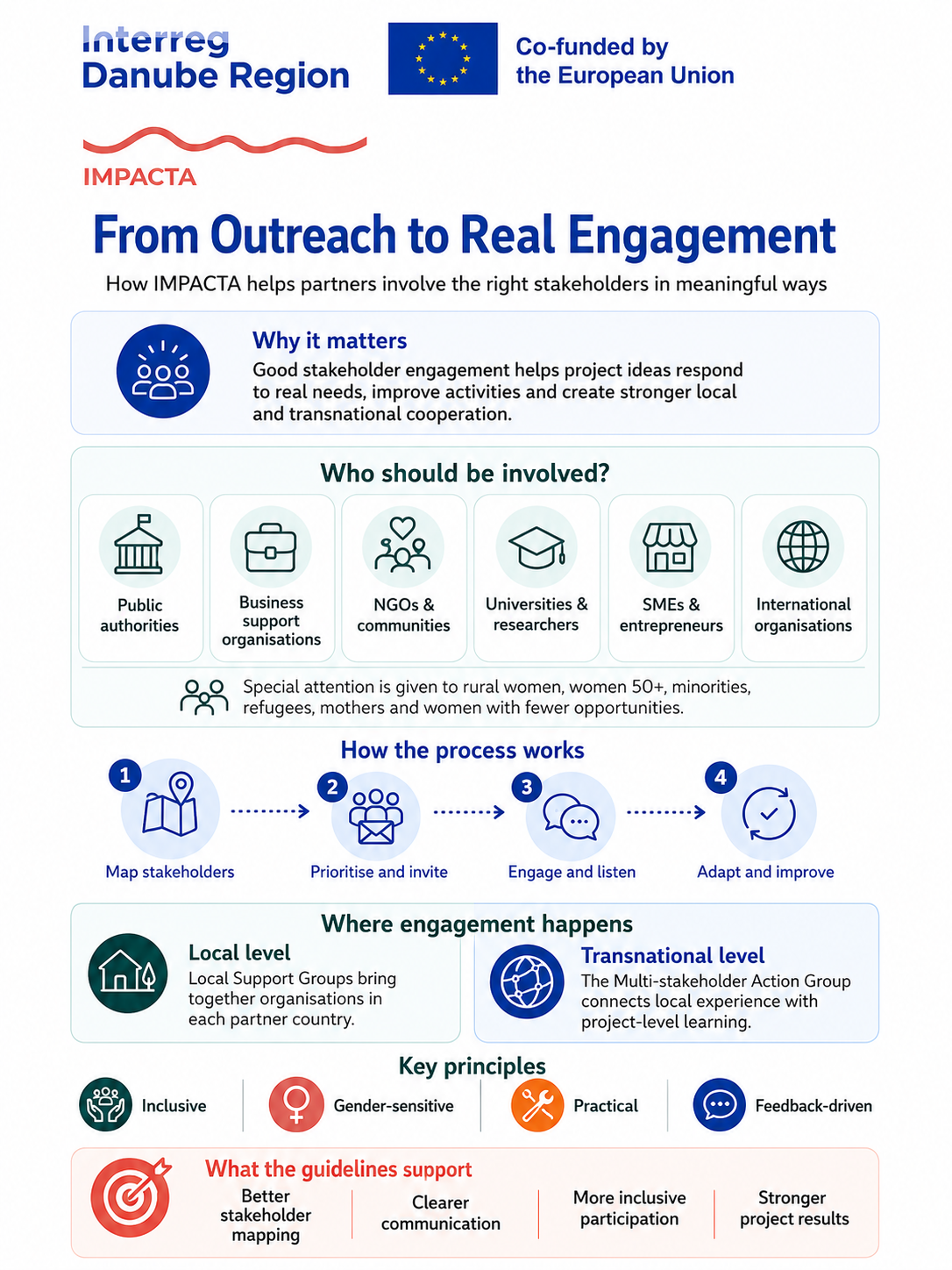
Who should be involved?
The document recommends using the quadruple helix model when mapping stakeholders. This means involving four main groups:
public institutions and policymakers;
businesses and business support organisations;
universities and research organisations;
civil society organisations and communities.
The guidelines also stress the importance of involving people and organisations connected to groups that may face additional barriers. These include rural women, women aged 50+, refugees, minorities, women with lower levels of education and mothers returning to work.
Project partners are encouraged to look not only at the organisations themselves, but also at the people representing them. Their experience, expertise, local knowledge and ability to contribute should all be considered.
From mapping to real cooperation
The guidelines describe stakeholder engagement as a continuous process, not a one-time activity.
The first step is to identify and group stakeholders by their geographical level, professional field and relevance to the project. Partners are then encouraged to assess how much influence each stakeholder has, how willing they are to engage and what kind of contribution they can provide.
The document also introduces a practical value exchange approach. This helps partners consider both sides of the cooperation:
what the stakeholder expects from the project;
what the project expects from the stakeholder;
what benefits the project can offer;
which communication or cooperation format is most suitable.
This can make engagement more focused and more useful for everyone involved.
Different ways to reach people
The guidelines propose several outreach methods.
Direct methods may include personal invitations, consultation interviews and individual briefings for key organisations or decision-makers.
Indirect methods may include newsletters, social media posts, public webinars, online forums and the sharing of research findings with a clear invitation for feedback.
The document also highlights the importance of local communication channels. In rural areas or among disadvantaged groups, local libraries, employment centres, municipal offices and community networks may be more effective than general online communication.
The guidelines recommend making outreach messages clear and practical. People should quickly understand who an activity is for, what it offers, what participation requires and how they can apply.
Local and transnational cooperation
Stakeholder involvement in IMPACTA takes place at two connected levels.
At local level, partners work with Local Support Groups. These groups bring together organisations and professionals from each partner country. They share local knowledge and provide feedback on project activities.
At transnational level, representatives from the Local Support Groups may join the Multi-stakeholder Action Group. This group connects local experience with project-level learning and supports cooperation between countries.
This structure helps ensure that ideas from local communities can influence wider project decisions. It also allows good practices and lessons to travel between countries.
Making participation more inclusive
A strong part of the guidelines focuses on inclusive and gender-sensitive engagement.
Partners are encouraged to use transparent selection criteria and to monitor whether different stakeholder types and target groups are represented. The document also proposes tailored solutions for groups that may otherwise be left out.
Examples include:
mobile or local training for rural women;
flexible and trauma-sensitive formats for refugees;
community mediators for Roma and minority groups;
childcare support or children’s corners for mothers;
simple application processes with fewer administrative barriers.
These practical measures can make participation more realistic and accessible.
Listening and adapting
The guidelines also underline that feedback must lead to action.
Stakeholder comments should be collected during workshops, consultations and meetings. The partnership should then use this feedback to improve training materials, pilot activities, communication methods and policy recommendations.
Partners are also encouraged to explain how stakeholder input has influenced decisions. This helps build trust and shows that participation has a real purpose.
By introducing a common approach to outreach and engagement, IMPACTA is strengthening its links with the organisations and communities that matter most. The new guidelines will support more inclusive cooperation, better-informed project activities and wider use of project results across the Danube Region.


16/07/2026
By Renáta Anna Jaksa
Share on social media:


Social

News & Events
Read the most recent updates and explore the upcoming events.



Would you like to receive project updates?
You're already part of our community!
Welcome to our newsletter community!
Subscribe to our newsletter