
A jointly developed technological pilot solution tested in parallel in operating energy communities
The NRGCOM project has published Output 3.2 – A jointly developed technological pilot solution tested in parallel in operating energy communities. Over the past two years the partnership built a shared readiness assessment method, applied it in eight real communities in Austria, the Czech Republic, Slovakia and Slovenia, and turned the result into a free online tool that any municipality or community initiative can now use.
One yardstick for very different communities
Energy communities across the Danube Region start from radically different positions — from mature systems that already settle shared electricity on the national market to village initiatives with strong local support but no metering infrastructure. Comparing them has been close to impossible, which makes it hard to know where public support would do the most good.
NRGCOM's answer was a standardised Methodology for Verifying the Readiness of the Territory. It scores a community across three interlinked dimensions — technical (renewable generation, consumption profile, quarter-hourly metering, energy management systems), economic (investment and operating costs, member savings, sharing fee, rate stability) and institutional and legal (legal form, municipal involvement, management capacity, legislative barriers). Twelve criteria are scored from 0 to 5, giving a maximum of 60 points and a classification into low, medium or high readiness.
What the pilots found
| Country | Energy community | Score | Readiness |
|---|---|---|---|
| Slovakia | EC Energetický Holding — Prešov region | 53 / 60 | High |
| Slovakia | EC SOM_EKO — Petržalka, Bratislava | 51 / 60 | High |
| Slovenia | Municipality of Velenje (with the Luče precedent) | 49 / 60 | High |
| Austria | EEG Neudörfl — Burgenland | 48 / 60 | High |
| Czech Republic | ENERKOM Růže — South Bohemia | 48 / 60 | Medium to high |
| Slovakia | EC TEEK — Petržalka, Bratislava | 45 / 60 | Medium |
| Slovakia | EC ES Ivanka — Bratislava region | 41 / 60 | Medium |
| Czech Republic | Enerkom Šumavsko — South Bohemia | 25 / 60 | Low |
Readiness scores of the pilot communities, Deliverable D.3.4.1 (Efficiency report of the targeted energy communities), April 2026. Maximum 60 points.
The numbers tell a consistent story. Technology is rarely the obstacle for well-prepared communities; the legal and economic framework is. Almost every community scored weakest on rate stability and price predictability, because shifting grid tariffs and support charges make long-term economic modelling genuinely uncertain for community managers.
Slovakia: what a mature community actually looks like
EC Energetický Holding in the Prešov region is among the first fully functioning community-energy projects in Slovakia. Six founding members cover twenty consumption points — a municipal office, four schools, a shopping centre, ten SMEs and four apartment buildings with 148 flats — supplied from four renewable sources, including two ground-mounted PV plants, a rooftop installation on a municipal school and a biomass-fired plant. The figures behind its score:
8,890 MWh — combined annual output of the community's renewable sources
73 % — share of local consumption covered from the community's own renewables
€180,000 — estimated annual savings across the community, roughly €269 per member per year
20 of 20 — consumption points with full quarter-hourly metering
Its counterpoint, EC ES Ivanka, was registered only in February 2026. Its metering is equally good and its rate stability scored a perfect 5/5 thanks to fixed internal tariffs — yet it lands nine points lower, because its civic-association legal form does not match what the Slovak Energy Act expects, and a transmission-operator certification backlog of more than a year keeps it in a verification mode instead of full production. A near-identical technical set-up, a very different score: the gap is purely institutional.
Czech Republic: two neighbouring communities, 23 points apart
The South Bohemian pilots show what targeted investment is worth. Enerkom Šumavsko has strong institutional backing from local action groups, but without continuous quarter-hourly metering (2/5) and without an energy management system (2/5) dynamic energy sharing simply cannot be deployed — "enthusiasm without infrastructure", as the report puts it, with price predictability scoring zero.
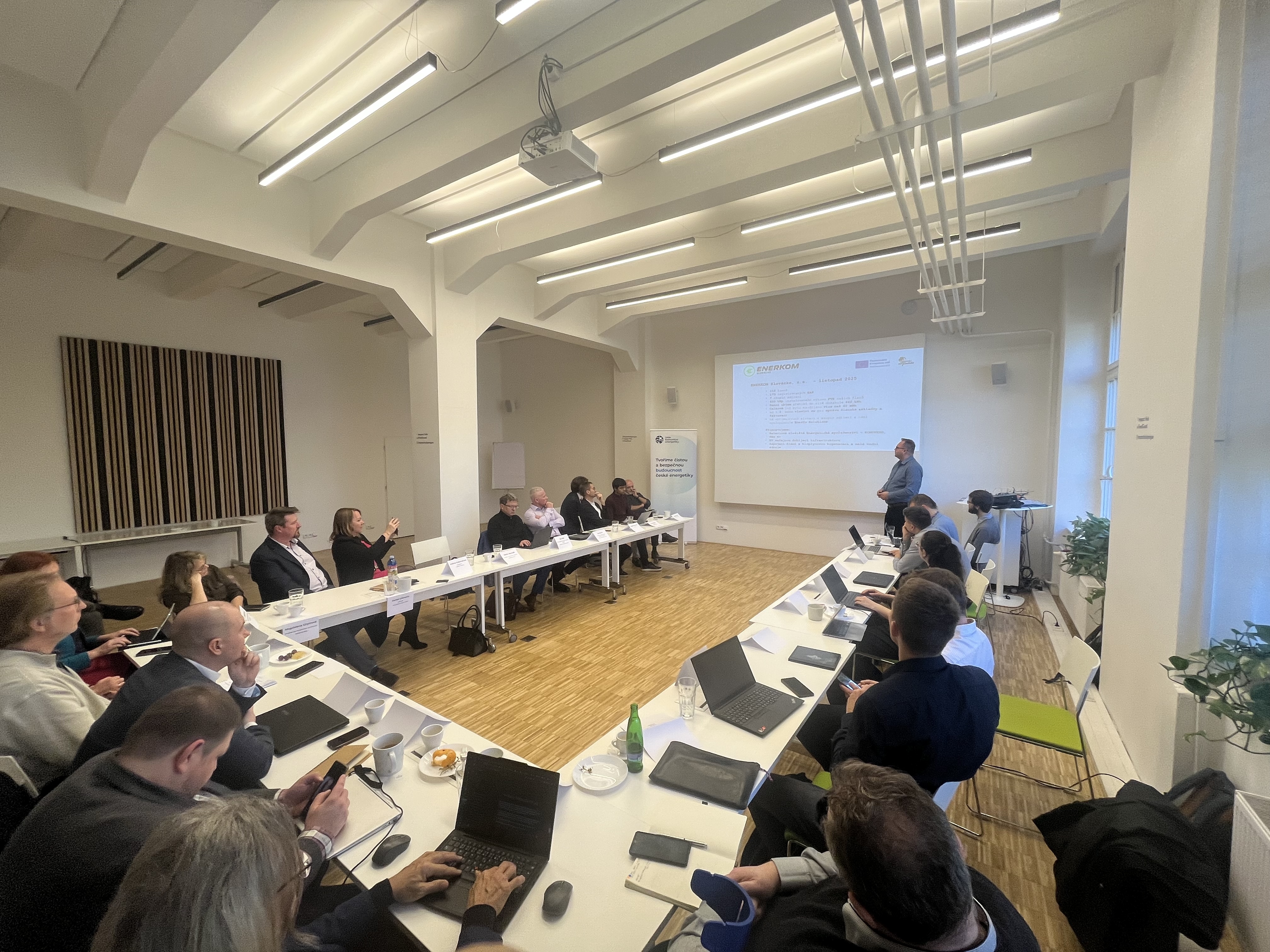
ENERKOM Růže, in the same rural setting, reaches 48 points. The project's study visit to Svatý Jan nad Malší documented why: a centralised biomass heating system consuming roughly 900 spatial metres of wood chips a year, 74 kWp of photovoltaics, and tracking software that lets the municipality actually manage what it produces. The Czech pair is the clearest evidence in the whole dataset that rural location is not a ceiling — missing metering and management tools are.
Austria and Slovenia: the refinement stage
EEG Neudörfl grew out of a research-driven Smart City project into a mature local energy system, scoring 5/5 on generation balance and renewable share; its open questions are structural — scaling participation and navigating the evolution of Austrian grid tariffs. Velenje formally launched its public-building energy community on 1 January 2026 with perfect marks on metering, generation balance, estimated savings, operating costs and sharing-fee design. Both build on the example of Luče, Slovenia's first self-sufficient energy community, where summer surpluses from school rooftops are redirected to high-demand infrastructure such as water treatment plants. For communities at this level the assessment works as a refinement instrument — optimising midday and weekend solar surpluses rather than diagnosing basic gaps.
Try the readiness assessment yourself
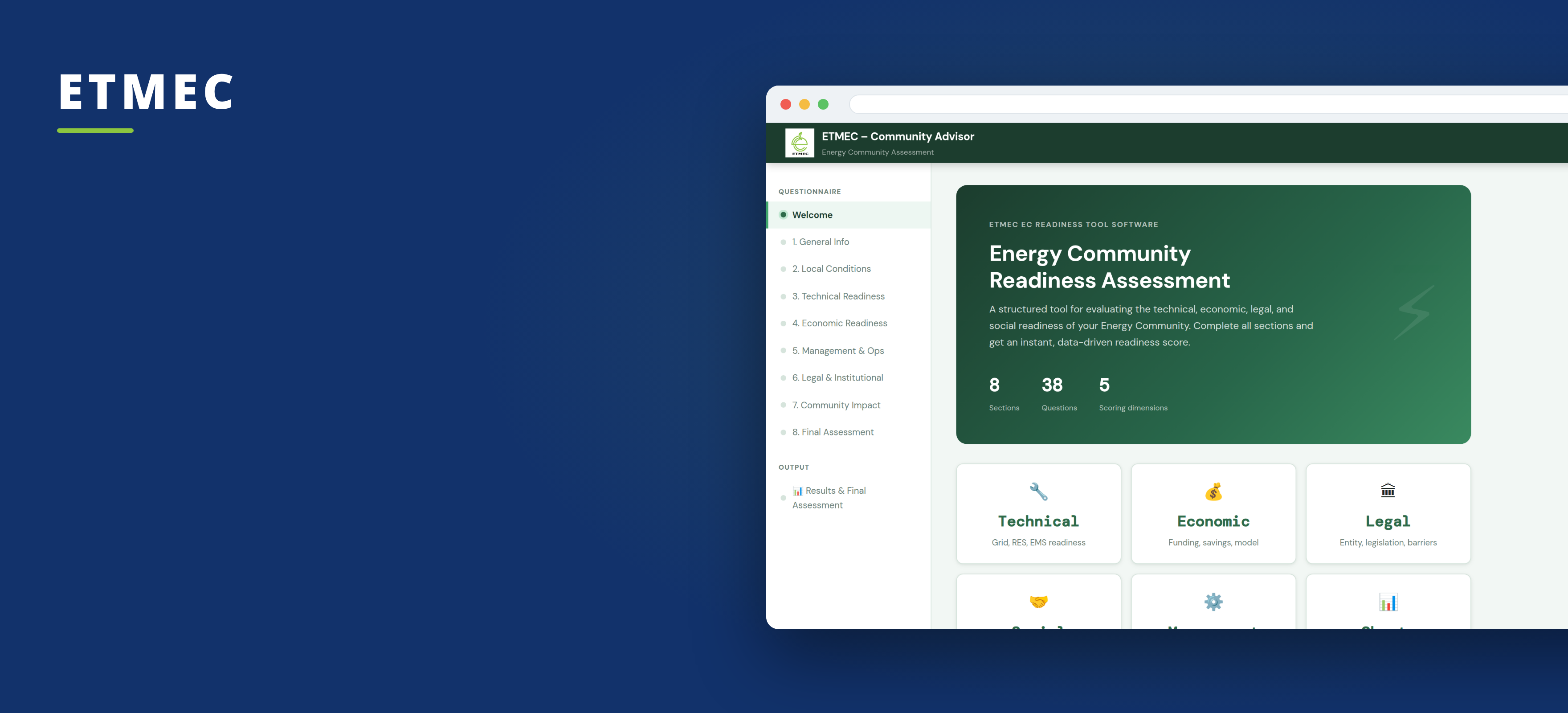
The methodology and the feedback from all eight pilots were consolidated into the ETMEC Community Advisor, developed by project partner NEK (Slovakia). It guides you through 8 sections and 38 questions across 7 readiness dimensions, each weighted by strategic importance, and returns a readiness score with interactive radar, bar and stacked-bar charts — classifying the community as high (≥ 70 %), medium (40–69 %) or low (below 40 %) readiness. Results can be exported as a formatted PDF report or a two-sheet Excel workbook.
The application runs entirely in a web browser. There is no installation, no login and no server; it keeps all data on your own device, and is provided free of charge and open source. Its assessment criteria are aligned with EU Directive 2018/2001 (RED II) and Directive 2019/944 on the internal electricity market, and it is designed for all 14 Danube Region countries.
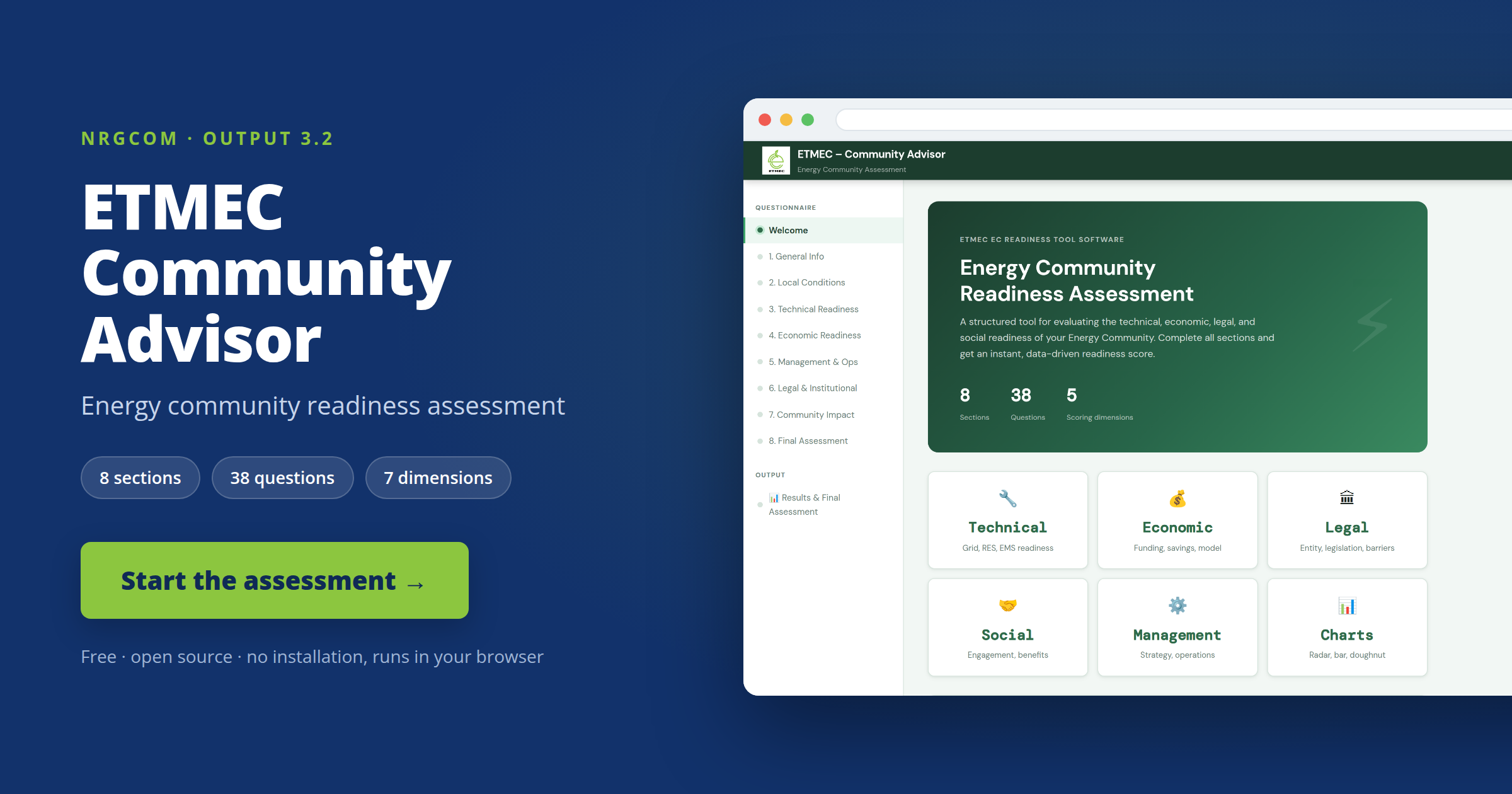
→ Open the ETMEC Community Advisor and assess your community
From pilot data to policy
The pilots did more than produce scores. They identified a recurring set of barriers and the measures that would remove them, and these feed directly into NRGCOM's final White Paper (Output 3.3):
Mandate and subsidise smart metering. High operational readiness is not possible without quarter-hourly data. Targeted national subsidies for meters and basic energy management systems in rural and emerging communities are a feasible, high-leverage early move.
Reform grid-allocation policies. Strict "first come, first served" capacity rules let a single applicant exhaust a municipality's capacity. Guaranteed reserved-power thresholds for active community customers would open participation to the rest.
Enhance financial predictability. Clear, long-term guarantees on distribution fees and renewable-support charges for community-shared electricity would address the one weakness shared by almost every community assessed.
Standardise legal and governance templates. GDPR-compliant model member agreements — defining investor returns, supplier-switching rights and dispute resolution — would cut the administrative complexity that holds back new communities.
Output 3.2 delivers Programme Output Indicator 2.1.3 (Pilot actions developed jointly and implemented in projects) and contributes to Specific Objective SO3 and to Priority Area 2 of the EU Strategy for the Danube Region. The tool is maintained by project partner NEK beyond the project lifetime, and a more advanced version with system-level and energy-sharing data is already in preparation.
Documents
Output 3.2 — A jointly developed technological pilot solution tested in parallel in operating energy communities (summary report, June 2026)
D.3.3.1 — Software solution with installation instructions and user manual
D.3.4.1 — Efficiency report of the targeted energy communities (April 2026)
NRGCOM is co-funded by the European Union through the Interreg Danube Region Programme.

21/09/2026
By NRG COM
Share on social media:



News & Events
Read the most recent updates and explore the upcoming events.


Would you like to receive project updates?
You're already part of our community!
Welcome to our newsletter community!
Subscribe to our newsletter