
Community Energy in the Czech Republic: Rapid Growth, Realistic Barriers, and Lessons from Early Case Studies
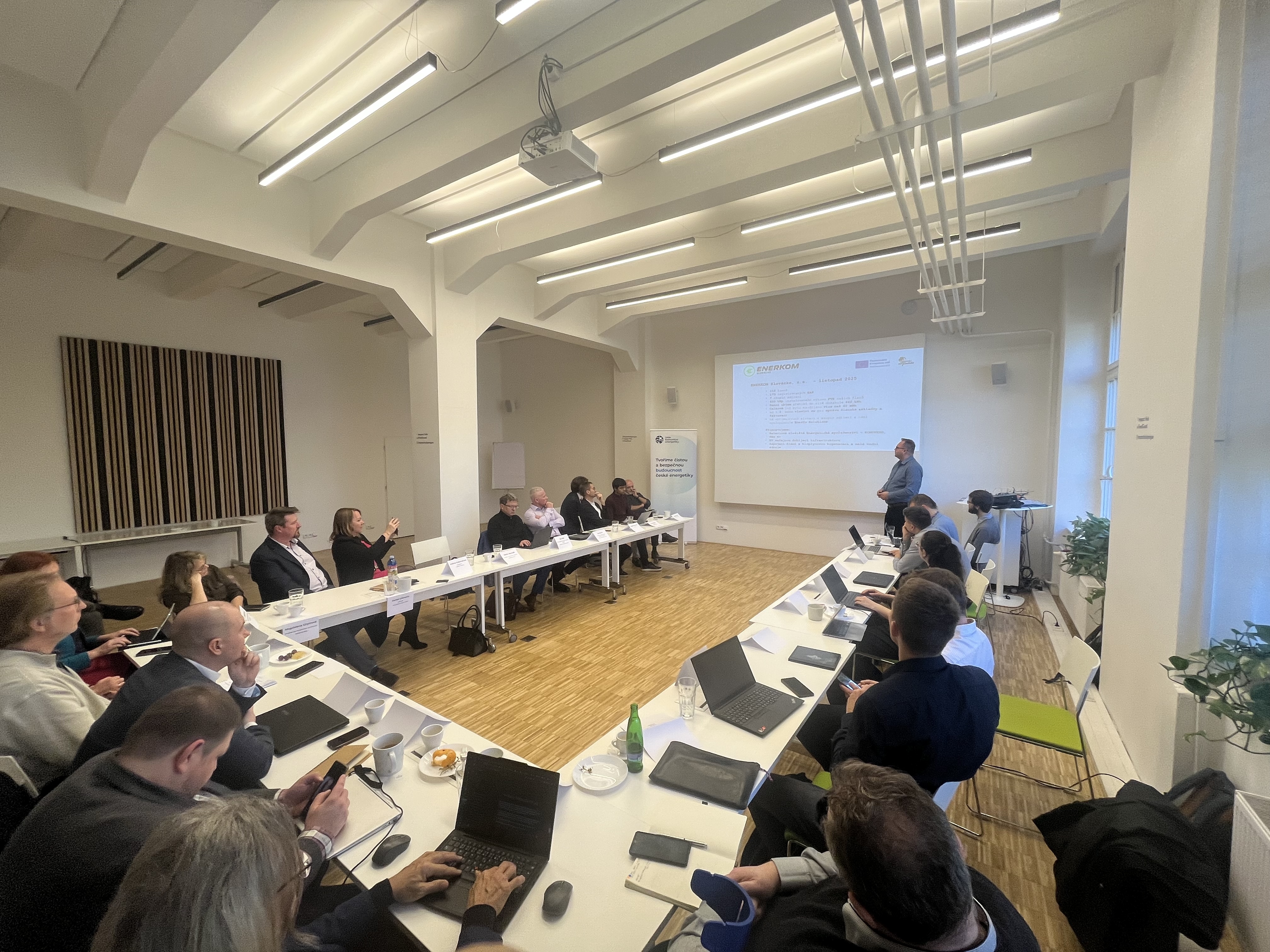
How can energy communities in the Czech Republic move from an early ”start-up phase” towards long-term financial stability? This question shaped the recent roundtable hosted by the Union of Community Energy (UKEN), which gathered community representatives, municipal actors, financial experts and policymakers. The discussion brought not only international inspiration, but also a realistic assessment of economic, regulatory and technical barriers currently slowing down community energy development in the Czech Republic.
The conversation also echoed findings from a recent academic case study on Czech energy communities, which demonstrated that the technical configuration of energy sharing—especially the choice of an allocation key—is a critical determinant of economic performance (Saman & Radil, 2025). These topics are particularly relevant in the context of the NRGCOM project, which aims to support the emergence of robust and sustainable community energy models across the Danube Region.
The event opened with an international example. Norbert Zösch from Stadtwerk Haßfurt showcased a Bavarian community energy model combining solar, wind and biogas sources, battery storage and hydrogen production from surplus electricity. Thanks to this diversified system, the cooperative achieved a threefold production surplus in 2023. According to Zösch, long-term success is rooted in trust and the ability of residents to invest directly into community projects that offer both environmental and financial benefits.
Several Czech examples showed that, while interest in community energy is growing rapidly, communities still face significant obstacles. The Hotař Energy Cooperative presented its plan for a local microgrid connecting public buildings, complemented by a CHP unit and shared e-mobility services. Despite its economic potential, the project is significantly limited by current regulation: Czech law only permits a static allocation key, which cannot flexibly distribute electricity according to real-time demand. This problem mirrors the academic case study, which shows that even the iterative static key often leads to unused electricity surpluses rather than optimal distribution among members (Saman & Radil, 2025, pp. 38–39). The study also highlights that dynamic or hybrid allocation methods, used in several European countries, would enable more efficient and fair energy sharing by allocating electricity to the consumption points with the highest real-time demand (Saman & Radil, 2025, p. 38).
Liberec Energy Community then presented its strategy for new photovoltaic plants and EV charging infrastructure. While the initiative is ambitious, it may not be able to benefit from the new KOMUNERG funding programme due to the requirement that 60% of daily electricity consumption must be shared—an ambitious threshold that some projects cannot meet for technical reasons.
Another example, ENERKOM Slovácko, illustrated gradual infrastructure development. With over 110 members and more than 600 kWp installed, the community is preparing a shared battery storage system connected to a new charging station built in cooperation with the distribution company E.ON. The community intends to finance the system through the KOMUNERG and RES 4+ programmes and plans to integrate biogas and small hydro members in the future, showing how Czech communities can diversify production portfolios.
Financial aspects were a dominant theme as well. The State Environmental Fund (SFŽP) presented the design of the KOMUNERG programme, which combines grants with preferential loans to stimulate first community investments. As Ivo Marcin explained, the programme is meant to kick-start initial projects—not to provide comprehensive financing for all community needs. This is consistent with an analysis by Enviros, which found that banks currently perceive energy communities as high-risk due to fluctuating membership, uncertain cashflow models and their non-profit legal form. As a result, commercial loans remain difficult to obtain even for technically viable projects.
Participants agreed that the key challenge is to guide communities from their initial launch phase to a state of economic stability. Many communities face high upfront costs, complex grid-connection procedures and limited possibilities for energy sharing. Early revenues often barely cover operational expenses, making it difficult to build reserves for future investments. Discussion highlighted potential solutions such as long-term PPA contracts, greater involvement of community members in project financing, or regulatory adjustments better reflecting the reduced grid burden associated with local energy sharing.
These conclusions align with the academic case study, which stresses that electricity sharing covers only the commodity component of the electricity price—distribution charges cannot be avoided unless the community operates its own distribution network (Saman & Radil, 2025, p. 40). The study therefore notes that energy sharing is not universally suitable: it works best where consumption and generation profiles match sufficiently and where communities can realistically balance investment costs with expected returns.
In closing, Ondřej Pašek from UKEN highlighted that Czech energy communities bring diverse societal benefits—from producing clean electricity to providing services such as senior mobility or supporting local grid stability. Their current situation is complex, but many barriers can be overcome, whether through targeted investment support, improvements in the Energy Data Centre’s sharing functions, or advancement in the technical foundations of energy communities.
The insights from the case study by Saman & Radil, together with the experience shared at the roundtable, underline a clear message: the success of community energy in the Czech Republic will depend not only on funding and legislation, but also on the ability to implement efficient, fair and technically robust models of energy sharing. This perspective is central to the mission of the NRGCOM project, which seeks to build enabling conditions for community energy across the Danube Region and support communities in moving from promising pilots to long-term sustainable practice.

03/12/2025
By
Share on social media:


Green

News & Events
Read the most recent updates and explore the upcoming events.


Would you like to receive project updates?
You're already part of our community!
Welcome to our newsletter community!
Subscribe to our newsletter