

The Results of the Plan-C project support the Circular Transition of the Plastics and Mechanical Engineering Industries in the Danube Region
The plastics and mechanical engineering industries play a key role in European industrial value chains, while also facing significant sustainability and resource-efficiency challenges. The Plan-C project was launched to address these challenges, with the aim of moving plastics and machine industry towards circularity in the Danube Region.
From January 2024 to June 2026 the project was implemented within the framework of the Interreg Danube Region Programme and brought together 14 partner organisations from 9 countries, including industrial clusters, research institutes and business support organisations, which explored how plastics manufacturing processes and the related mechanical engineering solutions can be rethought to better align with the principles of the circular economy.
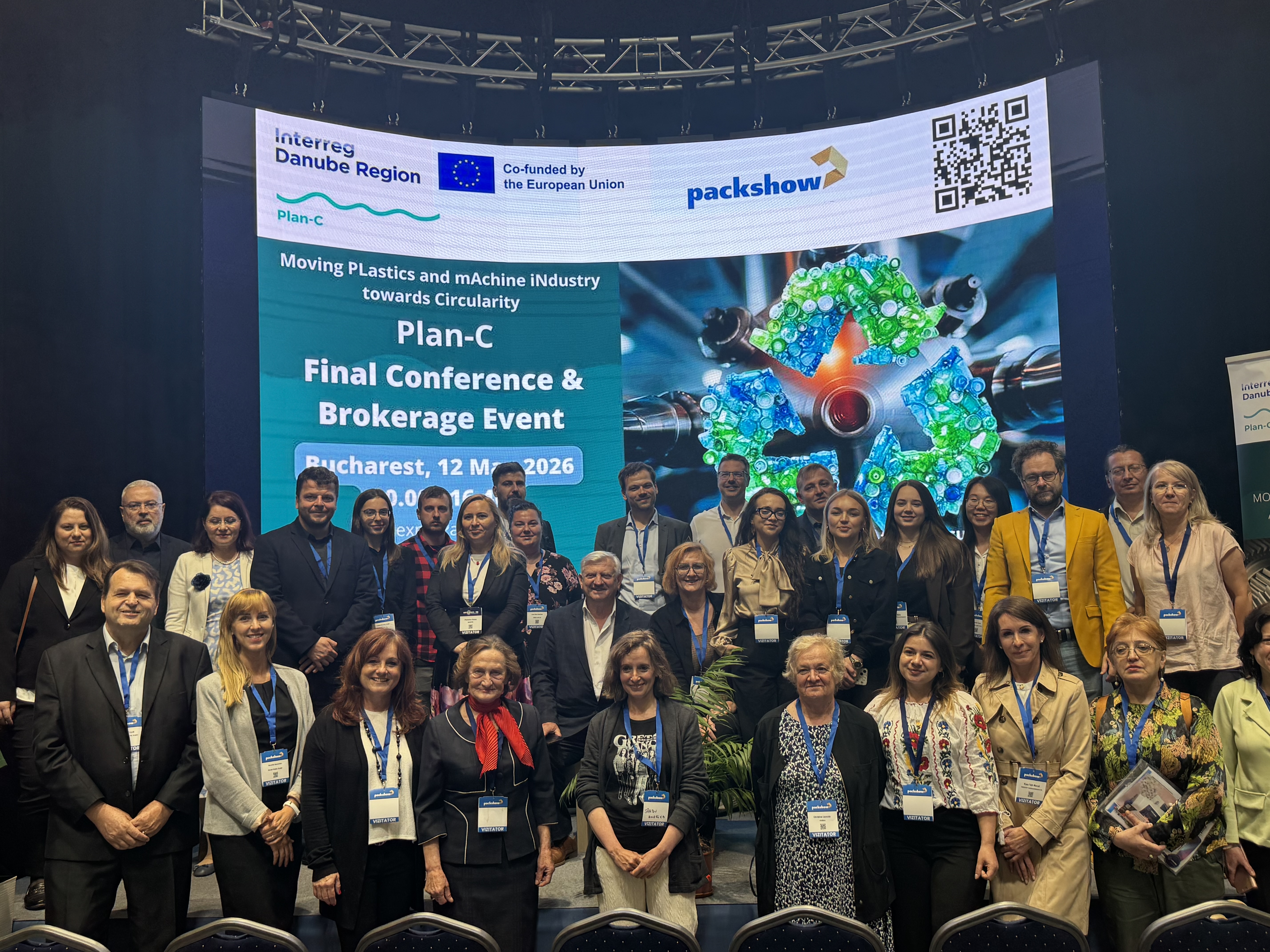
In total more than 450 representatives from plastics and machine industries contributed to Plan-C by providing best practice cases, giving interviews, sharing challenges and needs and participating to 30 design thinking workshops. Thus, Plan-C guidelines, handbooks, transnational strategies and the transnational action plan were co-created and are intended to support companies, business support organisations, policymakers, sectoral agencies, research institutions towards circular transformation, as well as to strengthen social awareness and education for circularity.
Transnational Cooperation for a Sustainable Industrial Transition
Partners from Baden-Württemberg to the Moldovan Danube Delta, mapped and analysed the maturity level of circularity in the plastics industry and the current situation in the machine industry with special focus on how the entire life cycle of machines can be rethought from a circular perspective. During the joint work industry specific-challenges and opportunities were identified and Design Thinking methodology applied in pilot workshops to co-create practical solutions with the involvement of companies and stakeholders.
Knowledge sharing and transnational exchange of experiences played a key role throughout the project. Transnational peer capacity building aimed at sharing know-how and lessons-learnt between regions of different development levels.
Practical Guidelines, Handbooks and Strategies for Plastics and Machine Industry
A guideline for the plastics industry on how to develop a circular plastics prototype, compiled cases and practical information to support the transfer of technological know-how, was developed. For the machine industry a guideline for circularity including factsheets of circular machine life cycle phases were prepared and business models for circularity in the machine industries.
Further two handbooks one for a circular plastics industry and another for a circular machine industry were elaborated, providing practical support for companies, business support organisation as well as strategic stakeholders in introducing a circular approach. Both handbooks address the identified challenges and opportunities, the co-creation approach with design thinking methodologies. In each one are included the thematic specific parts as the prototype concept and cases for the plastics industry, and the solution for circular machine life cycles and the related business models for the machine industry.
The separate work on plastics and machine industry in the project was closed with one transnational strategy for each industry.
Circularity across the entire Plastics Value Chain
The later project activities addressed the entire plastics value chain and how collaboration between plastics processors and machine manufacturers can boost their circularity. A set of macro-regional workshops with companies and strategic stakeholders along the plastics value chain developed joint strategic steps towards circularity which served as a main input the final action plan.
The “Transnational Action Plan for integrating Circularity in the entire Plastics Value Chain”
is the most important output of the Plan-C project. This action plan sets out recommended concrete measures and actions supporting the development of sustainable and circular products, as well as circular business cooperation between actors of the plastics value chain — especially plastics processing companies and machine manufacturers.
The Results are ready for Uptake
Plan-C project activities strengthened transregional cooperation of stakeholders in the plastics and machine industries across the Danube Region to jointly develop solutions and take concrete steps towards a more sustainable and circular plastics and machine industry.
The results of the Plan-C project therefore not only mark the completion of a European cooperation project, but also lay the foundation for further joint work, practical application and the wider uptake of circular industrial solutions.
Professional publications give you an overview. For diving deeper use the outputs and deliverables – all are available at the Plan-C project website for downloads as well.

03/07/2026
By Edina Tóth
Share on social media:



News & Events
Read the most recent updates and explore the upcoming events.


Would you like to receive project updates?
You're already part of our community!
Welcome to our newsletter community!
Subscribe to our newsletter