
SAFETY4TMF Final Conference: Danube region partners present a shared toolbox for safer tailings facilities
Budapest, 29 September 2026 – After 30 months of joint work, the 17 partners of the Interreg Danube Region project SAFETY4TMF presented their final results at the project's closing conference in Budapest on 28–29 September 2026, hosted by the Hungarian Lead Partner. All participants – ministries, environmental and mining authorities, water directorates, civil protection and fire services, tailings facility operators, universities and municipalities – discussed one question: how to keep the project's inventory, risk maps, safety checklist, training and pilot monitoring alive after the project ends.
Why tailings safety is a Danube issue
Tailings management facilities (TMFs) store millions of tonnes of residues from mining and ore processing, often upstream of towns and shared rivers. The project's updated inventory now covers 272 facilities in seven countries. For 224 of them, terrain-based flow paths show that a failure would not stop at the national border; eight facilities are classified as critical and 24 as high risk under the project's transboundary index. A failure in one country is a water-quality, infrastructure and civil-protection problem for its neighbours.
What the project delivered
• Updated TMF inventory and Tailings Hazard Index – 272 facilities with refined boundaries and characteristics; the index now combines capacity, toxicity, management status, seismic exposure and flood exposure.
• GIS-based transboundary risk mapping – flow paths and impact corridors identify the buildings, infrastructure and watercourses a release would reach.
• Harmonised safety assessment checklist – 267 questions in 12 safety categories, supporting visual inspections, document review, automated evaluation and corrective actions. Usable by any authority or operator in the region.
• Policy and governance recommendations – built on 16 stakeholder roundtables with 504 participations; they address abandoned facilities, fragmented inventories, emergency planning, public participation, financial guarantees and cross-border cooperation.
• Capacity building – 62 training sessions in eight countries with 1,338 participant entries at strategic, tactical and operational level, plus three e-learning pathways for preparation, induction and refresher training.
• Operational procedures – five partner procedures in four countries developed, updated or validated; lessons from exercises improved communication, command coordination, scene assessment and debriefing.
• Pilot actions at seven sites in Hungary, Romania, Slovakia and Slovenia – hydraulic modelling, low-cost GNSS stations, automated piezometers, rainfall monitoring and drone-based LiDAR surveys to detect ground movement and groundwater change before they become a disaster.
• Cross-border emergency exercises in Vlăhița, Szolnok and Algyő – the Vlăhița exercise alone brought together more than 100 responders from 17 institutions in six countries.
Voices from the conference
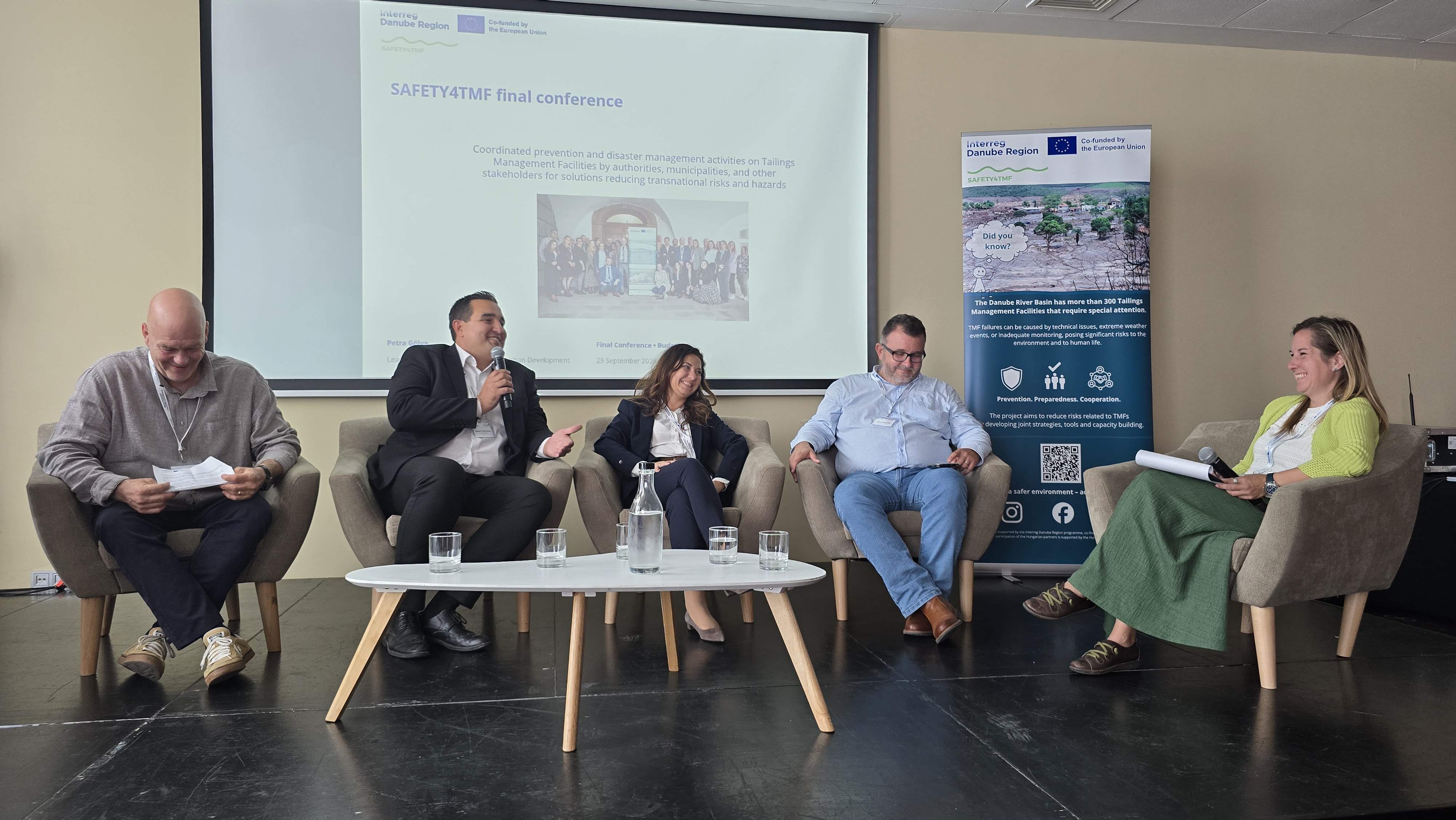
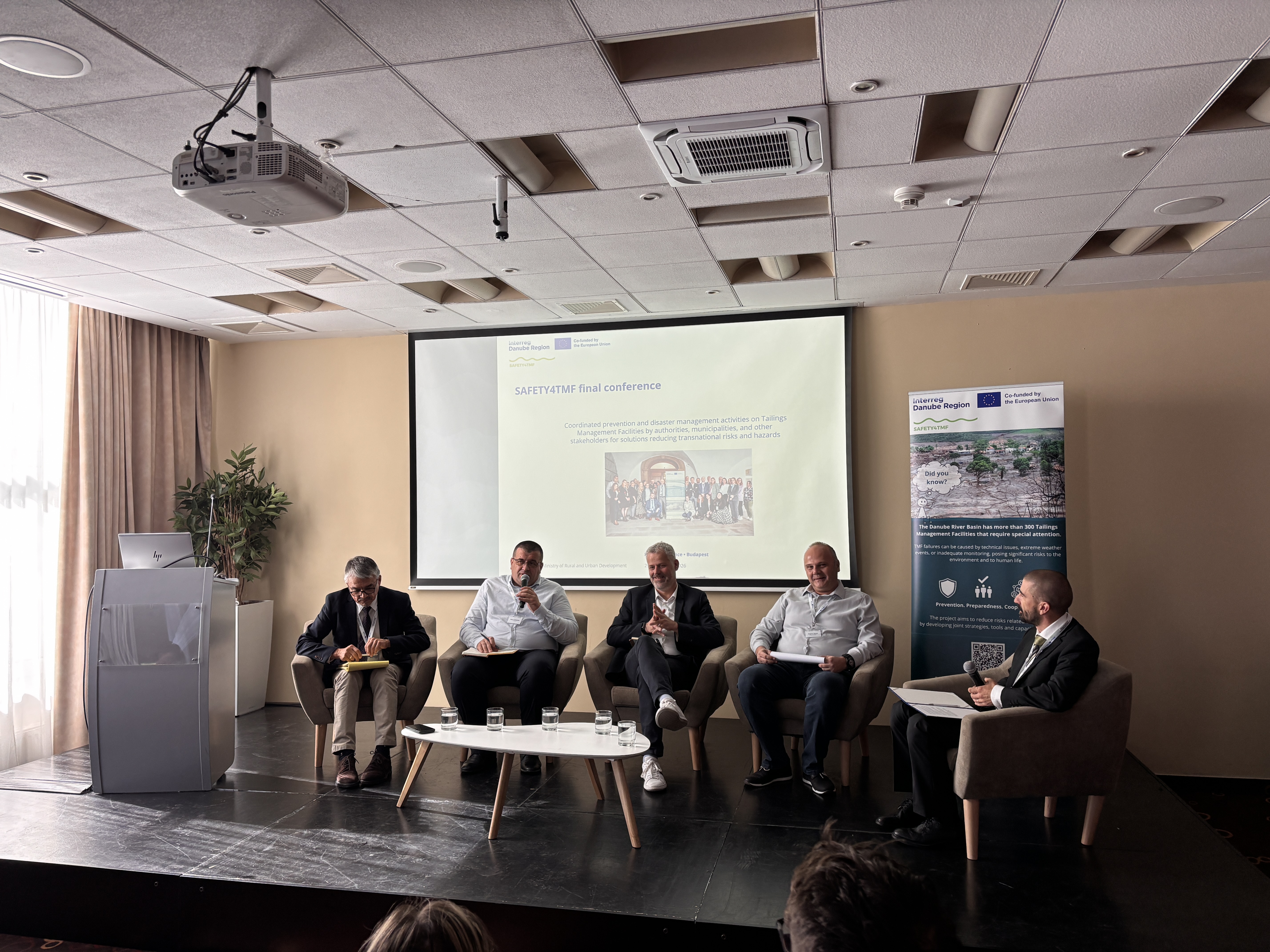
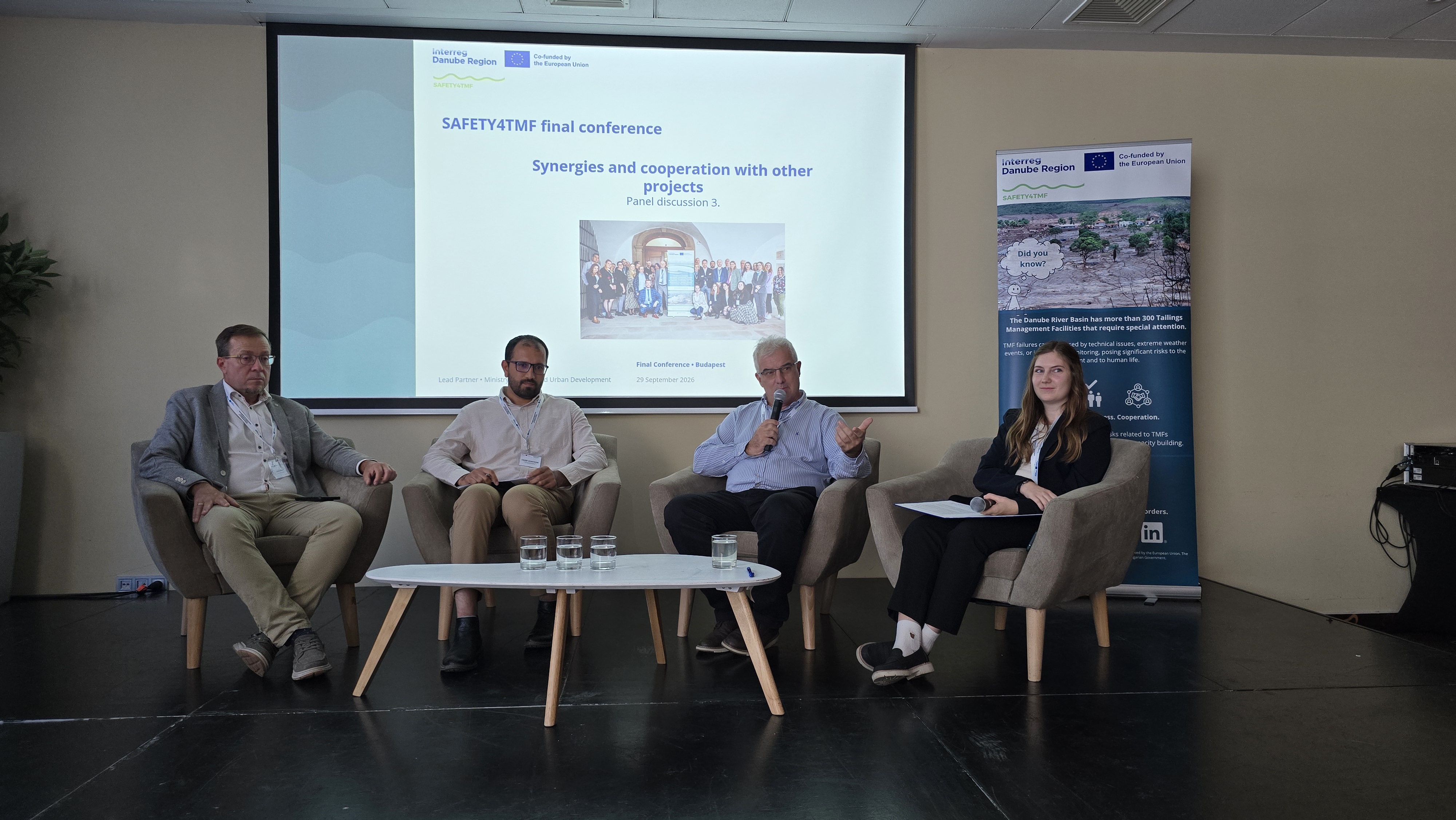
Representatives of the ICPDR and the EU Strategy for the Danube Region underlined that reliable inventories, early warning and closer links between research, policy and operational authorities are the conditions for preventing the next Baia Mare or Kolontár. In the closing circle, partners were asked which results should outlive the project and which forms of cooperation to keep. Three answers came up again and again: education – bringing TMF safety into university curricula, training for mayors and awareness work with the young generation; peer-to-peer learning – the pilot sites, the roundtables and the exercises that built institutional trust across borders; and municipalities – keeping local governments, through partners such as the Union of Towns and Municipalities of the Czech Republic, in the loop between operators, authorities and responders.
What happens after the project
The partners agreed that the results only matter if they are used. Priorities for the coming years: keep the TMF inventory updated and the data accessible to authorities and researchers; take up the safety checklist and the risk index in national inspection and planning practice; continue regular monitoring at the pilot sites and extend it where risk is highest; repeat trainings and joint cross-border exercises; maintain the professional network built through the roundtables and the project partnership.
All outputs – inventory, risk maps, checklist, policy recommendations, training materials and exercise reports – are available in the Results and Library sections of this website. The project SAFETY4TMF (DRP0200484) is co-funded by the European Union through the Interreg Danube Region Programme.

16/11/2026
By OSU Team
Share on social media:


News & Events
Read the most recent updates and explore the upcoming events.


Would you like to receive project updates?
You're already part of our community!
Welcome to our newsletter community!
Subscribe to our newsletter