


Liquid Air Energy Storage: Cryogenic Power for a Renewable Grid
Liquid Air Energy Storage (LAES) turns surplus electricity into cryogenic liquid air, stores it in insulated tanks, and later converts it back into electricity on demand. The result is a large-scale, long-duration storage option that can be deployed without the geographic constraints of pumped hydro or cavern-based storage.
LAES is especially relevant for power systems with growing shares of intermittent renewables. When there is excess generation, LAES can absorb it; when demand peaks or renewable output drops, LAES can discharge for hours. Its sweet spot is not the “fast battery” role, but the grid-balancing role—where longevity, scalability, and siting flexibility matter.
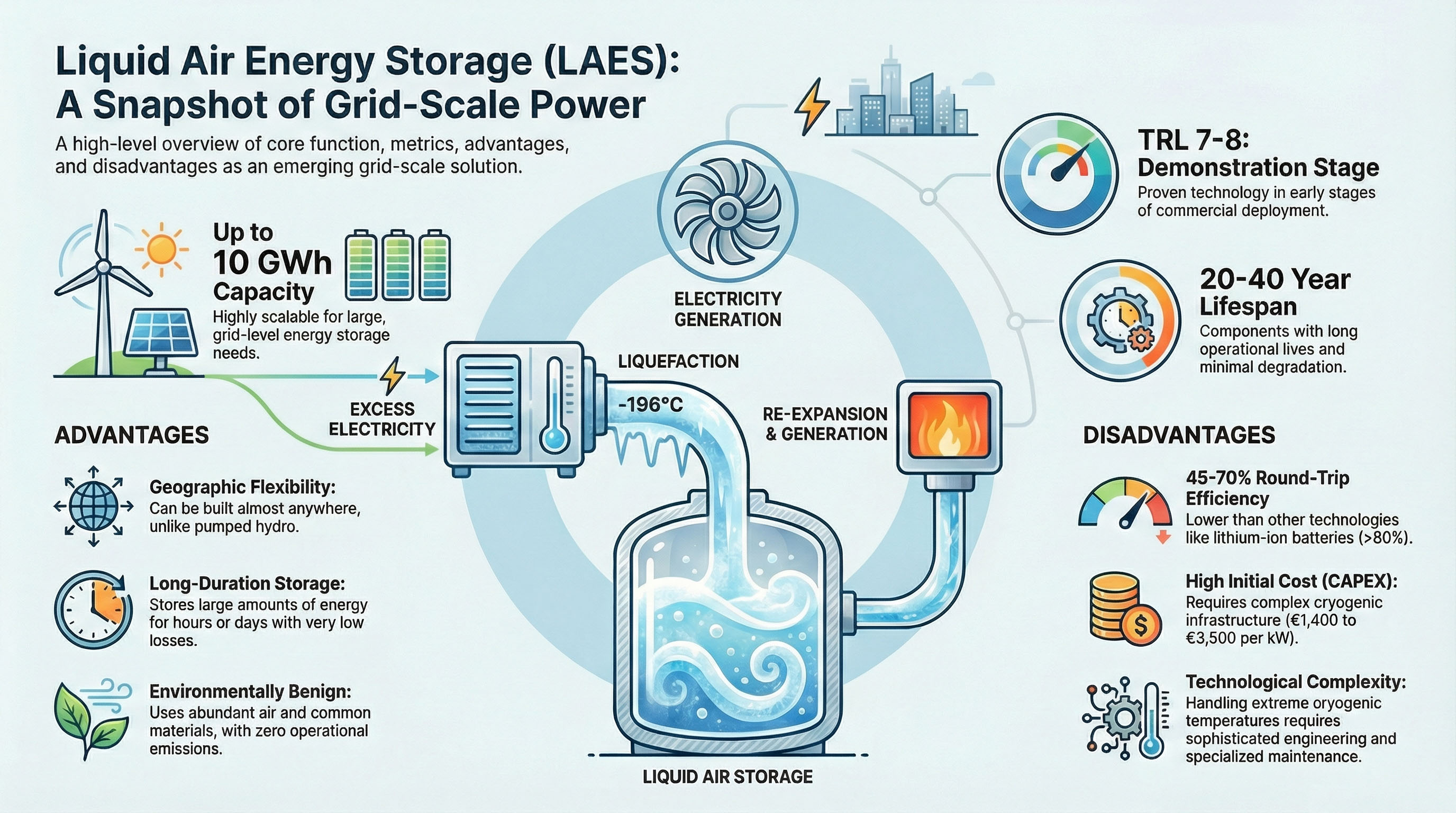
LAES in One Paragraph
A LAES system has three core blocks: (1) a charging unit that compresses and cools air until it liquefies at cryogenic temperatures; (2) an energy store where liquid air is kept at low pressure in insulated tanks; and (3) a discharge unit where liquid air is pumped to high pressure, warmed and vaporised, then expanded through turbines (or piston engines) to generate electricity. A key lever is thermal management—recovering and reusing cold and heat streams can materially improve overall performance.
The Numbers at a Glance (Typical Ranges)
From the StoreMore Outlook analysis, LAES systems are typically described by:
Energy density (volumetric): 60-200 kWh/l.
Power range: 100-1000 MW (project-dependent).
Typical storage duration: 4-12 hours.
Lifetime: 20-40 years; cycling: Several thousand to tens of thousands of cycles.
Discharge time / response: 2-12 minutes (from start to useful output, depending on design).
Round-trip efficiency (RTE): 45-70% (with from 1% to 2% per year reported in some configurations).
Technology maturity: Developing/Demo stage with TRL 7–8.
System size potential: energy capacity Up to 10 GWh; power rating 1–300 MW.
Indicative CAPEX: From 1,400 to 3,500 EUR/kW and From 300 to 800 EUR/kWh.
Indicative OPEX: 1,5% of the capital cost (often expressed as a share of capital cost).
A practical takeaway: LAES is designed for “big and steady” applications—multi-hour storage at utility or large industrial scale—where long lifetime and siting flexibility can outweigh lower efficiency compared to the best-performing batteries.
Why LAES Is Interesting for the Danube Region
LAES has a few characteristics that stand out in regional planning:
It can be built almost anywhere: LAES does not require mountains, large water bodies, or specific underground geology.
It uses benign and widely available materials (air as the working fluid; standard industrial components).
It scales well: increasing energy capacity is largely a matter of larger tanks and appropriately sized liquefaction and power-recovery units.
It can get a performance boost when integrated with waste heat or waste cold (for example, industrial heat streams or LNG cold recovery).
It supports grid services beyond energy shifting—fast enough for certain ancillary services and operational flexibility when well-designed.
Where LAES Adds the Most Value
LAES is a strong candidate for applications such as:
Grid-scale energy balancing and renewable integration: reduce curtailment by storing excess wind/solar and discharging during shortages.
Peak shaving and load shifting: charge off-peak and discharge during peak demand to reduce system stress and costs.
Ancillary services: provide reserve capacity and operational support where minutes-level response is sufficient.
Hybrid industrial integration: pair with industrial sites that can provide waste heat (to improve discharge) or waste cold (to improve liquefaction).
The Trade-Offs You Must Respect
LAES is promising, but it is not a free lunch. The key barriers are:
Efficiency: standalone round-trip efficiency is typically moderate; reaching the higher end often relies on strong thermal integration.
Capital intensity: cryogenic tanks, heat exchangers, compressors, and turbines are mature components, but the overall plant is still a sizeable industrial investment.
Thermal losses and boil-off management: cryogenic storage requires excellent insulation and careful operational design.
Operational and safety considerations: cold systems require robust procedures; oxygen enrichment and interaction with hydrocarbons must be avoided through proper engineering and controls.
Project pipeline maturity: LAES is developing/demonstration-stage in many markets, so bankability and vendor ecosystems are still forming.
A System-Level View: Heat and Cold Are the Secret Sauce
If you remember one thing about LAES, make it this: performance is largely dictated by how well the system captures and reuses its own heat and cold streams. The liquefaction step rejects heat; the discharge step needs heat to vaporise and expand the cryogen; and cold can be reused to reduce the energy needed for the next charging cycle. Projects that can tap into external waste heat or waste cold often unlock the most attractive performance and economics.

16/02/2026
By Eszter Németh
Share on social media:


Green

News & Events
Read the most recent updates and explore the upcoming events.



Would you like to receive project updates?
You're already part of our community!
Welcome to our newsletter community!
Subscribe to our newsletter