
WE.Circular Beyond the Project: Building on Partnerships and Empowering Women Entrepreneurs in Austria
How Austria is building on WE.Circular results through practical skills development, entrepreneurial confidence-building and cooperation with established business-support organisations.
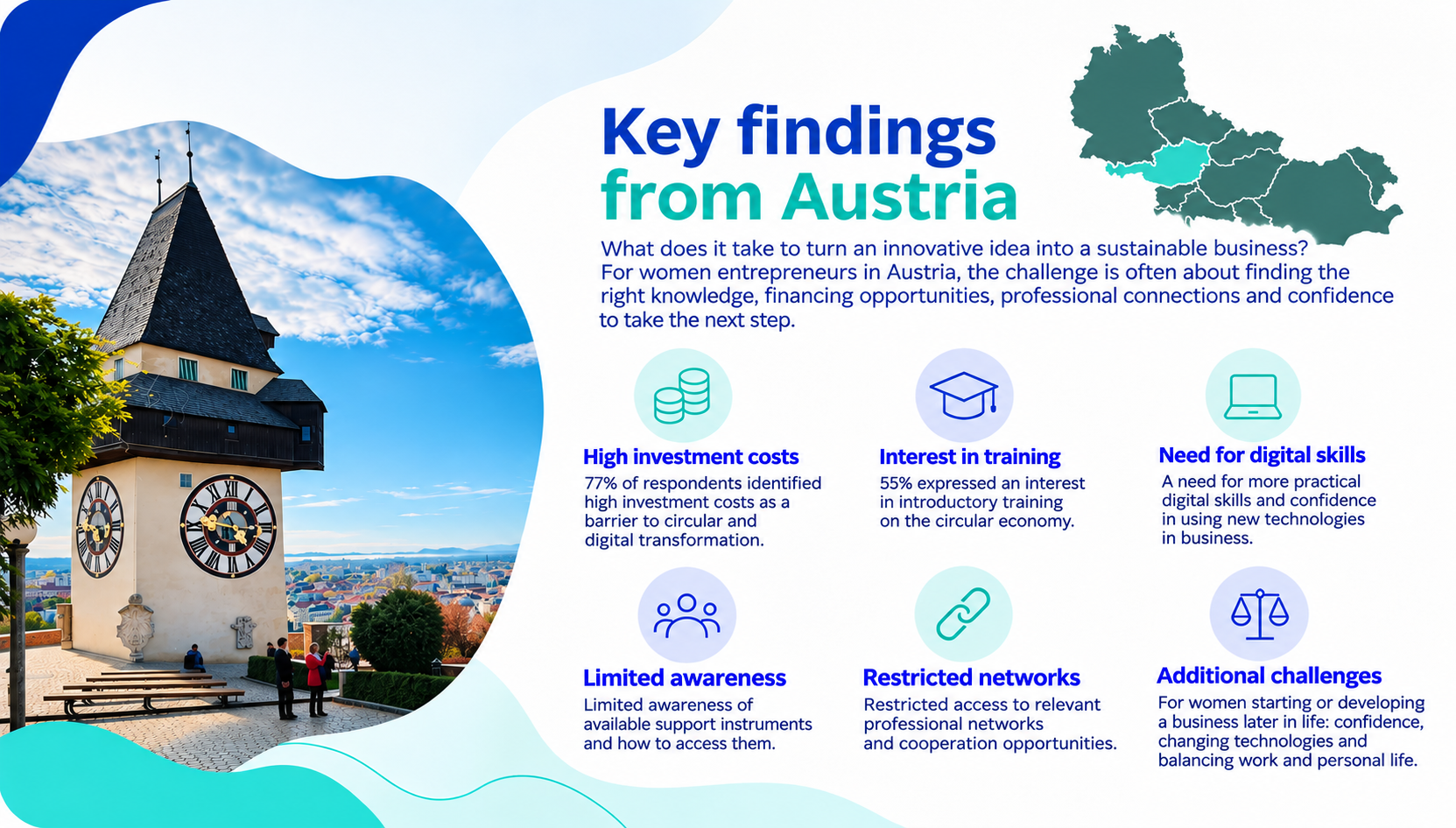
What does it take to turn an innovative idea into a sustainable business? For women entrepreneurs in Austria, the challenge is not necessarily a lack of ambition, creativity or access to a developed entrepreneurial ecosystem. It is often about finding the right knowledge, financing opportunities, professional connections and confidence to take the next step.
This was one of the findings of the research and stakeholder consultations carried out in Austria through WE.Circular.
Austria has a strong entrepreneurial tradition, established business-support structures and ambitious policies for circular economy and digital transformation. Women entrepreneurs are active in many sectors, including education, health and social services, fashion and textiles. Yet they continue to face barriers when introducing innovative technologies, adopting circular business models or expanding their businesses.
The WE.Circular research revealed that 77% of surveyed respondents identified high investment costs as a barrier to circular and digital transformation, while 55% expressed an interest in introductory training on the circular economy. Limited awareness of available support instruments, restricted access to relevant networks and the need for more practical digital skills were also identified as important challenges.
For women starting or developing businesses later in life, these difficulties can be accompanied by additional barriers related to confidence, changing technologies and balancing professional and personal responsibilities.
Despite Austria's comprehensive policy framework, dedicated measures specifically addressing women entrepreneurs in the circular and digital transition remain limited. Existing support opportunities are not always sufficiently connected or tailored to their particular needs.
The question is therefore not simply how to create more programmes, but how existing expertise, organisations and partnerships can work together to make support more accessible and effective for women entrepreneurs.
From project findings to a shared direction
This question is at the heart of the Austrian Regional Action Plan, developed by Innovation Region Styria (IRS) within WE.Circular.
The Plan builds on project research, an analysis of Austria's policy and legislative framework, consultations with national stakeholders and the exchange of good practices across the Danube Region.
Rather than proposing isolated initiatives, it brings together five complementary priorities: access to finance and business support, circular and digital skills development, awareness-raising and visibility, networking and mentoring, and more inclusive policy frameworks.
The Austrian approach recognises that women entrepreneurs need different forms of support at different stages of their business development. Practical digital training, access to financial information, mentoring, professional networks and greater visibility can all contribute to strengthening their businesses.
Particular attention is given to women entrepreneurs aged 40 and above, as well as those working in sectors where circular economy practices and digital technologies offer new opportunities.
The Plan also connects Austria's priorities with the broader Transnational Strategy for Women Entrepreneurs' Circular Transition developed through WE.Circular.
One of its most important principles is to build on existing expertise and support structures rather than creating entirely new mechanisms.
Austria already has a wide range of organisations working in entrepreneurship, innovation, education, financing and sustainability. By encouraging cooperation among these actors and integrating WE.Circular priorities into ongoing activities, the Plan provides a practical framework for extending the project's impact.
An important milestone was reached on 11 September 2026, when Innovation Region Styria formally expressed its commitment to the Regional Action Plan, supporting continued cooperation and the potential implementation of selected measures.
By that time, practical activities addressing several of the Plan's priorities had already started, demonstrating how cooperation with established organisations can help turn strategic objectives into concrete opportunities for women entrepreneurs.
Putting the plan into practice
An important contribution to the implementation of the Austrian Regional Action Plan comes from Business Frauen Center (BFC) Klagenfurt, led by its founder and Managing Director, Daniela Stein. The organisation has extensive experience in supporting women entrepreneurs through advisory services, training, mentoring and networking.
The BFC has expressed its support for the Austrian Regional Action Plan and expressed its willingness to contribute to selected measures within the framework of its technical priorities, organisational possibilities and available resources.
Its involvement is particularly valuable because it connects the priorities identified through WE.Circular with activities and services already offered to women entrepreneurs.
Making digital skills more accessible
One of the first examples is the “Digital überall” (Digital Everywhere) workshop series delivered by Business Frauen Center in June 2026.
The initiative consisted of 4 workshop sessions organised in June 2026 and brought together 11 women entrepreneurs.
The workshops focused on understanding the digital world and artificial intelligence, providing participants with opportunities to strengthen their knowledge of technologies that increasingly influence business development and everyday professional activities.
This initiative contributes to the objectives of Action 2.1 – WE.Circular Training Programme: Modular Capacity Building, under the Austrian Regional Action Plan's measure on building circular and digital skills for women entrepreneurs.
The measure recognises that digital transformation is not only about introducing new technologies. It also requires accessible learning opportunities that help entrepreneurs understand technological developments, recognise their potential and become more confident in using digital tools.
By delivering practical training through an established organisation working directly with women entrepreneurs, Business Frauen Center has demonstrated how existing educational initiatives can support the objectives of WE.Circular.
The four-session training series provides a concrete example of how digital capacity-building can be integrated into broader activities supporting women's entrepreneurship.
Building confidence to embrace change
Knowledge and technical skills are essential for business development, but they are not always sufficient. Confidence, resilience, leadership and a willingness to challenge established ways of thinking can be just as important when entrepreneurs face new opportunities or unfamiliar technologies.
Recognising this, the Austrian Regional Action Plan includes Action 2.3 – Mindset Training: Courage, Leadership and Self-Efficacy.
Business Frauen Center has already taken steps in this direction through the development of its “Mindset Change” initiative, including the establishment of a dedicated focus group and the development of a pool of experts.
An important opportunity to introduce this approach was the closing event of the Startup50+ project on 24 August 2026.
The event included a session exploring how perceptions, attitudes and deeply rooted beliefs can influence people's decisions, confidence and willingness to pursue new opportunities, particularly when starting or developing a business later in life.
The activity engaged 19 women entrepreneurs, with contributions from two female experts, providing an opportunity to reflect on the importance of changing mindsets in entrepreneurship and personal development.
Special recognition goes to Michaela Türk and Rita Turner, who initiated together with Daniela Stein from Business Frauen Center the development of the Mindset Change focus group and its activities.
Their engagement demonstrates how the knowledge and motivation of individual experts can help address challenges that are not always solved through conventional business training alone.
The initiative is particularly relevant to the Austrian Action Plan's focus on women entrepreneurs aged 40 and above, for whom confidence-building, changing perceptions and recognising their own experience as a business asset can be important elements of entrepreneurial development.
Business Frauen Center has also explored the relationship between confidence and technology through its Mindset Change activities, encouraging women to reconsider limiting beliefs about their ability to engage with technical and digital subjects.
These efforts contribute to an important message: supporting women in the circular and digital transition also means helping them recognise their own capabilities and become more confident in exploring new opportunities.
Giving women entrepreneurs greater visibility
Another important priority of the Austrian Regional Action Plan is to improve the visibility of women entrepreneurs and showcase their contribution to innovation and the circular economy.
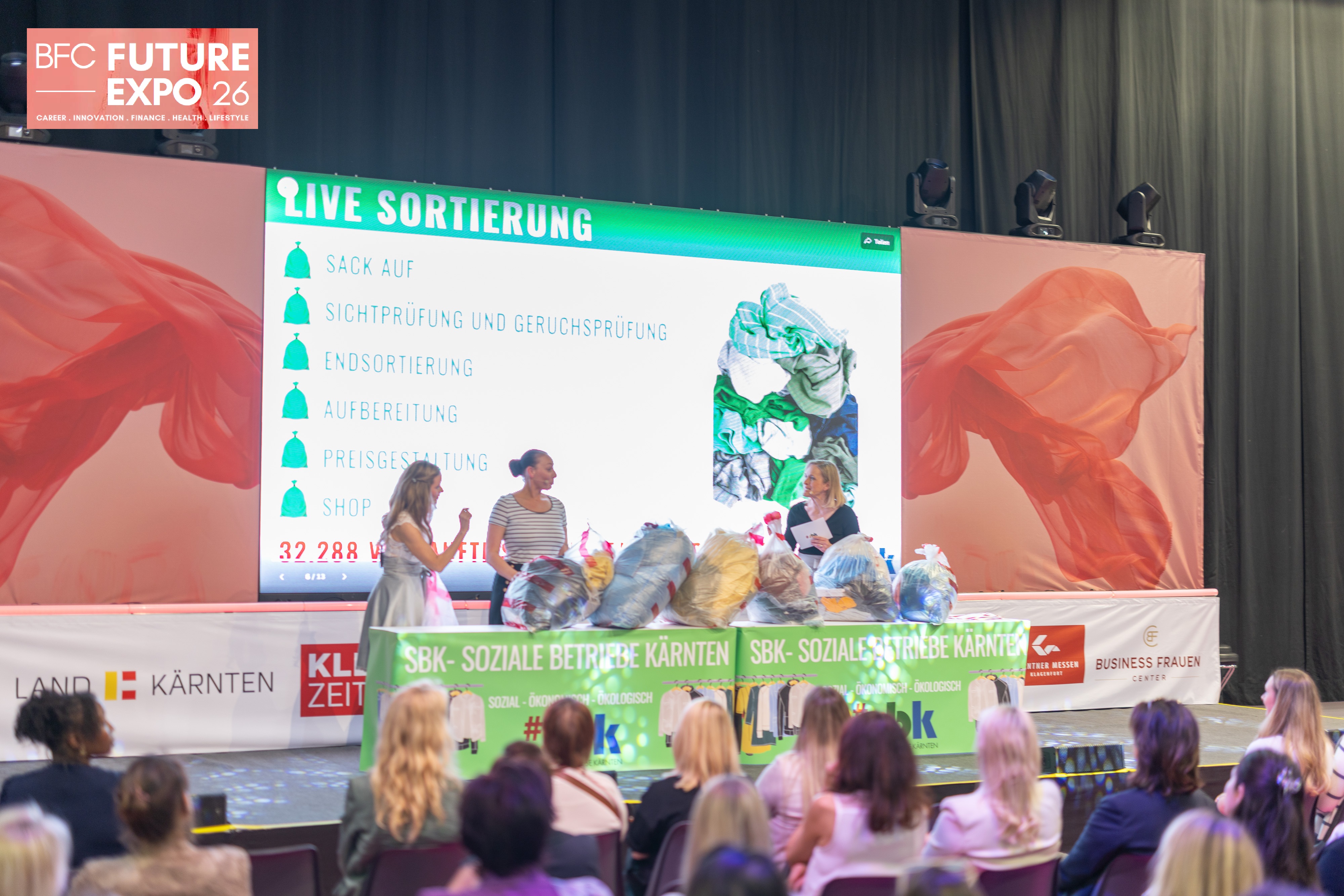
On 7–8 May 2026, Business Frauen Center organised BFC Future Expo 2026 in Klagenfurt, a major public event that attracted approximately 3,000 visitors.
The Expo brought together women entrepreneurs, business leaders, experts and representatives from business and politics to discuss current challenges, emerging opportunities and future-oriented approaches to entrepreneurship.
The programme addressed a broad range of topics, including sustainability, circular economy, digitalisation, artificial intelligence, mentoring and networking.
Among its highlights were more than 10 good-practice examples and expert contributions, presented through in-depth sessions and presentations exploring current business and technological developments.
These included contributions related to artificial intelligence, digitalisation, sustainable fashion and circular practices such as reuse and more responsible consumption.
By bringing these subjects into a highly visible public event, BFC helped raise awareness of emerging opportunities while showcasing women entrepreneurs, their ideas and their contribution to shaping future business practices.
This initiative is particularly relevant to Action 3.1 – Awareness Campaign “Women Go Circular”, under the Austrian Regional Action Plan's measure on awareness-raising and visibility for women entrepreneurs in the circular economy.
The event demonstrates the importance of established organisations and communication platforms in reaching audiences beyond the immediate project community.
Business Frauen Center's contribution was made possible through the involvement of speakers, experts, exhibitors and cooperating organisations who shared their knowledge and experience with participants.
We warmly acknowledge the efforts of Business Frauen Center and everyone involved in making BFC Future Expo 2026 possible. The event illustrates how established initiatives can advance the objectives of WE.Circular while creating opportunities for learning, inspiration and professional connections.
Taken together, the digital workshops, Mindset Change activities and Future Expo demonstrate the complementary nature of the Austrian Regional Action Plan.
Strengthening practical skills, encouraging entrepreneurial confidence and improving the visibility of women entrepreneurs are closely connected elements of building a more inclusive and innovative business environment.
Keeping knowledge and partnerships alive
The continued use of WE.Circular results does not depend only on individual activities. It also requires organisations willing to exchange knowledge, share expertise and maintain cooperation beyond the project's lifetime.
This is the purpose of the WE.Circular Learning Network, established to connect universities, business-support organisations, public institutions and other stakeholders committed to strengthening women's circular and digital entrepreneurship across the Danube Region.
In Austria, two important organisations have formalised their commitment to the Network by signing Memoranda of Understanding with Innovation Region Styria.
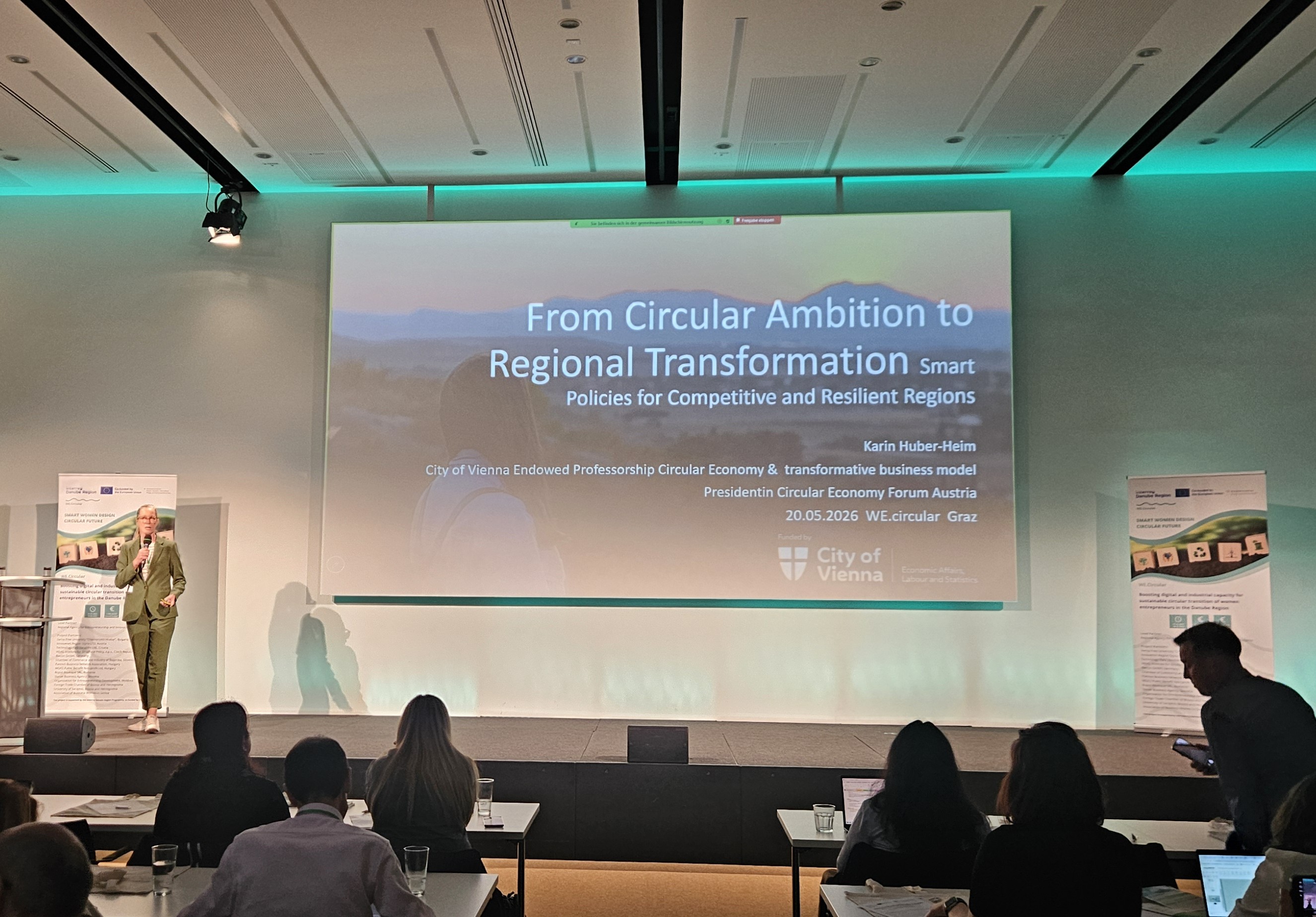
Circular Economy Forum Austria (CEFA), represented by its President Karin Huber-Heim, has joined the Network, bringing valuable expertise and connections within Austria's circular economy ecosystem.
As a platform bringing together stakeholders from different sectors, CEFA offers opportunities to strengthen knowledge exchange, encourage cooperation and promote circular business practices.
Its participation creates an important link between the WE.Circular community and Austria's broader circular economy network.
FH JOANNEUM University of Applied Sciences has also joined the Network, contributing an educational and academic perspective.
The university's involvement creates opportunities for exchanging expertise, sharing learning resources and exploring the further development and application of knowledge and skills related to circular economy and digital transformation.
Through their Memoranda of Understanding, both organisations have expressed their willingness to support the long-term sustainability of the WE.Circular Learning Network, contribute to capacity building and encourage cooperation between businesses, educational institutions and other stakeholders.
Their commitment is particularly meaningful because the Network is designed to remain active for at least five years after the completion of WE.Circular.
During this period, participating organisations can exchange knowledge and good practices, contribute to the development and adaptation of learning resources and explore opportunities for new cooperation.
We sincerely appreciate the commitment of Circular Economy Forum Austria and FH JOANNEUM to the WE.Circular Learning Network. Their participation strengthens the foundations for continued cooperation in Austria and contributes to the wider community established across the Danube Region.
These commitments complement the contribution of Business Frauen Center Klagenfurt, which has formally endorsed the Austrian Regional Action Plan and has already demonstrated how existing training, awareness-raising and professional development activities can support its objectives.
Together, these organisations represent two complementary ways of building on the achievements of WE.Circular: implementing selected measures of the Regional Action Plan and maintaining the exchange of knowledge and cooperation through the WE.Circular Learning Network.
This combination of practical activities and institutional commitments reflects one of the project's central ambitions: ensuring that the knowledge, tools and partnerships developed through European cooperation remain useful and accessible after the project ends.
Interested in joining the WE.Circular Learning Network?
The Network remains open to new members.
Universities, business-support organisations, public institutions, companies, NGOs and other stakeholders interested in circular economy, digital innovation and women's entrepreneurship are welcome to express their interest in joining.
Membership provides opportunities for knowledge exchange, cooperation with organisations across the Danube Region, access to practical learning resources and participation in future joint activities.
Join the WE.Circular community and help keep knowledge, experience and cooperation alive!
Building on what has already started
Austria's experience demonstrates how the results of WE.Circular can continue to create value through existing organisations, established activities and commitments to long-term cooperation.
The work undertaken by Business Frauen Center Klagenfurt provides practical examples of how selected priorities of the Austrian Regional Action Plan are already being addressed.
From strengthening digital skills and entrepreneurial confidence to raising awareness of women's contributions to sustainability and innovation, these initiatives show the value of connecting strategic objectives with the everyday work of business-support organisations.
At the same time, the participation of Circular Economy Forum Austria and FH JOANNEUM in the WE.Circular Learning Network provides an important foundation for maintaining and sharing the knowledge, expertise and relationships developed during the project.
The contribution of Innovation Region Styria, as the Austrian WE.Circular partner responsible for developing and formally endorsing the Regional Action Plan and supporting cooperation with relevant stakeholders, has been essential in bringing these different elements together.
We would like to express our appreciation to Business Frauen Center, Circular Economy Forum Austria, FH JOANNEUM and the experts, speakers and stakeholders who have contributed to the activities and partnerships presented in this article.
Their involvement demonstrates that the long-term value of European cooperation depends not only on the strategies and tools developed, but also on the organisations and people willing to use them, share their experience and work towards common goals.
In Austria, WE.Circular is already leaving a practical legacy — through new learning opportunities, stronger connections and a shared commitment to supporting women entrepreneurs in the circular and digital transition.

12/11/2026
By Mariya Zlateva
Share on social media:


News & Events
Read the most recent updates and explore the upcoming events.

Would you like to receive project updates?
You're already part of our community!
Welcome to our newsletter community!
Subscribe to our newsletter