
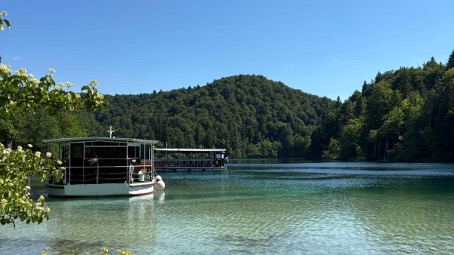

Quality Local Gastronomy Only Outside the Park Gate? Plitvice Is Not Using the Potential of Local Cuisine
When you find yourself in Croatia’s largest, oldest and most visited national park, you can hardly stop marvelling at its beauty. Plitvice Lakes are exactly the kind of place where, as a visitor, you expect a powerful experience — natural, visual, physical, but also cultural. After several hours of walking, however, everyone gets hungry, and the need to eat and drink well naturally arises. At Plitvice, however, the refreshment offer can be surprisingly limited for visitors who are not simply looking for quick fast food.
At first glance, Plitvice has everything a smaller destination could only dream of — an iconic natural attraction, a huge visitor flow, both international and domestic visitors, and customers who are ready to pay for a quality experience. This makes the question all the more interesting: why does the taste of the Lika region seem to disappear once visitors enter the paid zone, instead of becoming part of the simpler everyday offer for the regular visitor?
Unfulfilled potential
While just outside the entrance to the park you can find the award-winning restaurant Lička kuća, recognised by Gault&Millau, which shows that the Lika region has a strong gastronomic story and is able to present it at a high-quality level, the refreshment offer directly within the main visitor flow feels much more universal and uninspiring. Hamburgers, fries, packaged sandwiches and ice cream may fulfil the basic function of feeding hungry tourists, but they say very little about the place where visitors find themselves. The only items on the menu that come close to being regional, at least in name, are “Plitvička klobasica u pečivu” — Plitvice sausage in bread — and the “Lika hamburger”, which appears to replace only the bun with bread. And so, while looking out over the crystal-clear water of the lake, you sincerely wish you had packed a healthier snack option in your backpack. This is not even to mention visitors with dietary restrictions, such as a gluten-free diet.
“Lička kuća restaurant has for many years been a place where visitors can taste traditional dishes prepared from local ingredients, while other dining establishments also strive to incorporate as many local products as possible, in line with operational capabilities and the needs of the large number of domestic and international visitors,” explained Marija Marić from the Marketing Department of the national park.
The large number of international tourists should be a motivation for the best possible presentation of the region, not an obstacle. According to 2024 data, Plitvice Lakes are visited annually by approximately 1.5 million visitors from more than 160 countries. This gives the destination a truly generous opportunity to present the country in the best possible light in many respects — including gastronomy. Yet for some reason, Plitvice seems to rely on hungry and undemanding tourists, and on the waterfalls delivering a stronger experience than the unfulfilled expectations at a buffet along the route.
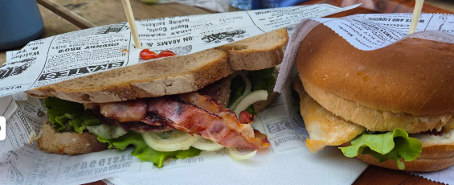
Food from Bistro Hladovina. The problem is not the food itself, but rather the missed opportunity to present local specialities. Source: Google reviews
From the perspective of destination management, this is an interesting situation. Visitors pay a considerable entrance fee, devote several hours of their time to the site, move through places that evoke strong emotions, and at some point naturally begin to look for a place to rest and regain energy. This is precisely the moment when there is potential to deepen the experience of the place through gastronomy. In buffets along tourist routes, probably no one expects high culinary art. But sometimes even a simple dish can carry a piece of local identity. In the case of Plitvice, there are several possibilities — fresh fish, local cheeses, soups or potato-based dishes.
This is where the topic addressed by the Culinary Trail project opens up, because local gastronomy is not only a matter of restaurants. It is a tool for connecting tourism, local producers, cultural heritage and regional development. If food becomes part of the visitor experience, the destination does not gain only another service — it gains another layer of its story.
A good-practice example just across the border
We do not have to go far to find an example of well-managed local gastronomy in a tourist location. Just a few kilometres from Plitvice Lakes, in Bosnia and Herzegovina, lies the tourist resort Japodski Otoci, located on the Una River and on the edge of the national park. The offer in the local restaurant is not complicated, but it is built around typical dishes such as grilled trout, ćevapi served in bread, or veal roasted using a traditional method. Add to this local ajvar, a curd cheese spread or local beer, and suddenly, as a tourist, you feel connected to the place where you are. This is where the strength of local gastronomy lies — it does not have to compete through the size of its menu, but it creates a memory of place.
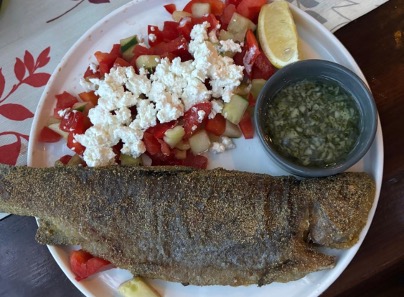
Local grilled trout served by the lake with Šopska salad. Author: Tarush Sharma
Plitvice does not need to invent gastronomy from scratch, because several restaurants in the region show that it already has a strong foundation. It also has a story and visitors to whom at least part of this regional identity could be transferred beyond the gates of the national park. This does not mean replacing buffets with fine dining, but rather supplementing or expanding the offer with dishes and regional products that tell visitors: you are in the Lika region, and this is its taste. And perhaps also offering something healthier or fresher, which is especially welcome in the summer heat.
The economic power of local products
Local gastronomy, however, is not just a pleasant addition or attractive marketing. In such a large destination, it can become a tool for transforming visitor flow into local value and strengthening the local economy. In this way, the destination effectively decides on behalf of visitors whether their money supports an anonymous universal assortment, or local producers, farmers, processors and the identity of the region. Moreover, at Plitvice, the demand already exists.
This idea is also supported by the fact that the Lika Quality label already exists in the region. It is a regional quality label for products from this area and was created within the INTEGRA LIKA 2020 project with the aim of “positioning the destination as a recognizable gastronomic destination,” according to the Lika Destination website. A joint sales point for local products was even established in 2018 in Plitvice Lakes National Park, and the aforementioned award-winning restaurant also works with these products. According to the information available on the website, Lika Quality kiosks are available at Entrance 1 and Entrance 2, although they appear to function more as sales points for regional products and souvenirs. “These products are featured in our restaurants as well as in the Park’s souvenir shops and stores; through this, we aim to promote local producers and allow visitors to experience a part of the Lika region’s rich tradition,” said Marija Marić. However, no one from the park directly commented on questions concerning the offer in small refreshment facilities.
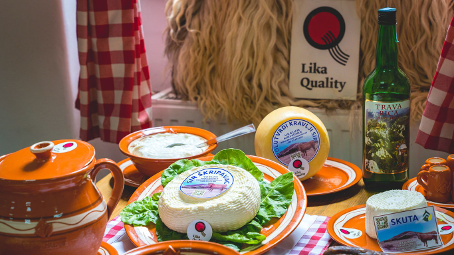
The Lika Quality brand presents products from the Lika region. Source: https://radnja.hr/en/work/lika-quality
Sustainability as one of the park’s pillars
In a national park, sustainability is naturally associated primarily with the protection of nature — water, trails, forests, biodiversity and sensitive visitor management. Plitvice is doing a great deal in this respect, and its sustainability report shows that it takes this topic seriously. Sustainable tourism, however, is not only about protecting natural resources. According to the principles of UN Tourism, it should also take into account the economic and socio-cultural impacts on host communities. Sustainability also means asking whether tourism creates value for the region in which it takes place. In this sense, gastronomy is one of the simplest and most natural tools. It can serve as a bridge between visitors, the landscape, producers and the local community.
Projects such as Culinary Trail show that local gastronomy does not have to be merely the goal of a dinner after a trip, but can be a natural part of the entire visitor journey. Even a simple meal, if connected to the place, can support local producers, strengthen the identity of the region and turn an ordinary break into part of the experience. In the case of Plitvice, the question of local refreshments is therefore more than just a detail in a buffet. It is a question of how a world-class natural destination can transfer part of its economic power back to the region that gives it its identity.
Author: Tarush Sharma, co-author: Adriána Henčeková (BizGarden)

15/07/2026
By Erika Dzajic Ursic
Share on social media:



News & Events
Read the most recent updates and explore the upcoming events.




Would you like to receive project updates?
You're already part of our community!
Welcome to our newsletter community!
Subscribe to our newsletter