


Hydrogen Energy Storage (H2ES)
Hydrogen Energy Storage Systems (H2ES). Unlike mechanical or electrochemical storage, hydrogen stores energy in chemical form. Electricity can be used to split water, produce hydrogen, store it, transport it, and later convert it back into electricity or use it directly in industry, transport, and heating.
As renewable electricity expands across the Danube Region, some storage questions are no longer about seconds or even just a few hours. They are about how to manage surpluses across days, weeks, or seasons, and how to decarbonise sectors that cannot be easily electrified. That is where hydrogen becomes relevant. Its promise is enormous - but so are the efficiency, infrastructure, cost, and safety challenges that come with it.
Click here for a detailed audio summary.
Hydrogen in One Paragraph
A hydrogen storage system usually begins with an electrolyser, which uses electricity to split water into hydrogen and oxygen. The hydrogen can then be stored as compressed gas, liquid hydrogen, or in carrier materials and compounds such as metal hydrides, ammonia, or liquid organic hydrogen carriers. When needed, it can be converted back into electricity through fuel cells or turbines, or used directly as a feedstock or fuel. In simple terms, hydrogen is less a fast-response storage device and more a way to turn electricity into a storable energy molecule.
In practical terms, hydrogen behaves very differently from batteries. Its great strength is exceptional gravimetric energy density and the possibility of long-duration or even seasonal storage. Its main weaknesses are low round-trip efficiency, low volumetric density, and the cost and complexity of the surrounding system. That makes hydrogen especially valuable where duration, sector coupling, and industrial use matter more than pure electrical efficiency.
The Numbers at a Glance (Typical Ranges)
From the StoreMore Outlook analysis, hydrogen systems are typically described by:
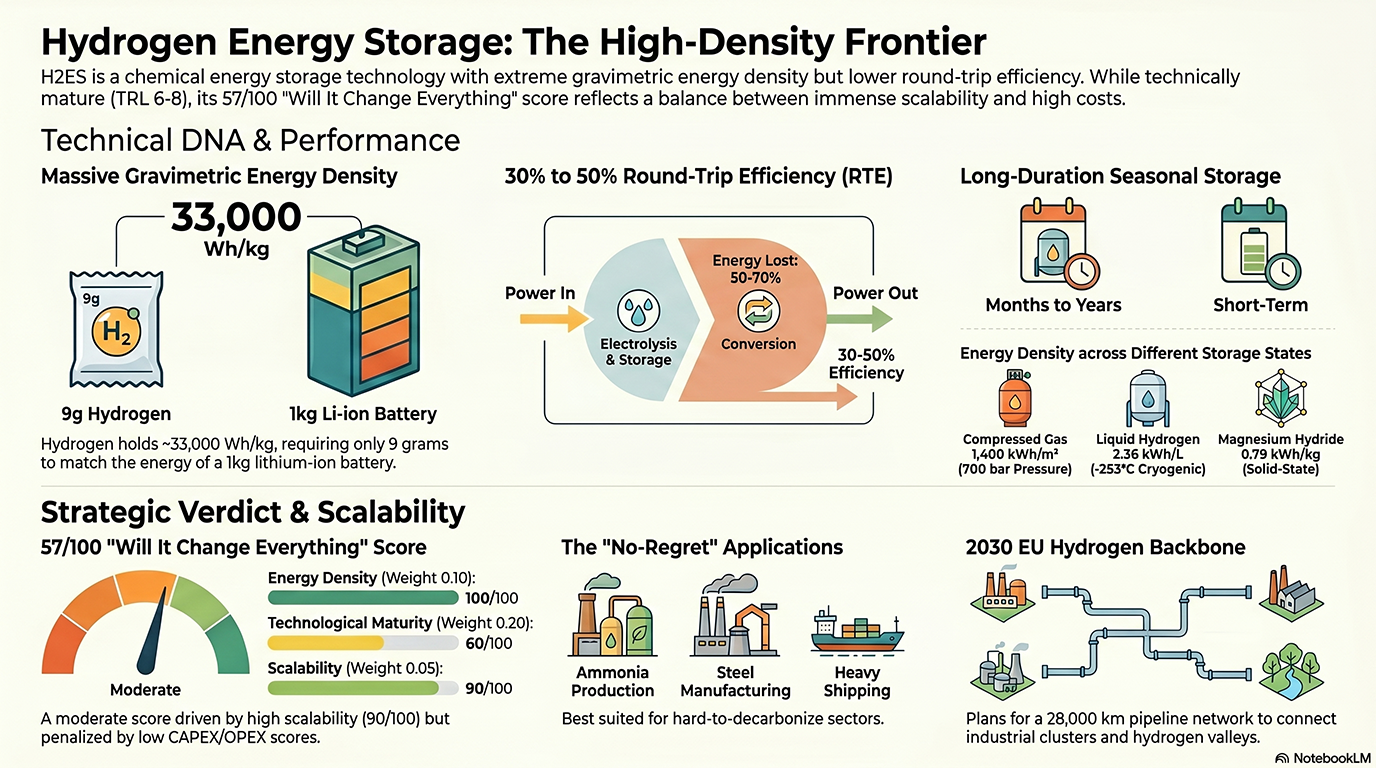
Gravimetric energy density: about 39,405.6 Wh/kg (HHV) or 33,313.9 Wh/kg (LHV), making hydrogen exceptionally light for the energy it carries.
Power range: from small kW-scale systems up to modular projects reaching into the hundreds of MW.
Typical storage duration: from about 24 hours to multi-month or seasonal storage, depending on the storage route and application.
Lifetime: roughly 5-10 years for electrolysers and fuel cells, and around 10-15 years for storage components.
Discharge time: from minutes up to hours, depending on plant design and end use.
Round-trip efficiency (RTE): typically around 30-50% for integrated hydrogen-to-power systems.
RTE degradation: the source benchmark reports less than 2% per 1,000 operating hours.
Technology readiness: generally assessed around TRL 6-8 for complete systems.
System size potential: from small kWh-scale units to large industrial and grid-scale projects through modular expansion.
Indicative cost picture: the source benchmark notes roughly 800-1,200 EUR/kW for power-related equipment, while operating costs remain highly technology-dependent.
The practical takeaway is clear: hydrogen is not trying to outperform batteries or flywheels in fast, efficient cycling. Its real value appears when the task involves long duration, cross-sector energy use, transportable molecules, or industrial decarbonisation.
Why Hydrogen Matters for the Danube Region
Hydrogen stands out for regional energy planning for several reasons:
It offers one of the few credible pathways for long-duration and seasonal storage of renewable energy surpluses.
It can connect electricity, industry, transport, and heating - making it a true sector-coupling technology rather than only a power asset.
It is especially relevant for hard-to-abate sectors such as ammonia, chemicals, refining, steel, heavy logistics, and potentially aviation or shipping.
It can strengthen energy security by reducing dependence on imported fossil fuels and by creating domestic clean-fuel value chains.
It aligns with wider European developments such as Hydrogen Valleys, the EU Hydrogen Strategy, REPowerEU, and the European Hydrogen Backbone.
Where Hydrogen Adds the Most Value
H2ES is especially well suited to applications such as:
Seasonal storage and renewable curtailment avoidance - converting surplus solar or wind power into a storable fuel for later use.
Industrial feedstock and process decarbonisation - especially where hydrogen is needed directly rather than only for electricity generation.
Backup power and resilient energy supply - particularly where long autonomy matters more than maximum efficiency.
Heavy-duty transport - including buses, trucks, rail, and other uses where fast refuelling and lower weight can be decisive.
Hybrid energy systems - combining electrolysers, storage, fuel cells, turbines, ammonia routes, or LOHC pathways depending on local conditions.
The Trade-Offs You Must Respect
Hydrogen is powerful - but it is not universal. The key limitations are:
Lower round-trip efficiency than direct electrification: every conversion step adds losses, especially when hydrogen is converted back into power.
Storage complexity: hydrogen's low volumetric density means compression, liquefaction, or carrier-based storage is usually required.
High upfront cost: electrolysers, tanks, compressors, fuel cells, and associated infrastructure make complete systems capital intensive.
Safety and materials challenges: flammability, leakage risk, cryogenic handling, and hydrogen embrittlement require robust engineering and permitting.
Business-case uncertainty: green hydrogen depends heavily on cheap renewable electricity, policy support, reliable offtake, and infrastructure availability.
Duration, Molecules, and Sector Coupling: That's the Hydrogen Logic
If you remember one thing about hydrogen, make it this: it is not just an electricity storage technology. It is a system-integration technology. Hydrogen becomes compelling where energy has to be stored for a long time, moved across sectors, transported as a molecule, or used in industrial processes that batteries cannot easily serve. That is why hydrogen keeps returning in strategy documents even though its electrical efficiency is modest.
From Strategy Topic to Serious Deployment Path
The technology is no longer only theoretical. The StoreMore source material points to active development across Europe and beyond: pilot projects for transport, buildings, industry, and power generation; the Deep Purple pilot in Norway; Bosch SOFC deployments in Germany; and Underground Sun Storage 2030 in Austria. At the same time, Europe is building the policy and infrastructure narrative around Hydrogen Valleys and a future cross-border backbone. That does not mean hydrogen will dominate every storage market. It does mean it has moved well beyond curiosity status.
What's Next in StoreMore?
The hydrogen chapter is an important part of the StoreMore comparison of sustainable energy storage solutions. Its value lies in clarifying where H2ES should be screened in - and where it should not. For Danube Region stakeholders, hydrogen is strongest where renewable integration intersects with industrial demand, long-duration balancing, or wider decarbonisation strategies beyond the power sector.
Compare hydrogen fairly against batteries, CAES, LAES, thermal storage, and grid reinforcement based on the actual duration and end-use required.
Identify no-regret applications where hydrogen creates value as a feedstock, transport fuel, or long-duration balancing option - not just as a default power-storage concept.
Test hybrid concepts in which electrolysers, storage, and downstream hydrogen use are linked to real local renewable surpluses and credible offtake demand.
In practice, the next step is a focused pre-feasibility check: define the renewable supply profile, duty cycle, water availability, storage route, safety and permitting boundary, end use of the hydrogen, and the revenue logic behind production and offtake. That is where hydrogen moves from buzzword to realistic project option.
Stay connected with us! For more news and updates on H2ES and other StoreMore results, visit our project channels:
Website: https://interreg-danube.eu/projects/storemore
LinkedIn: https://www.linkedin.com/company/storemoreproject/

30/04/2026
By Eszter Németh
Share on social media:


Green

News & Events
Read the most recent updates and explore the upcoming events.




Would you like to receive project updates?
You're already part of our community!
Welcome to our newsletter community!
Subscribe to our newsletter