

How Agile Piloting Helps Cities and Small Municipalities Unlock the Potential of Energy Communities
What does a city of 80,000 people have in common with a small municipality of just 500 inhabitants?
At first glance, not much. Their scale, infrastructure, administrative capacity, and energy needs are very different. Yet both face the same strategic challenge: how to secure affordable, reliable, and locally optimised energy for households, businesses, public buildings, and municipal infrastructure.
This is exactly where Energy Communities can play an important role. By enabling local production, sharing, and smarter use of electricity, they offer municipalities a practical path towards greater energy resilience and cost efficiency. However, for many local governments, one major barrier remains: limited data and limited in-house energy expertise make investment decisions difficult, complex, and risky.
That is why agile piloting can be so valuable.
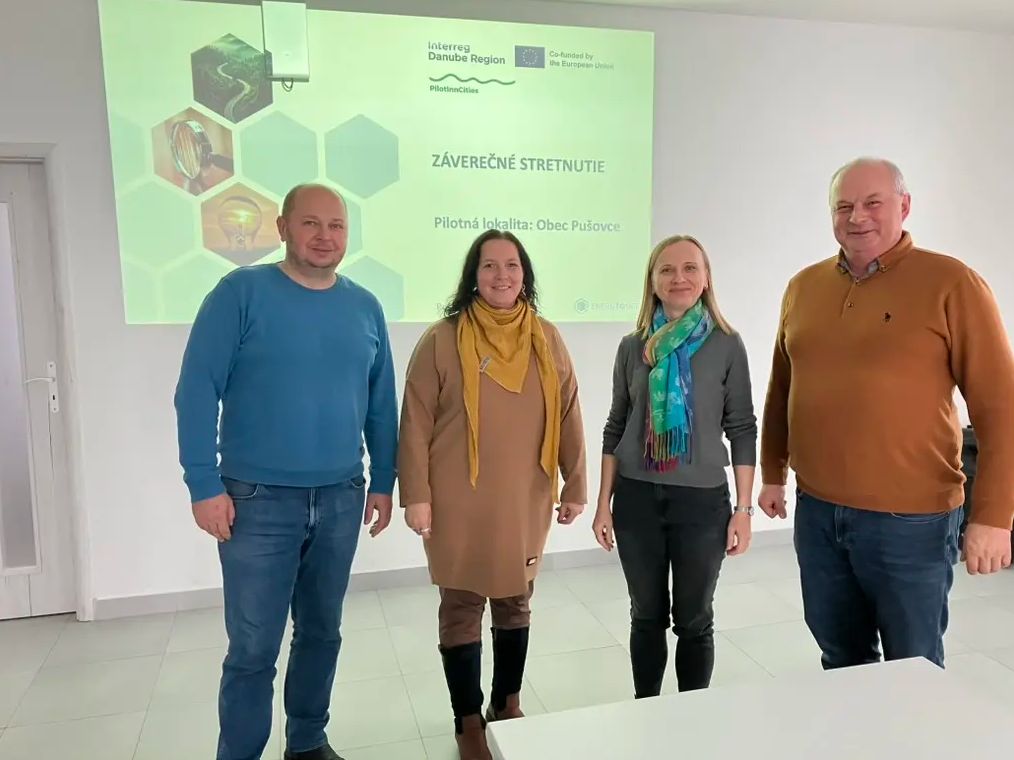
As part of the PilotInnCities project, the Slovak startup ENERGIQUBE, led by Lucia Liptáková, tested and continuously improved its ENESIM platform through parallel pilot implementations in two very different environments: the city of Žilina and the municipality of Pušovce.
These pilots provided a real-world opportunity to validate how data-driven simulations can support municipalities in designing, assessing, and optimising energy-sharing scenarios.
Supporting Better Decisions Through Energy Simulations
ENERGIQUBE’s ENESIM platform helps municipalities, electricity suppliers, and energy-sharing organisers evaluate different scenarios before making investment decisions.
The platform enables simulations of electricity sharing and surplus utilisation across multiple consumption points. Its publicly accessible self-service portal helps identify complementary production and consumption patterns, making it easier to use locally generated electricity more efficiently.
The solution brings several key advantages:
one application for all users,
cloud-based scalability,
universal design with English localisation for international use.
In practice, this means that both small municipalities and larger cities can use the same platform to assess how local renewable energy sources could be shared, where surplus electricity could be used, and which infrastructure investments may bring the greatest value.
Pušovce: Small Municipality, High Local Impact
In the municipality of Pušovce, the pilot focused on simulations for a planned energy source at the local primary school.
The analysis showed that a 3 kWp photovoltaic system could fully cover the school’s electricity demand while delivering the highest savings on electricity supply and distribution costs.
The simulations also revealed an important opportunity: surplus electricity generated during weekends and school holidays could be shared with other municipal facilities, including the kindergarten, municipal office, cultural centre, and heat pumps.
According to the pilot results, the planned sharing group could utilise nearly 100% of the electricity generated. In the future, an increase in installed capacity could also create benefits for residents and neighbouring properties.
For a small municipality, this represents more than an energy optimisation exercise. It shows how even relatively modest investments in local renewable energy can strengthen public services, reduce costs, and lay the groundwork for broader community energy sharing.
Žilina: Validating and Expanding an Existing Energy-Sharing Setup
In Žilina, the pilot focused on validating the city’s current electricity-sharing model and identifying further optimisation opportunities.
The analysis confirmed that existing production sources, including those at the seniors’ facility and the ice rink, can cover almost 100% of the electricity consumption needs of selected city facilities, including the swimming pool, ice rink, and city office.
The pilot also assessed a new planned energy source at the city police station. Simulations showed that this source could generate around 40% surplus electricity.
To make better use of this surplus, the pilot proposed several options, including battery storage with evening and nighttime discharge for public lighting, as well as adding further consumption points to absorb excess electricity during periods when major facilities are shut down at the same time.
For a city the size of Žilina, this demonstrates how data-driven energy planning can help improve the performance of existing infrastructure while supporting future investments in renewables, storage, and local energy sharing.
One Challenge, Two Different Realities
The pilots in Žilina and Pušovce show that energy communities are not limited to one type of municipality. Whether in a larger urban environment or a small rural commune, the underlying challenge is similar: municipalities need better tools to understand their energy flows, test investment scenarios, and reduce uncertainty before implementation.
By combining agile piloting with a scalable digital platform, ENERGIQUBE was able to test its solution in two contrasting environments, gather practical feedback, and improve the platform based on real municipal needs.
This is precisely the value of agile piloting: it allows innovative solutions to be tested quickly, adapted continuously, and validated in real-life conditions before being scaled more widely.
Building Smarter Energy Communities in Slovakia and Beyond
As municipalities across Europe look for ways to increase energy resilience, reduce costs, and accelerate the use of renewables, solutions such as ENESIM can help bridge the gap between ambition and implementation.
The experience from Žilina and Pušovce highlights how local governments can move from abstract energy strategies to concrete, data-supported decisions.
For municipalities, energy suppliers, and sharing organisers interested in energy sharing in Slovakia and beyond, the PilotInnCities partners are ready to support further connections and cooperation, including the Ministry of Investments, Regional Development and Informatization of the Slovak Republic and the Association of Towns and Communities of Slovakia.
Energy communities are not only about technology. They are about helping local places — large and small — make better use of the energy they produce, strengthen their infrastructure, and create more resilient communities for the future.


12/05/2026
By Viktor Holy
Share on social media:


Smart

News & Events
Read the most recent updates and explore the upcoming events.


Would you like to receive project updates?
You're already part of our community!
Welcome to our newsletter community!
Subscribe to our newsletter