

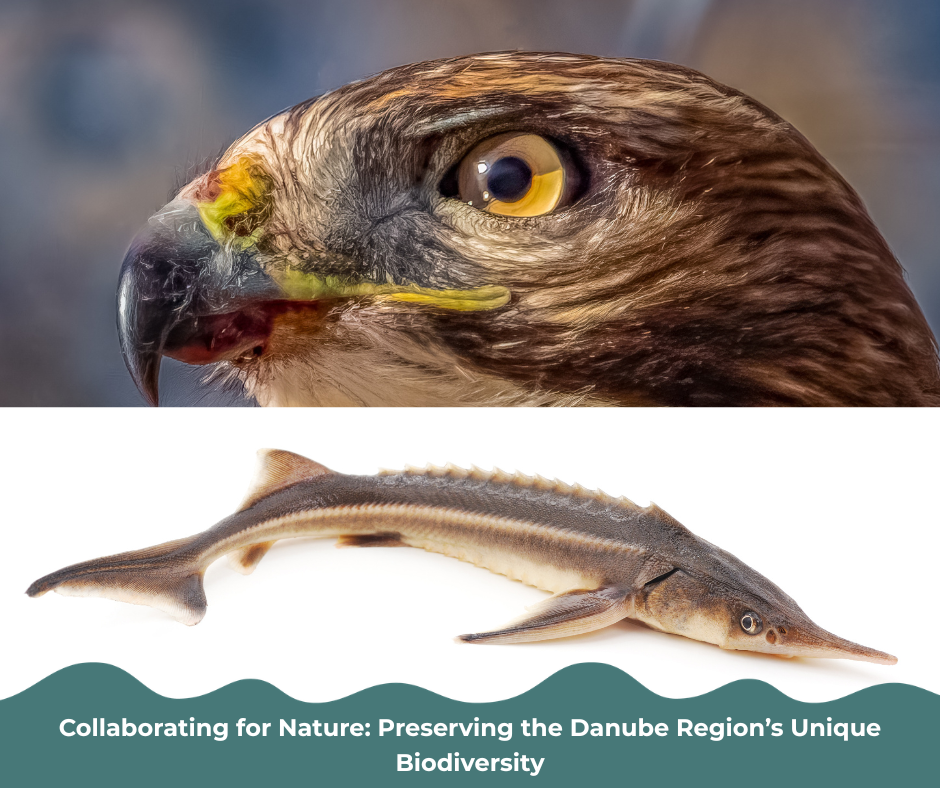
Collaborating for Nature: Preserving the Danube Region’s Unique Biodiversity
The Danube Region is one of Europe’s richest ecological corridors, home to diverse species and interconnected ecosystems that stretch across national borders. However, increasing pressures from climate change, habitat fragmentation, pollution, and human activity are putting many species at risk. Addressing these complex challenges requires coordinated, science-based, and cross-border responses. Within this context, the Danube Region Programme (DRP) supports projects that strengthen biodiversity protection through joint monitoring, knowledge sharing, and collaborative governance.
Two DRP-funded initiatives, AVIATOR and MonStur in the Danube, focus on safeguarding vulnerable wildlife species in the region. While AVIATOR targets birds of prey and MonStur in the Danube focuses on migratory fish, both projects share a common goal: enhancing biodiversity conservation through improved monitoring systems, coordinated action, and stakeholder cooperation.
Monitoring and data collection aimed at supporting effective conservation strategies play a key role in both projects. AVIATOR develops systematic monitoring of raptor populations and their health, including tracking diseases and environmental threats. It combines this with innovative approaches such as vaccination trials and vector control to reduce risks to bird populations. Similarly, MonStur in the Danube establishes the first transboundary monitoring system for sturgeons across the Danube River Basin. The development of this system is part of the flagship process on migratory fish coordinated by Priority Area 4 - Water Quality and Priority Area 6 - Biodiversity, Landscapes and Air & Soil Quality of the EU Strategy for the Danube Region. By integrating data from multiple countries into a shared database, the project enables a comprehensive understanding of population trends, habitats, and migration patterns.
Wildlife conservation in the Danube Region is best addressed at a transnational scale, as species and ecosystems do not follow administrative boundaries. By fostering cross-border cooperation, both projects ensure that conservation efforts are aligned and effective at the scale required by ecological processes. At the same time, the projects bridge the gap between research, real-world impact and policy development, ensuring that knowledge leads to concrete conservation actions and policy responses. AVIATOR translates monitoring results into practical interventions, such as disease prevention measures and management strategies, while also developing action plans and frameworks to improve policy responses. MonStur in the Danube, on the other hand, uses its monitoring system to generate scientific evidence that supports policy improvements, conservation planning, and habitat protection measures across the region.
Both AVIATOR and MonStur in the Danube highlight the importance of integrated, transnational approaches to biodiversity conservation. By combining advanced monitoring systems, scientific research, stakeholder engagement, and policy support, both projects contribute to safeguarding endangered species and strengthening ecological resilience in the Danube Region. Their shared emphasis on cooperation, data-driven decision-making, and practical action demonstrates how coordinated efforts can address complex environmental challenges and protect the region’s unique natural heritage for future generations.

26/03/2026
By admin 2
Share on social media:



News & Events
Explore our upcoming events and read news regarding our programme and project activities.








Would you like to receive programme updates?
You're already part of our community!
Welcome to our newsletter community!
Subscribe to our newsletter