


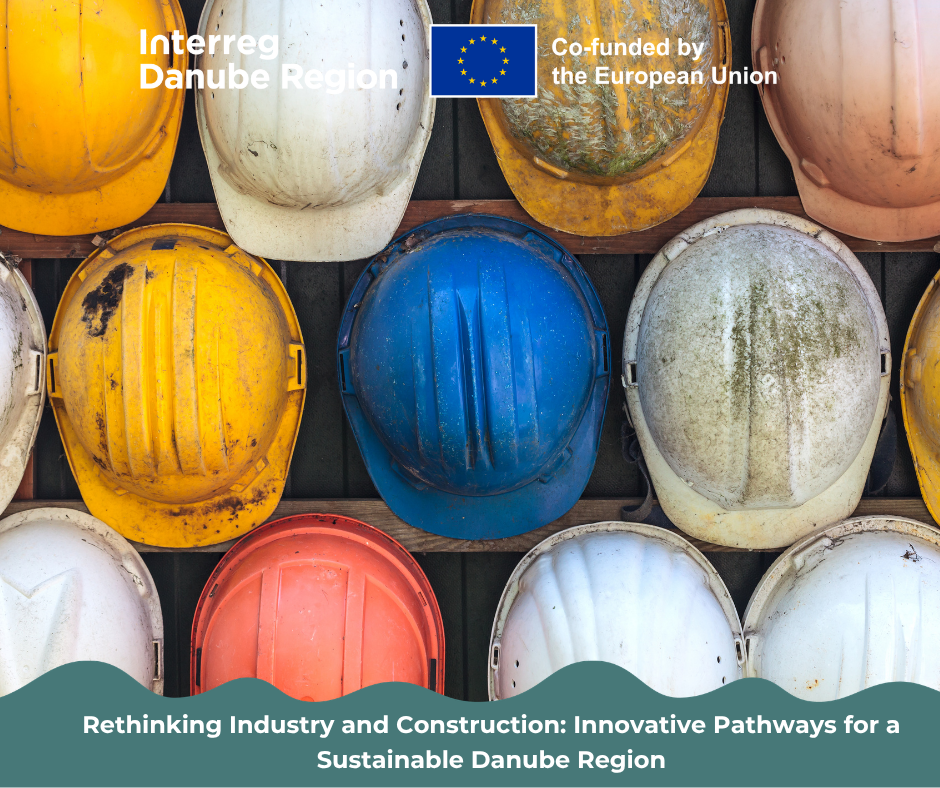
Rethinking Industry and Construction: Innovative Pathways for a Sustainable Danube Region
Building and industrial sectors have long been recognised as powerful economic drivers, requiring advanced technical skills and intensive physical labour. At the same time, they are often associated with high resource consumption, safety risks, and significant waste generation. As the need for sustainable development becomes more urgent, these sectors are increasingly challenged to rethink their practices and reduce their environmental footprint.
In this context, the Danube Region Programme (DRP) supports forward-looking initiatives that redefine how industry and construction interact with people and the environment. Two DRP-funded projects, DECORATOR and REIND-BBG, demonstrate how innovation can transform traditionally resource-intensive sectors into drivers of circularity, sustainability, and regional resilience.
The DECORATOR project addresses one of the most pressing challenges in the construction sector: waste generation and inefficient resource use. However, rather than treating circularity as a purely technical issue, the project adopts a holistic and innovative perspective. It considers ecological, technical, socio-cultural, and economic dimensions as interconnected elements of the transition towards sustainability. Aligned with the principles of the New European Bauhaus, DECORATOR goes beyond conventional approaches by integrating aesthetic, social, and environmental values into construction practices. In this vision, sustainability is not only about reducing emissions or reusing materials, but also about creating built environments that are functional, inclusive, and visually appealing. Advanced technologies are used not as ends in themselves, but as enablers of this broader transformation, supporting circular design, material reuse, and more efficient construction processes.
While DECORATOR focuses on the built environment, REIND-BBG tackles the challenge of industrial development and land use. The project promotes an innovative approach to re-industrialisation based on the “Brownfield is Better than Greenfield” (BBG) principle. By revitalising existing industrial sites instead of developing new land, the project helps reduce land consumption, soil sealing, and biodiversity loss in the Danube Region. REIND-BBG further strengthens this approach by supporting the development of bio-based and circular business models, encouraging the use of renewable biological resources as alternatives to fossil-based inputs. Its 4H approach integrates environmental, economic, and social considerations, ensuring that industrial redevelopment contributes not only to sustainability goals but also to local economic growth and community well-being. Beyond environmental benefits, the project provides tangible advantages for municipalities by attracting investment, creating jobs, and enhancing regional competitiveness.
The two projects share a commitment to innovation as a driver of systemic transformation, moving beyond incremental improvements and instead proposing new ways of thinking about materials, space, and resource use. They challenge traditional sectoral models by promoting circular economy principles, integrating environmental, social, and economic dimensions, encouraging cross-sector collaboration and knowledge exchange and supporting practical, scalable solutions for real-world application.
As the Danube Region moves towards a more sustainable future, projects like DECORATOR and REIND-BBG illustrate how even the most resource-intensive sectors can be transformed through innovative, integrated approaches. By rethinking construction practices and industrial development, they demonstrate that it is possible to balance economic growth with environmental protection and social value and they send out a clear message: the future of industry and the built environment lies in circularity, creativity, and responsible resource use where innovation serves not only efficiency, but also people

16/04/2026
By admin 2
Share on social media:



News & Events
Explore our upcoming events and read news regarding our programme and project activities.

Would you like to receive programme updates?
You're already part of our community!
Welcome to our newsletter community!
Subscribe to our newsletter