

Testing Energy Communities Before the Rules Are Complete
Waiting for legislation to be fully developed may seem like the safest approach. In innovation, however, waiting can also become one of the most expensive decisions.
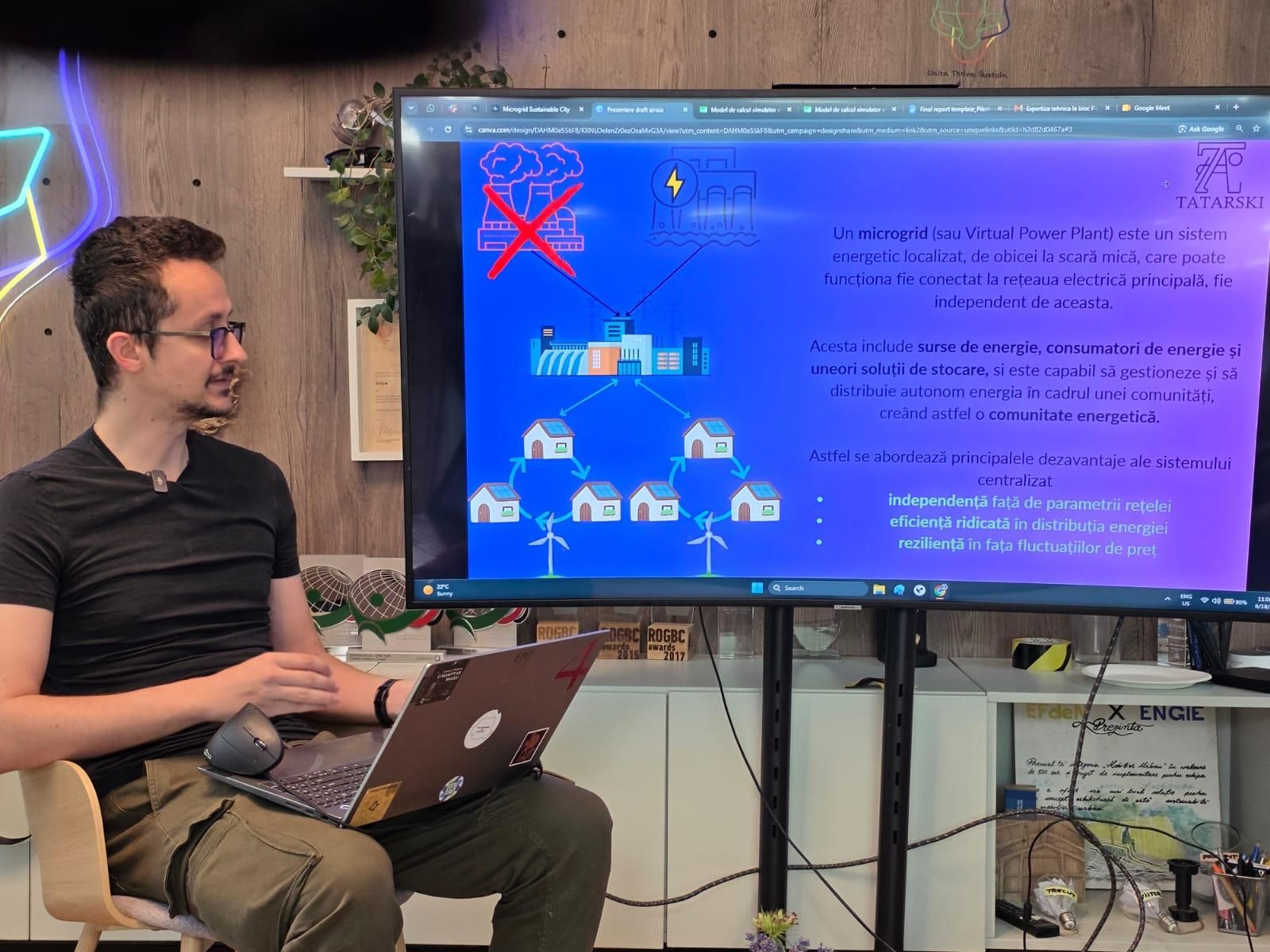
The Romanian company Tatarski chose a different path during its agile pilot in Bucharest. Instead of postponing implementation until every detail of Romania’s emerging framework for energy communities had been clarified, the team launched a real microgrid pilot and began learning directly from practice.
The result was not only a functioning technical solution, but also valuable evidence for future regulation.
A Community Microgrid in Practice
The pilot connected six photovoltaic installations into a shared community microgrid equipped with real-time monitoring.
The basic principle was straightforward: electricity generated locally should also be consumed locally. By matching local production with local demand, the community could reduce unnecessary energy flows through the public grid and increase its level of energy self-sufficiency.
However, real operating conditions quickly revealed that the system was more complex than expected.
Discovering a Hidden Inefficiency
Although electricity was being produced and consumed within the same community, it was not always being used directly by the nearest consumer.
The reason was the configuration of the electrical phases. Some production units and consumers were connected to different phases, meaning that part of the locally generated electricity first had to leave the community through the public distribution grid before returning to another consumer located only a short distance away.
This hidden inefficiency would have been difficult to identify through theoretical planning alone.
By testing the microgrid under real conditions, the team was able to detect the issue and adjust the configuration. The change significantly improved the community’s effective self-consumption and provided practical evidence that could support the development of Romania’s national regulatory framework.
The pilot team also shared its experience with the Romanian Energy Regulatory Authority, demonstrating how experimental projects can contribute to better-informed policymaking.
Transparent Energy Data
The solution included an online monitoring platform providing continuous public access to both live and historical data.
The platform displays:
electricity production across the community
electricity consumption
historical performance
patterns in local energy generation and use
the balance between production and demand
This transparency helps stakeholders better understand how the microgrid operates and makes the results of the pilot accessible beyond the immediate implementation team.
The public platform is available at microgrid.up.railway.app.
Piloting as a Tool for Better Regulation
One of the main lessons from the pilot is that an incomplete regulatory framework does not necessarily have to prevent deployment.
On the contrary, carefully designed pilots can help create the evidence needed to complete that framework.
Regulation developed without practical testing may overlook technical details, operational barriers or unexpected behaviour within a real system. Agile pilots create a controlled environment in which these issues can be identified early, before solutions are introduced on a larger scale.
Sometimes, the most useful contribution to better regulation is not another theoretical discussion, but a well-documented experiment.
Rethinking the Traditional Energy System
For more than a century, electricity networks have largely been designed around a centralised model: large power plants generate electricity, which is then transported across the grid to consumers.
Microgrids introduce a different logic.
They aim to keep energy as close as possible to the place where it is produced and needed. This can:
reduce unnecessary transmission through the grid
limit energy losses
improve local energy self-consumption
strengthen resilience during disruptions
support greater energy independence
enable communities to play a more active role in the energy transition
The Bucharest pilot demonstrated that even relatively small changes in system configuration can have a major effect on how efficiently locally generated electricity is used.
Administrative Barriers to Innovation
The pilot also exposed a challenge unrelated to technology.
The implementation team had to visit the treasury five times in order to access the project funding. Outdated administrative procedures and unclear instructions repeatedly diverted time and attention away from the pilot itself.
This experience points to a broader issue facing European innovation ecosystems. Public systems designed to support innovators can still create excessive administrative burdens, reducing the time available for experimentation, implementation and value creation.
Supporting innovation therefore requires more than funding programmes. It also requires simple, predictable and user-friendly administrative processes.
Key Lessons from the Pilot
The Tatarski pilot offers three important lessons for agile piloting.
First, regulatory uncertainty should not automatically prevent implementation. Pioneering pilots can provide the technical and operational evidence required to develop more effective regulation.
Second, microgrids can improve energy efficiency and resilience by reducing the distance between electricity production and consumption.
Third, administrative systems must evolve alongside technological innovation. When innovators are forced to spend excessive time navigating outdated procedures, public support mechanisms risk undermining the very progress they are intended to enable.
The Bucharest microgrid shows why real-world experimentation matters. By testing first, identifying hidden inefficiencies and sharing the results with regulators, the pilot helped move the discussion about energy communities from theory towards practical implementation.

13/07/2026
By Viktor Holy
Share on social media:


Smart

News & Events
Read the most recent updates and explore the upcoming events.


Would you like to receive project updates?
You're already part of our community!
Welcome to our newsletter community!
Subscribe to our newsletter