

Circular Economy Business Modeller (CEBM) – a methodological framework for modelling, analysing and evaluating circular economy business models
Deliverable D1.2.1 – Circular Economy Business Modeller (CEBM) provides a comprehensive methodological framework for modelling, analysing and evaluating circular economy business models.
The CEBM was developed in response to identified gaps in existing approaches to circular business modelling. While traditional business models primarily follow a linear logic in which products and resources eventually lose their value and are disposed of, circular business models aim to retain and continuously recreate value through reuse, refurbishment, remanufacturing, recycling and repurposing. Existing modelling approaches do not always adequately capture these more complex value flows or combine economic assessment with environmental and sustainability considerations. The deliverable therefore introduces a structured methodology for designing and assessing circular business models in a more integrated manner.
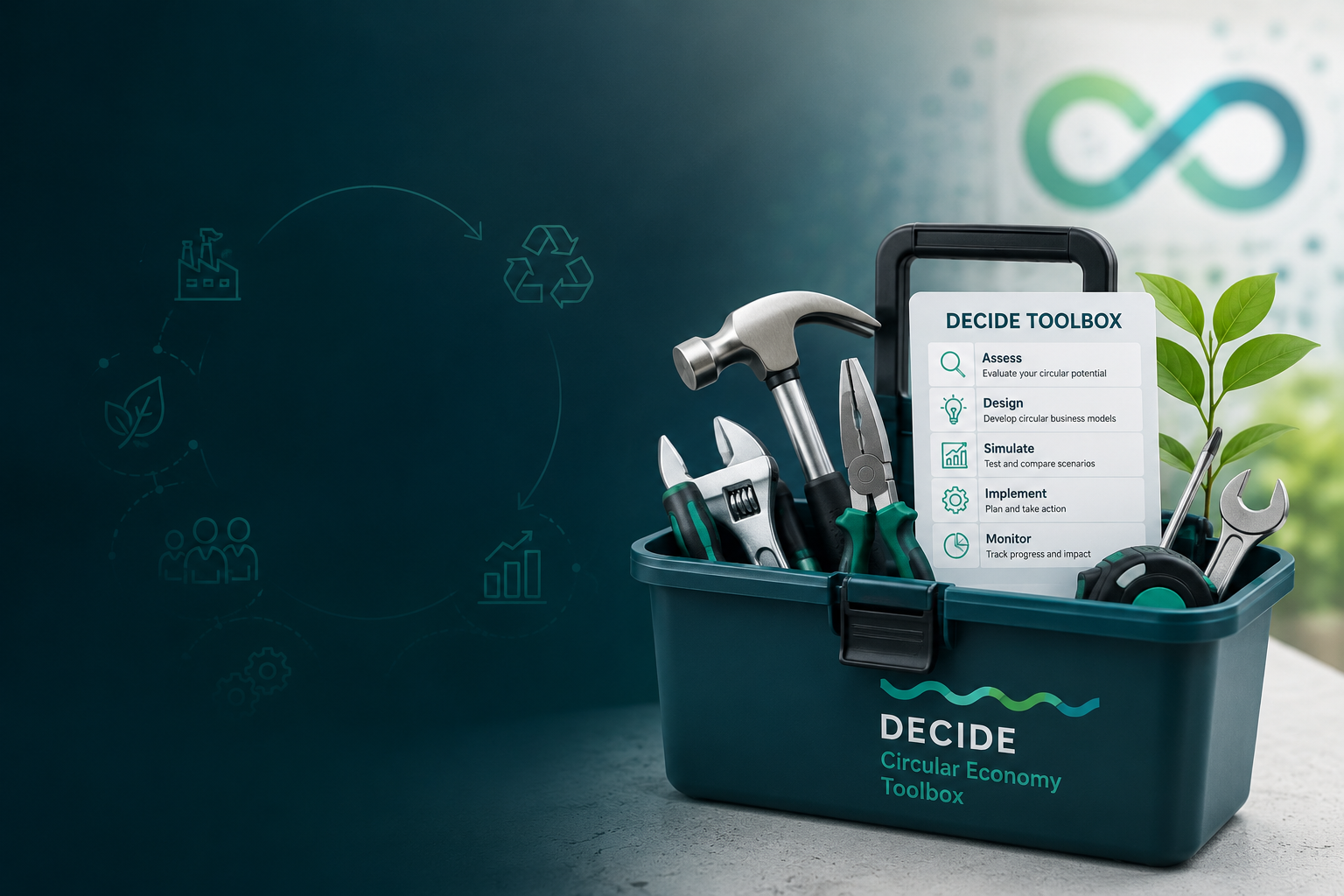
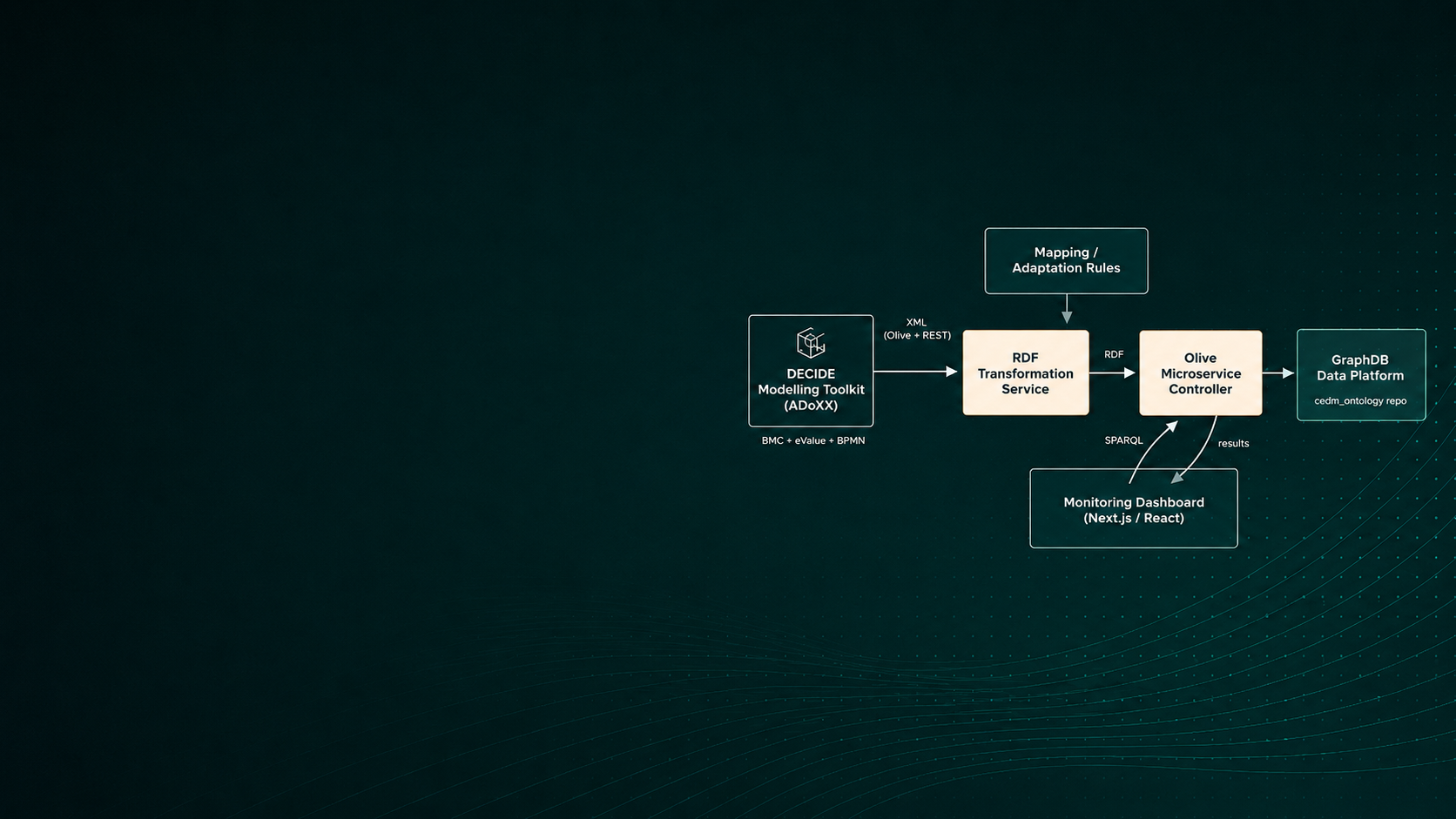
The Circular Economy Business Modeller forms an important methodological component of the wider DECIDE Toolbox. It combines three complementary approaches: Business Process Modelling, Business Model Canvas and e3Value modelling. The methodology provides a step-by-step process for understanding existing business processes, identifying opportunities for greater circularity, developing or adapting the corresponding business model and analysing how value is created, exchanged and captured within more complex circular value networks.
In practice, the process starts with Business Process Modelling to obtain a structured overview of relevant activities, actors and workflows and to identify potential points for circular intervention. The resulting insights are subsequently transferred into Business Model Canvases, allowing circular economy principles to be reflected in key business model elements such as value propositions, customer relationships, resources and revenue streams. Finally, the Business Model Canvases are mapped into e3Value models, enabling a more detailed analysis of value exchanges and the economic logic of the resulting circular business model.
The deliverable was developed as part of Activity 1.2 under the responsibility of PP2 – Reutlingen University (HSRT). Its development was supported by DECIDE project partners that contributed practical pilot cases and sector-specific knowledge, including partners involved in the packaging, food and textile pilots, among others.
The methodology was tested and validated through practical pilot cases from several sectors, including second-life batteries, packaging, food, textiles and smart cities. These pilots enabled the project partnership to apply the proposed approach in different sectoral and organisational settings and to verify its practical relevance and transferability. The pilot cases included, for example, the use of tomato-processing residues for packaging and paper production, brewing residues for new food and feed value chains, reuse and recycling of textile materials, second-life battery applications and circular energy solutions in smart-city environments.
The main purpose of the deliverable is to provide enterprises and other organisations with a practical and systematic tool for supporting the transition from linear to circular business models. It enables users to better understand existing value-generation processes, identify activities where value is lost, explore new circular value streams and design business models that combine economic viability with environmental and social considerations. In this way, the CEBM supports both the development of new circular business models and the improvement of existing ones.
The methodology is particularly relevant for SMEs, business support organisations, higher education institutions and research organisations. As it is not limited to a particular industry or national context, it provides a basis for transferring and replicating the approaches tested within DECIDE across other sectors and geographical areas in the Danube Region and beyond.
This article has been developed within the framework of the project Digital Services for Circular Economy - A Toolbox for Regional Developers & SMEs (DECIDE), co-financed by the Interreg Danube Region Programme under the 2021-2027 financial period. The content reflects the views of the authors and does not necessarily represent the official position of the DECIDE project, its partners, or the programme authorities.

18/08/2026
By Lea Trojnar Mustak
Share on social media:


Smart

News & Events
Read the most recent updates and explore the upcoming events.


Would you like to receive project updates?
You're already part of our community!
Welcome to our newsletter community!
Subscribe to our newsletter