
From project results to policy guidance: DECIDE finalises its Policy Recommendations
Circular economy solutions need more than good ideas, motivated companies and useful digital tools. To become widely adopted, they also need supportive policies, clear rules, adequate financing and strong awareness among stakeholders.
This is the focus of Deliverable D2.3.5 – Policy Recommendations, finalised within the DECIDE project. The deliverable brings together project findings, partner inputs, stakeholder perspectives and practical experience from DECIDE activities to formulate recommendations that can support a more effective transition towards circular economy practices in the Danube Region.
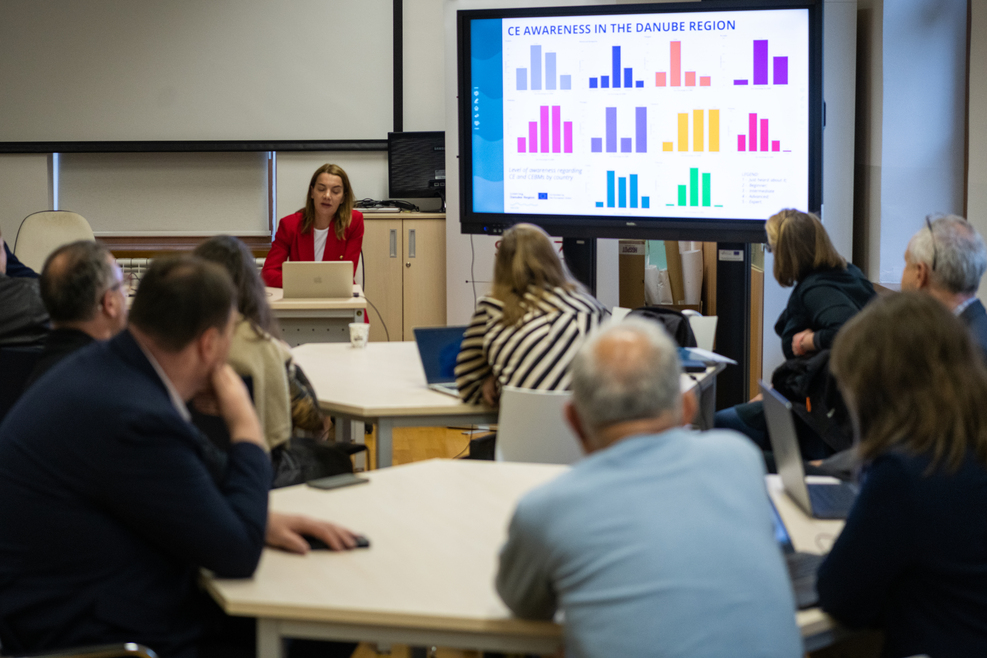
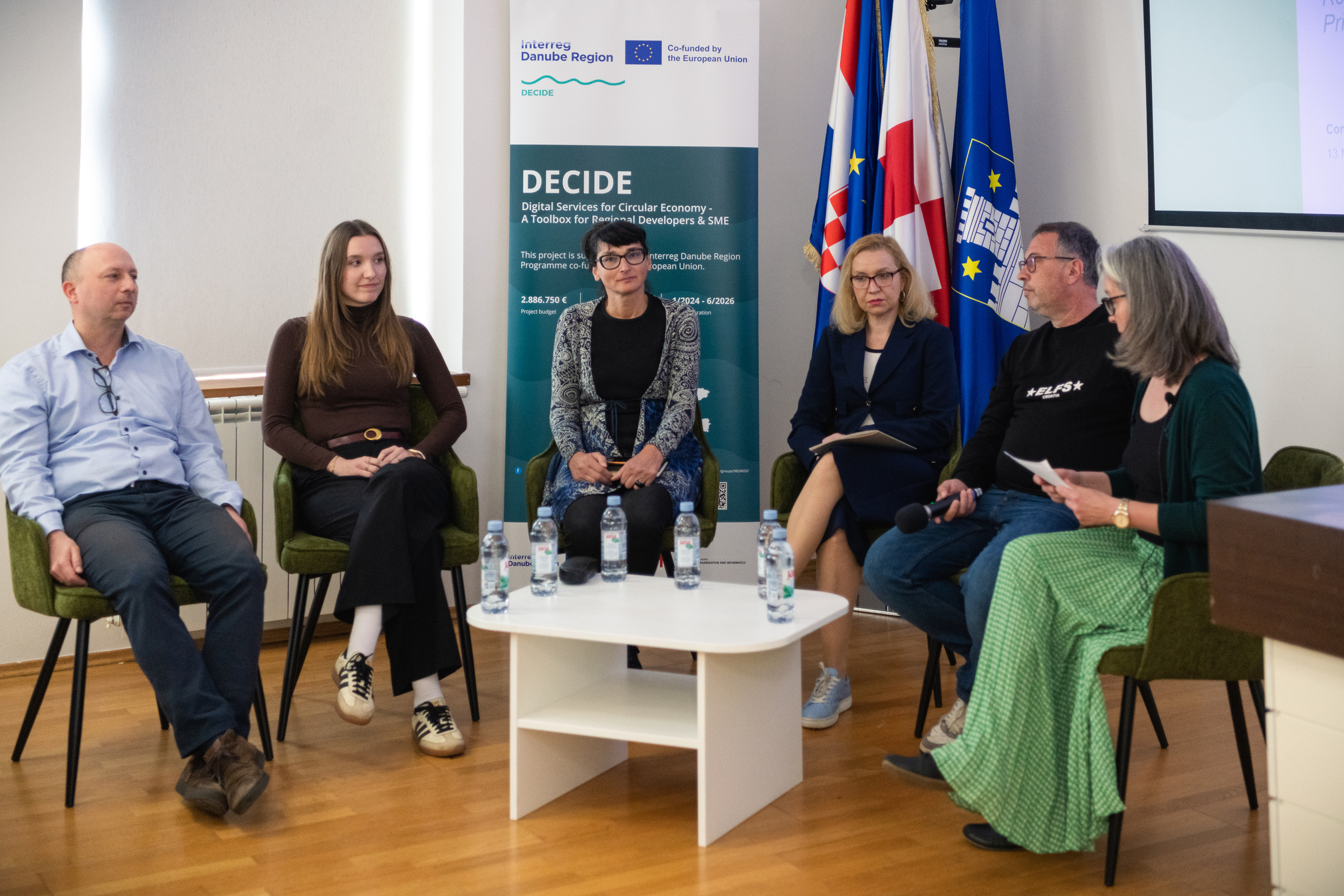
Paula Pop Nistor (UMFST) is presenting the findings from the process of Policy Recommendations creation. Copyright: TICM
The Policy Recommendations build on the wider work carried out through DECIDE, including best practice cases, pilot activities, the Maturity Report with Gap Analysis, the Circular Economy Business Model Catalogue, the DECIDE Toolbox and discussions among project partners and stakeholders. In this way, the deliverable connects practical project results with policy needs and provides guidance for decision-makers at the local, regional and national level.
The analysis focuses on three key dimensions that strongly influence the implementation of Circular Economy Business Models: legislation, financing and education. These dimensions are closely connected. Legislation provides the framework for action, financing makes circular initiatives more feasible in practice, while education and awareness help change behaviour and strengthen the capacity of organisations to adopt circular approaches.
The deliverable covers the five DECIDE sectors with strong circular economy potential: food, batteries, packaging, textiles and smart cities. It also takes into account the different national and regional contexts across the Danube Region, recognising that circular economy implementation does not face the same challenges everywhere.
One of the main findings is that circular economy policies in the Danube Region are generally aligned with European objectives, including the European Green Deal and the Circular Economy Action Plan. However, implementation remains uneven. In many cases, the challenge is not the complete absence of legislation, but the gap between policy ambition and practical application.
Several recurring barriers were identified across countries and sectors. These include institutional fragmentation, weak enforcement, insufficient infrastructure, limited financial incentives, capacity gaps and low awareness levels. Such barriers can make it difficult for SMEs, startups, public authorities and support organisations to move from circular economy concepts to practical implementation.
The recommendations therefore focus on making circular economy policies more coherent, practical and easier to apply. They highlight the need for stronger coordination between institutions and levels of governance, clearer implementation guidelines, better enforcement mechanisms and more targeted support for circular economy initiatives.
Financing is another important area. Circular business models often require investment in new processes, technologies, cooperation structures or infrastructure. The Policy Recommendations therefore point to the need for financial instruments that are better adapted to circular initiatives, especially for SMEs and regional actors that may lack the resources to test, implement or scale circular solutions on their own.
Education and awareness are also essential. Even when policy frameworks and funding opportunities exist, stakeholders need the knowledge and capacity to use them effectively. This includes practical guidance, training, awareness-raising activities and stronger links between policy, business support and educational initiatives.
For policymakers and public authorities, the deliverable provides a practical reference for improving circular economy policy frameworks and addressing implementation barriers. For SMEs and startups, it highlights the conditions needed to make circular business models easier to develop and adopt. For business support organisations, cluster managers, development agencies and innovation hubs, it offers guidance that can be used in advisory work, workshops, policy dialogue and future support measures.
The added value of the Policy Recommendations lies in their connection with real project experience. They are not based only on general policy analysis, but also on insights from DECIDE partners, best practice and pilot cases, stakeholder inputs and tools developed through the project. This makes them more grounded in the practical challenges faced by organisations working on circular economy in the Danube Region.
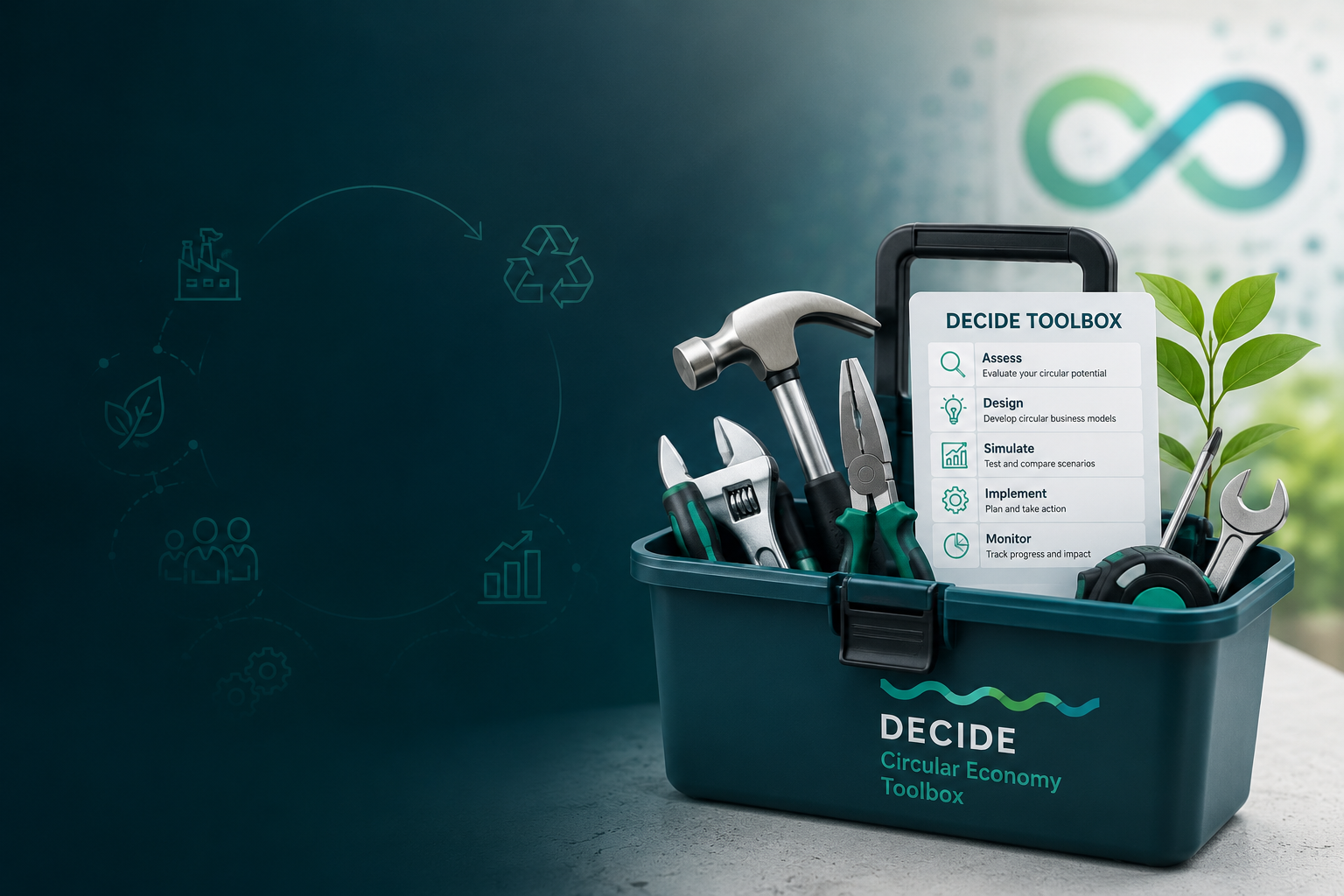
The deliverable also supports the long-term use of DECIDE results. While the DECIDE Toolbox helps stakeholders identify, analyse, simulate, implement and monitor Circular Economy Business Models, the Policy Recommendations address the wider framework conditions needed for such models to be adopted more successfully. Together, these results support both practical implementation and strategic decision-making.
Although developed for the Danube Region, the approach can also be relevant for other regions and sectors. The identified barriers and recommendations are structured around common themes such as legislation, financing and education, which can be adapted to different geographical and sectoral contexts.
By finalising Deliverable D2.3.5, DECIDE has completed an important step in translating project knowledge into policy guidance. The recommendations help connect circular economy tools and practical examples with the institutional, financial and educational conditions needed for broader uptake.
In this way, the Policy Recommendations contribute to the wider objective of the DECIDE project: supporting the development, transfer and scaling of sustainable and resource-efficient business models across the Danube Region.
This article has been developed within the framework of the project Digital Services for Circular Economy - A Toolbox for Regional Developers & SMEs (DECIDE), co-financed by the Interreg Danube Region Programme under the 2021-2027 financial period. The content reflects the views of the authors and does not necessarily represent the official position of the DECIDE project, its partners, or the programme authorities.

06/07/2026
By Lea Trojnar Mustak
Share on social media:


Smart

News & Events
Read the most recent updates and explore the upcoming events.


Would you like to receive project updates?
You're already part of our community!
Welcome to our newsletter community!
Subscribe to our newsletter