

From Circular Ideas to Measurable Impact: DECIDE Turns Pilots into Blueprints for Change
Designing a circular business model is one thing. Understanding whether it works in practice, what impact it creates and whether it can be successfully transferred to another company, sector, or country is another. With the completion of D1.4.1 – Pilot Documentation and D1.4.2 – Pilot Impact Progress Reports, the DECIDE project has taken an important step from testing circular economy approaches to turning pilot experience into practical and transferable knowledge.
Both deliverables were developed within Activity 1.4, Transfer of Best Practice Circular Economy Business Models to Identified Transnational and Intersectoral Potentials, under the responsibility of PP5 – University of Maribor (UM) with contributions from all DECIDE project partners.
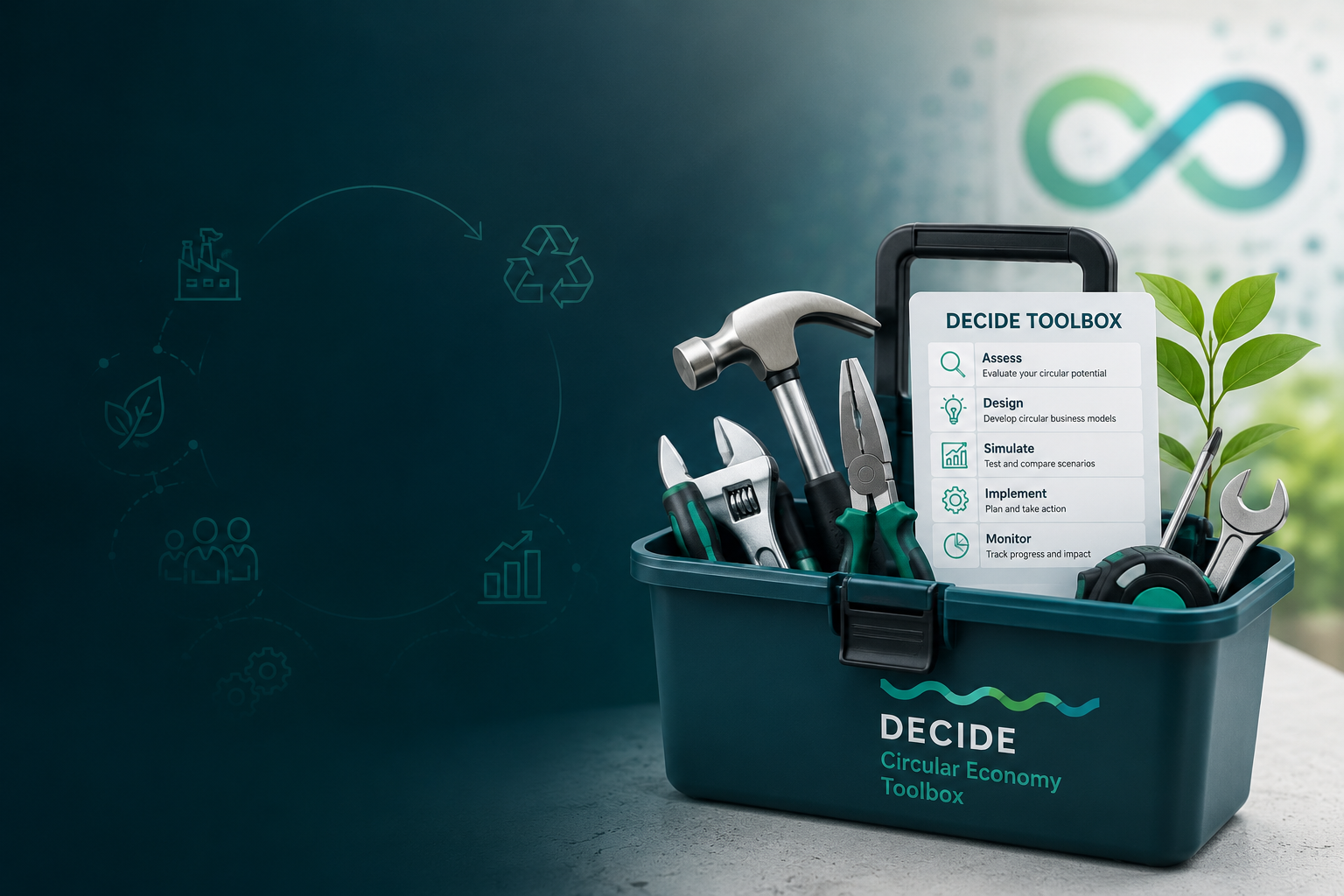
At the centre of DECIDE is the DECIDE Toolbox, a set of complementary methods and tools designed to help organisations understand existing business processes, identify opportunities for circular value creation, develop circular business models and assess their potential and impact. The project applies these approaches across five areas – second-life batteries, packaging, food, textiles and smart cities – addressing a common challenge: how to retain resources and value for longer instead of losing them through linear production and consumption models.
This is where the two completed deliverables play a particularly important role.
D1.4.1 – Pilot Documentation captures what actually happened in the pilot cases. Using common templates, procedures and guidelines, the project partners systematically documented implementation plans, strategies, monitoring frameworks, analytical models and supporting evidence. Documentation from eight final pilot cases was harmonised into a common knowledge base, making experiences from different countries and sectors easier to understand and compare.
This means that a successful pilot does not remain an isolated example. Its processes, decisions and lessons learned can be examined and reused elsewhere. Practical cases demonstrate the variety of circular opportunities: residues from tomato production can become raw material for packaging and paper; by-products from brewing can enter new value chains through insect farming and feed production; and used textiles can be resold, recycled or remanufactured into new products. These examples illustrate how materials traditionally regarded as waste can become inputs for new value creation.
D1.4.2 – Pilot Impact Progress Reports adds another layer: it asks whether these circular models actually create measurable benefits. The project developed an impact assessment methodology based on a 20-Dimension Framework, comparing the current situation, the desired “wish-to” state and the expected state after implementation of a Circular Economy Business Model. The final assessment covered eight pilot cases and examined their economic, environmental and social impacts.
Results showed meaningful progress across different sectors and regions, with particularly visible environmental benefits linked to material reuse, recycling and emission reduction. Economic and social benefits were also identified, while the work highlighted the importance of further standardising KPIs and combining quantitative data with qualitative expert assessment.
Together, the two deliverables therefore answer two practical questions: How was a circular business model implemented? And what difference did it make?
For SMEs and start-ups, this provides tested examples that can be adapted before investing in change. Business support organisations can use the cases and models when advising companies and preparing investment logic. Public authorities and sectoral agencies can better understand the processes and monitoring frameworks needed to launch similar initiatives, while researchers, universities and consultants can reuse the methodology for new pilot cases and training activities.
Most importantly, the approach is not limited to the original pilots. The methodology, templates and assessment framework were designed to be reused in other sectors, countries and regions, with adaptation mainly to local data, partners and business conditions. In this sense, the Danube Region serves as a practical testbed for wider replication of circular economy solutions.
The completed pilot documentation and impact assessment now strengthen the DECIDE Toolbox with something especially valuable: evidence from practice. They turn pilot projects into learning resources and circular economy ideas into blueprints that others can understand, evaluate and adapt.
This article has been developed within the framework of the project Digital Services for Circular Economy - A Toolbox for Regional Developers & SMEs (DECIDE), co-financed by the Interreg Danube Region Programme under the 2021-2027 financial period. The content reflects the views of the authors and does not necessarily represent the official position of the DECIDE project, its partners, or the programme authorities.

18/08/2026
By Lea Trojnar Mustak
Share on social media:


Smart

News & Events
Read the most recent updates and explore the upcoming events.


Would you like to receive project updates?
You're already part of our community!
Welcome to our newsletter community!
Subscribe to our newsletter